A Beast Slinks Towards Beijing: A Novel
- By Alice Evelyn Yang
- William Morrow
- 368 pp.
- Reviewed by Marcie Geffner
- February 27, 2026
A family’s fantastical secret is rooted in China’s violent past.
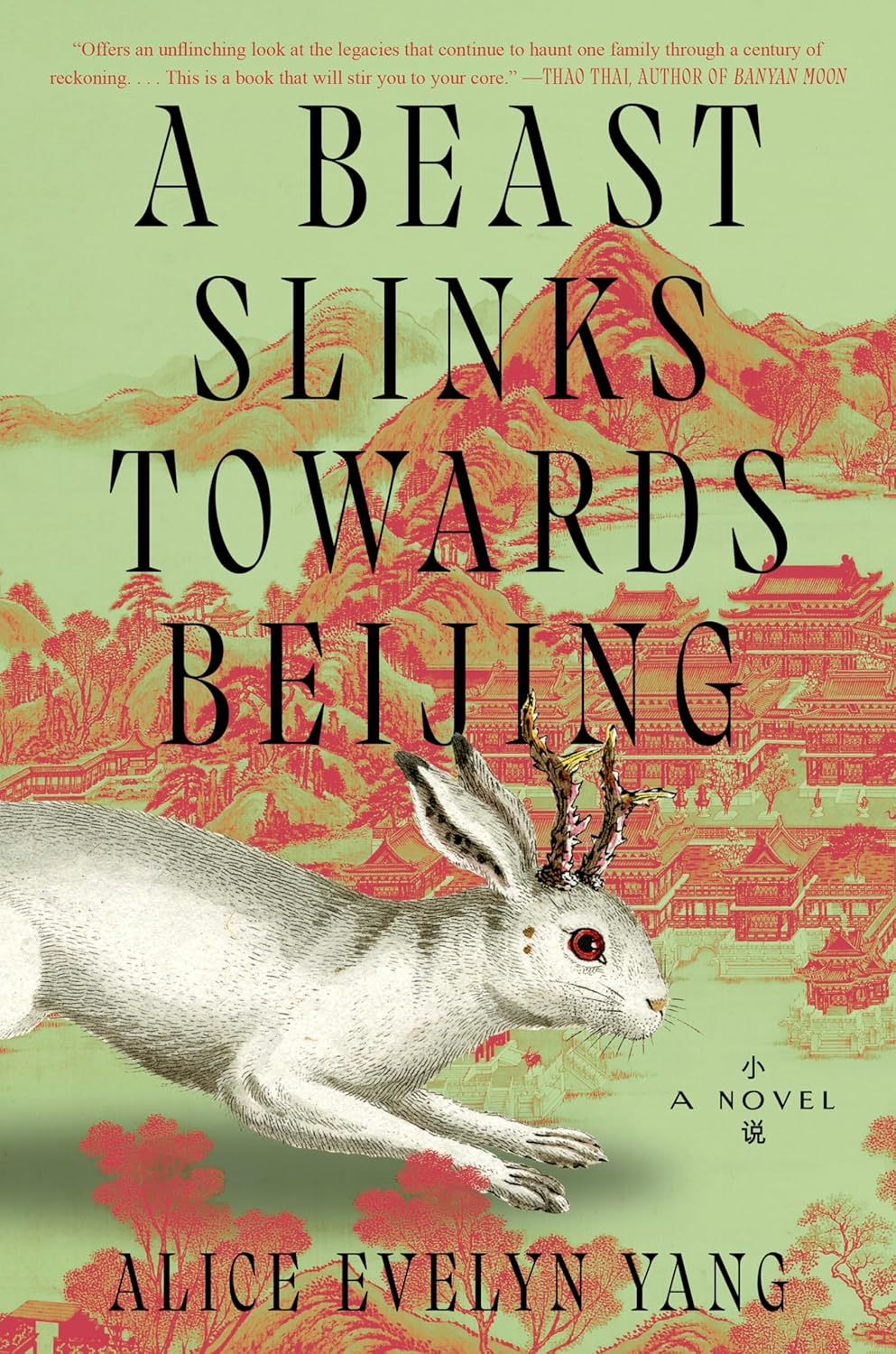
Alice Evelyn Yang’s debut novel, A Beast Slinks Towards Beijing, incorporates both historical fiction and magical realism, but at its heart, it’s a family saga about memory, betrayal, conspiracy, violence, abandonment, and reunion.
Twenty-five-year-old Qianze Zhou is unexpectedly and inconveniently reunited with her father in 2017, 11 years after he abandoned her and her mother. Father and daughter quickly become locked in an agonizing stasis as she tries to cope with his erratic behavior and contain her anger over his abandonment, while he struggles to retrieve memories of his life as a young man in China — memories he’s willfully repressed and claims include a terrible and frightening secret he’s desperate to warn Qianze about but can’t recall the details of.
She can’t be sure if his memory is truly blocked, his forgetfulness is a symptom of his alcohol abuse, or he’s simply lying so she’ll continue to let him live in her cramped New York apartment:
“In her head, Qianze had been drawing a distinction between the father of the past week and her father…Her father tried his best to give her everything she wanted…This father was an unwanted guest, an infestation. If she entertained his words as truth, the separation between the fathers would disintegrate.”
The story is enriched by a non-chronological timeline that spans almost a century and four points-of-view, one of which is Qianze’s and two of which belong to her father, who’s called “Ba” (an informal Chinese word for “father”) in 2017 and “Weihong” from 1963 to 1975. The fourth perspective is that of Weihong’s mother and Qianze’s grandmother, Ming, from 1924 to 1952. (Weihong’s uncaring father, Fei, elderly grandmother, Năinai, and sensitive sister, Kangmei, complete the family unit.)
Weihong and Ming tell their stories from Ānshān, an industrial area in China’s northeastern Liáoníng Province. The area was occupied by the Japanese from 1918 to 1945, and then by the Soviet Red Army near the end of World War II. After the war, the area was returned to China, only to be caught up in the country’s violent and repressive Cultural Revolution in the late 1960s. The author steers clear of China’s Communist politics to focus instead on Ming’s life under the oppressive Japanese occupation and Weihong’s involvement in the brutality of the Cultural Revolution.
As a young girl, Ming doesn’t know what the Japanese occupation will mean for her and comes to an uneasy realization that the adults around her don’t know, either:
“She squinted at the horizon, wondering at what point a dark shape would manifest, when the Japanese army would approach, slinking toward them to lay claim on them.”
The “beast” of the book’s title that’s doing the slinking will determine all of their fates: Ming’s, Fei’s, Weihong’s, Năinai’s, Kangmei’s, and Qianze’s. Decades later, Weihong tries to imagine how he might explain his past to his daughter, but any explanation feels impossible:
“The old gods were dead. They were rotting in the boglands. There was only one God now, and His name was Mao. From our mother, we were born in blood, but in His revolution, we would be reborn and baptized in new blood until we were all red, red. Red.”
The violence becomes savage, horrific, and, for 14-year-old Weihong and his friends, enjoyable. People are tortured, set on fire, minced into “small pink pieces” by machinery, even buried alive in the name of Mao’s revolution. Anyone might be targeted as “a monster, a demon, a class enemy.”
The story’s magical elements are fragmented and hard to hold in the mind, with multifaceted meanings that aren’t always clear. Are the jackalope, nine-tailed fox, and mystical elderly aunties who populate Qianze’s dreams and visions connected to the mysterious warning her father is convinced he has to give her, or are they signs that she herself is on the edge of a mental breakdown? Again, she can’t be sure:
“Now that the Aunties sat between Qianze and the fox, she began to slowly edge off the bench, preparing to run back to her apartment. She did not know what was wrong with the women, but there was a wrongness to them, an eeriness that rolled off them in waves and made her skin prickle into gooseflesh.”
Qianze’s and Ba’s stories are at times less compelling than Weihong’s and Ming’s, in part because Qianze and Ba are psychologically stuck, a condition that tends to be slow and repetitive. That Ba will recover his memories is a given. The demonic secret buried in them creates the novel’s tension, suspense, surprise, and horror.
Becoming unstuck may seem to happen all at once for Qianze and Ba, but it’s clear by the end that they’ve earned their release only after months of struggle with themselves and each other, and after Ba’s revelation of their family’s shocking and traumatic past. Both the magical realism and the history are essential to the book’s stunning climax and auspicious ending.
Marcie Geffner is a journalist, essayist, and book reviewer in Ventura, California.