A Brief History of the World in 47 Borders: Surprising Stories Behind the Lines on Our Maps
- By Jonn Elledge
- The Experiment
- 368 pp.
- Reviewed by Drew Gallagher
- December 23, 2024
Who knew cartography could be laugh-out-loud funny?
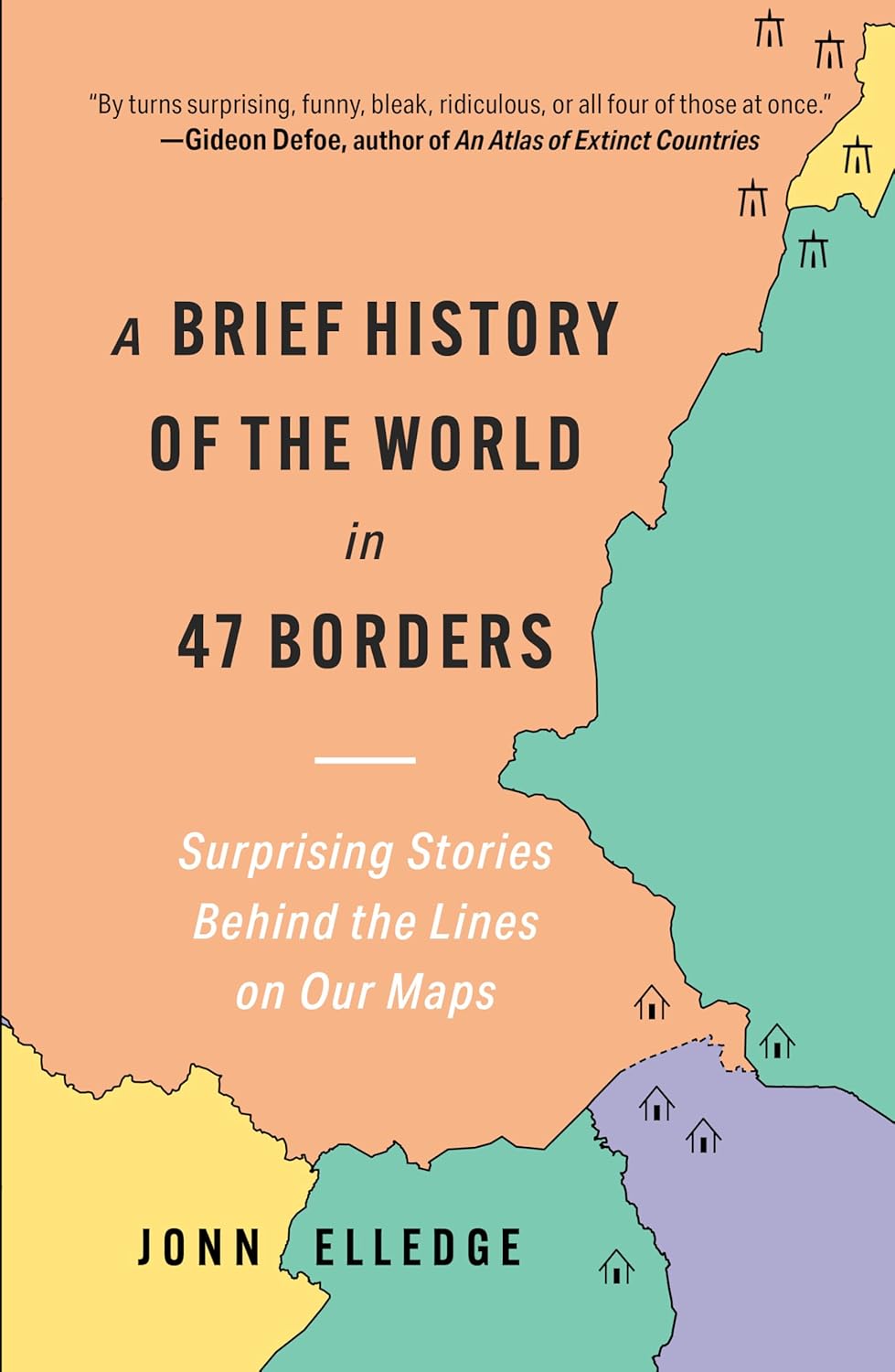
In the vernacular of its author, Jonn Elledge, A Brief History of the World in 47 Borders is bloody brilliant. Someone needs to tell him that the lines on maps are not supposed to be this entertaining.
Granted, not everyone will be fascinated by the travails of poor Bir Tawil (more on that later), but if you’ve ever looked at the outline of Washington, DC, and were reminded of the partially chewed Cheez-It your toddler hurled from his car seat into your wife’s hair before proceeding to cry uncontrollably for the next three hours of the trip, then this is the book for you. (And if you looked at the Cheez-It when she plucked it out and said, “Wow, that looks like the outline of Washington, DC,” I hope you found a good divorce attorney.)
The book is intended to be read longitudinally, but I skipped ahead to the chapters concerning the more confounding borders — like DC’s — in my own life. (As some readers may know, Virginia, and the city of Alexandria specifically, liked its slaves and worried that being part of the newly formed District of Columbia might make slave-owning illegal. Hence, during the great retrocession of 1847, Washington’s bottom-left corner was lopped off.)
After satisfying my curiosity about DC (the chapter on which not only introduced me to the word “retrocession” but also offered a helpful reference to the musical “Hamilton”), I read the remainder of the book as the author intended: from beginning to end. Throughout, Elledge’s writing is equal parts insightful and amusing, and his myriad footnotes contain some of the funniest writing. Here’s an example from the chapter on the U.S./Mexico border:
“A fun bonus fact! In the early 1930s, the government of President Herbert Hoover attempted to blame Mexicans for the Great Depression and deported somewhere between 335,000 and 2 million of them to Mexico. At least half of them were US citizens. This almost certainly meets the definition of ethnic cleansing, too!”
Weird how they don’t teach that in school.
The establishment of borders is often dictated by geography, but Elledge focuses on less-mundane creation stories, like that of the aforementioned Bir Tawil, which he describes as a “small patch of desert on the Egypt-Sudan border” that’s sometimes referred to as “the last unclaimed land on Earth.” He then adeptly shows that the only nimrods who’d describe Bir Tawil thusly either have zero knowledge of the Egypt-Sudan border or else don’t know how to use Google. While recounting the many claims made on this wee expanse of landlocked sand over the decades, Elledge spotlights one 2014 claimant with a connection to the DMV:
“Last but not least, there’s Jeremiah Heaton, a farmer from Virginia, whose daughter Emily had told him she wanted to be a princess. ‘So be it proclaimed,’ Heaton wrote on Facebook, after visiting and planting a flag, ‘that Bir Tawil shall be forever known as the Kingdom of North Sudan. The Kingdom is established as a sovereign monarchy with myself as head of state; with Emily becoming an actual princess.’ From one perspective, this story is rather sweet. From another — the one from which you’ve perhaps rather more direct experience of white people showing up with flags — it was a little bit close to the bone.”
Flag-planting is a pervading theme in A Brief History; the practice even extended to disputes over Antarctica, wherein seven countries once proclaimed dominion over shifting ice plates simply by driving their flags into them. (Nazi Germany, eschewing this approach, airdropped metal swastikas onto the ice to make its claim.) The long-running feud between Britain and Argentina once spread to the world’s most inhospitable continent when the Brits planted a flag there, only to later discover the Argentineans had yanked it up and replaced it with their own.
The “ownership” of Antarctica has actually become a beacon of hope in our broken world ever since competing nations agreed to the Antarctica Treaty in 1957, which established that the continent would be used by everybody for science and exploration, not exploitation and habitation. As Elledge points out, though, the treaty is set to expire in 2048.
“Science is all very well,” he writes, “but national interest still has an annoying habit of outvoting it.”
Drew Gallagher is a freelance writer in Fredericksburg, Virginia. He is the second-most-prolific book reviewer and first video book reviewer in the 139-year history of the Free Lance-Star newspaper. He writes a weekly humor column for the FXBG Advance that you can pay for (or you can just click a tab that lets you read it for free, which is what his friends and family do).