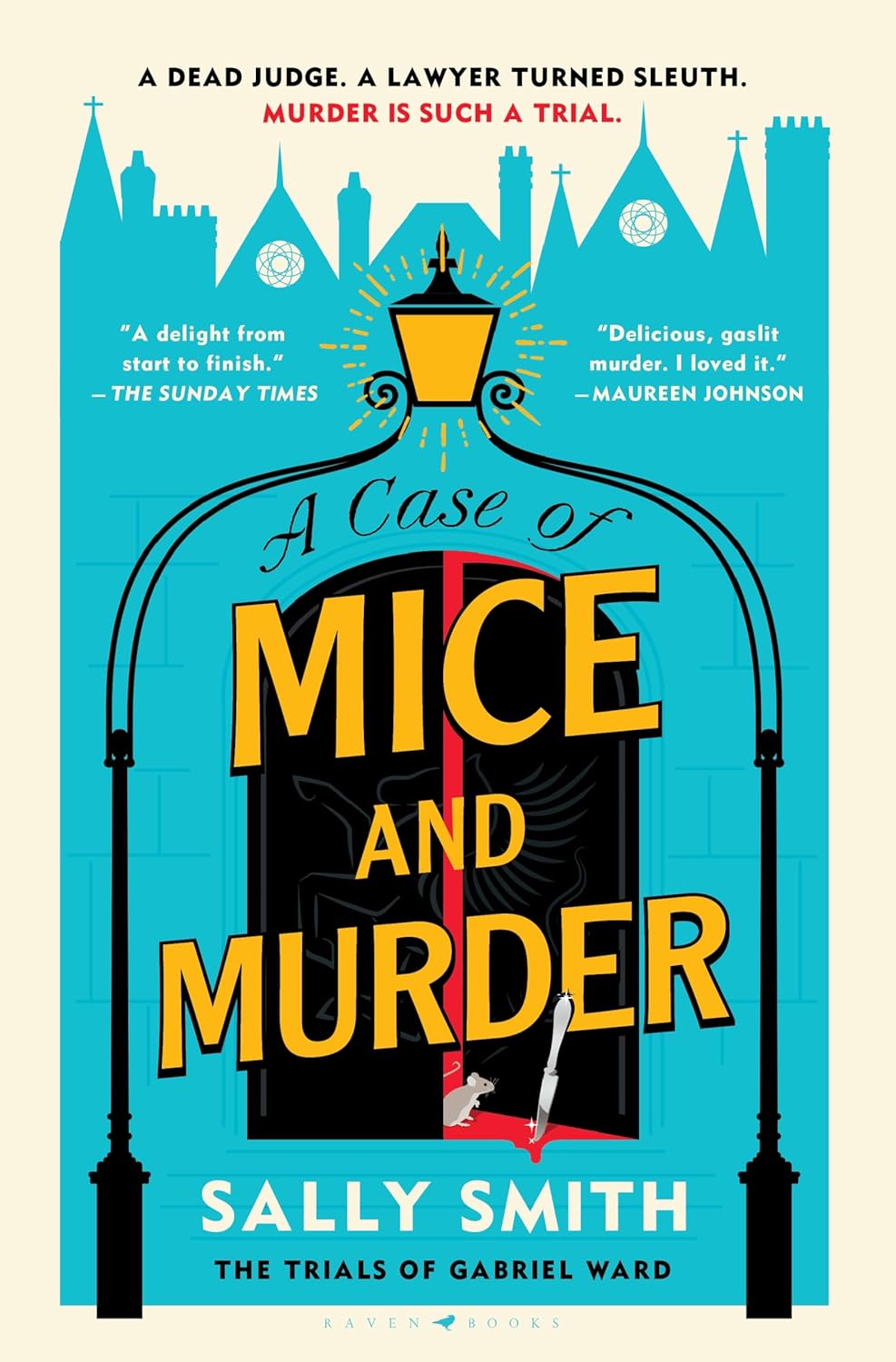
A Case of Mice and Murder: The Trials of Gabriel Ward
- By Sally Smith
- Raven Books
- 336 pp.
- Reviewed by Paul D. Pearlstein
- August 19, 2025
Engaging characters populate this charming debut whodunit.
Author Sally Smith is a real-life retired barrister and King’s Counsel who still lives in the Inner Temple of the Inns of Court in London. But she’s embarked on her next career — as a mystery writer — by (fictitiously) killing off Norman Dunning, Lord Chief Justice of England, who was visiting the Temple on a May evening in 1901 to plan a tribute for the new king, Edward VII.
“He was the very last sort of man to be murdered,” she informs readers.
The Temple and its environs comprise a unique municipal sovereignty called Liberties, not unlike the Vatican in Rome. This means London police may not enter the grounds without permission. To maximize the Temple’s privacy regarding the homicide, its brilliant but long-cloistered barrister, Gabriel Ward, is assigned to handle the investigation. After all, it was he who stumbled onto the face-down corpse while entering his chambers. With this unwelcome assignment — “He was the very last sort of man to become an amateur sleuth” — the reluctant Ward becomes our Sherlock Holmes as we watch him learn the craft.
Eventually, the body — clothed in formal attire but barefoot and quite dead — is turned over to authorities, who recognize it as that of the Lord Chief Justice. The apparent murder weapon is the large carving knife protruding from his chest. The knife is engraved with the winged horse Pegasus, the symbol of the Inner Temple.
In A Case of Mice and Murder, Smith unspools the whodunit alongside an important court case also being handled by Barrister Ward. He’s representing a publishing house that’s enjoying great success with its new children’s book, Millie the Temple Church Mouse, the manuscript of which was left at its door and later rescued from the trash by the publisher’s young daughter. As a favor to the girl, they printed a few copies and were astonished when their “favor” became a national bestseller.
The only name on the manuscript belongs to a Miss Harriet Cadamy, who couldn’t be located despite an extensive search. Instead, Miss Susan Hatchings, in partnership with her sleazy minister, came forward to claim authorship. She is now suing the publisher for a share of the profits.
While unfolding the ins and outs of both cases, the author convincingly immerses readers in turn-of-the-century London. With keen eyes and ears, she describes the buildings, streets, and parks, along with the culture and temperament of this post-Victorian/Edwardian time.
The deceased Lord Chief Justice embodied the worst sexism of the age. Despite his only modest gifts (“The world considered Lord Dunning to be a sound judge and a decent enough man. Gabriel thought him stupid”), he amassed excellent credentials — helped by his correct family pedigree — and was fueled by unrestrained ambition. His home included a submissive wife, three children, and a brilliant unmarried sister, a bibliophile who would’ve loved to practice law, had such a thing been allowed. The late, esteemed Lord Chief Justice strongly disapproved of her dream and went out of his way to stifle her ambition.
As Ward tries to solve the murder, readers are treated to lessons about the British legal system and the role of the four Inns of Court: Lincoln’s Inn, Gray’s Inn, the Middle Temple, and the Inner Temple. All four have existed since the Middle Ages, and the Inner Temple land was once owned by the Knights Templar (some of whom are buried on its grounds).
Until recent times, a formal law-school education was neither available nor necessary to practice law in Britain. This meant that the Inns were central to the training of barristers and solicitors, a role that endures today via the Inns’ “total immersion” legal training (loosely akin to long-ago ambitious men in the U.S. “reading the law” and then passing the bar). Even now, a lawyer in England must be a member of one of the Inns of Court to become a barrister.
Along with presenting her murder case and describing British law, the author reveals the era’s pernicious class divisions. The upper class — often hailing from old money — was accustomed to many privileges, special respect, and obedience (if not fear) from the lower classes. Smith poignantly conveys the hardships and limitations faced by ordinary people trying to work and live within this lopsided judicial and social environment. Without things like unemployment protection, a worker could be dismissed at any time and suddenly face homelessness and poverty.
With its unique Inner Temple setting, A Case of Mice and Murder is an exciting story full of suspense, head-scratching complexity, and Dickensian coincidences, one that leaves readers guessing until the very end (which wraps up a bit too tidily). Having spent considerable time with its many interesting characters, I’m ready for more. Happily, a series is in the works, meaning we haven’t heard the last from barrister/sleuth Gabriel Ward.
Paul D. Pearlstein is a retired lawyer who is a past president of the George Washington American Inn of Court. The American Inns of Court movement, which began in the 1970s, is unrelated to the British Inns of Court, which began in the 13th century.