A Fate Worse than Hell: American Prisoners of the Civil War
- By W. Fitzhugh Brundage
- W.W. Norton & Company
- 464 pp.
- Reviewed by Paula Tarnapol Whitacre
- March 2, 2026
A harrowing assessment of a savage penal system.
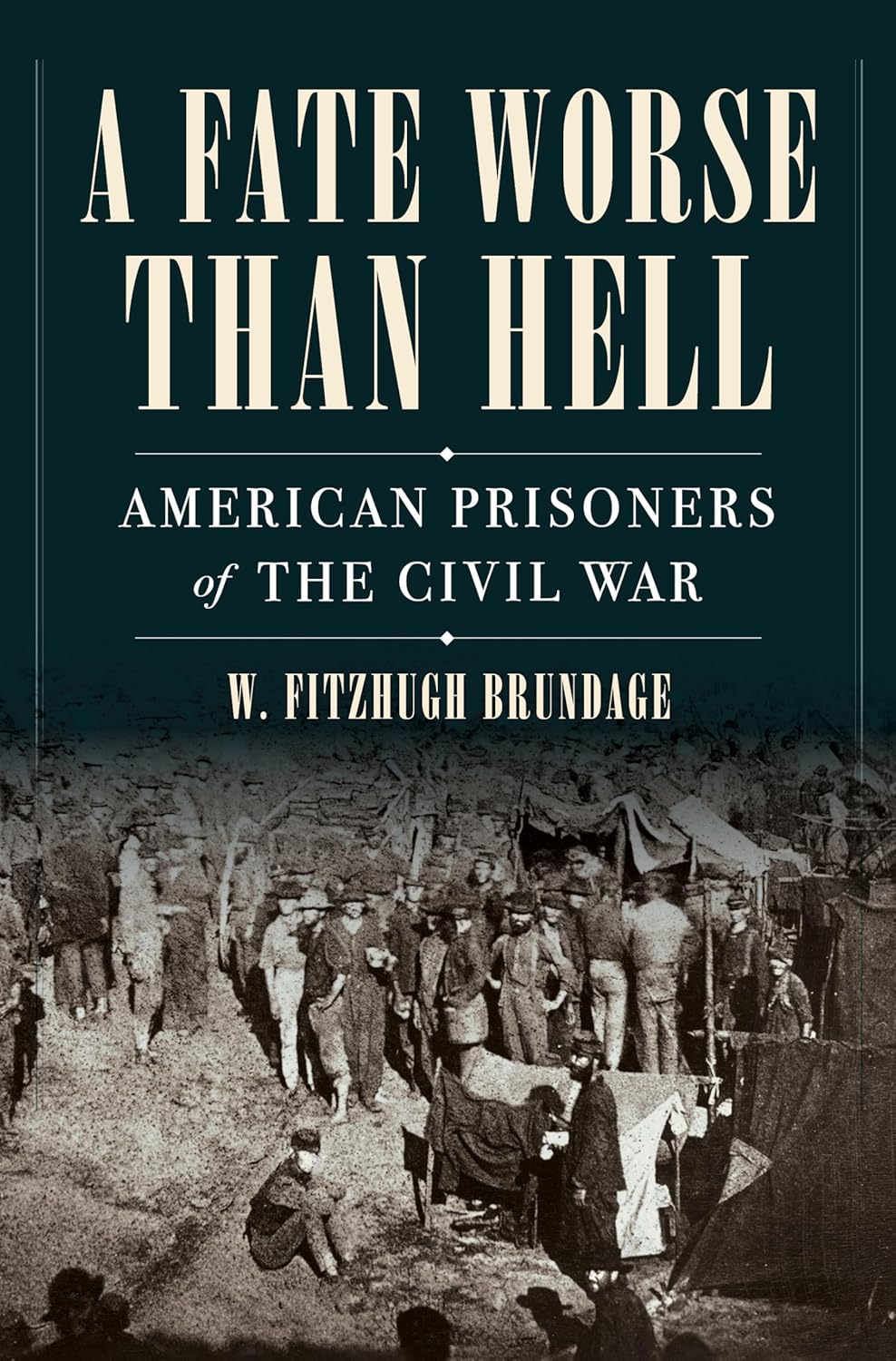
It takes fortitude to open a book titled A Fate Worse than Hell in these turbulent times. Fair warning if you do: You’ll quickly become mired in the horrendous conditions faced by Civil War prisoners on both sides. But persevere. Historian W. Fitzhugh Brundage not only introduces us to the war’s prisoners, officials, and places, but also discusses the long-term impact of the prison system on Civil War memory and, more broadly, on modern warfare.
Most readers of Civil War history know about Andersonville, the vast and deadly Confederate prison camp set up in 1864 for captured Union soldiers. This is where the book begins, when local portrait photographer Andrew Jackson Riddle improbably lugs his equipment to the then-newly opened camp and is allowed to chronicle its squalor. Brundage analyzes each of Riddle’s photos to describe the highlights (or, more accurately, lowlights) of the morass. Other photographs and illustrations made the horrors of the camps known in both the North and the South, yet conditions still deteriorated.
According to Brundage, the sheer volume of prisoners turned Andersonville and other hastily assembled camps into massive “dystopian cityscapes.” A soldier had a one in five chance of being captured by the enemy during the Civil War. (In World War II, the odds were one in 100.) Neither side was prepared to feed, shelter, transport, or provide medical care to the tens of thousands of men it captured, nor did either side prioritize these responsibilities amidst the other demands of war. Reviewing evidence from the larger camps, Brundage does not spare the Union from blame but finds conditions worse in Confederate camps.
A prisoner’s experience depended on when he was captured. Before July 1863, Union and Confederate officials implemented a system of orchestrated exchanges called paroles. As Brundage notes, “the negotiations, which took place without fanfare near Richmond, were the most important bilaterial negotiations that the warring sides conducted during the conflict.” While prisoners waited their turn for an exchange, conditions were relatively tolerable, especially compared to what followed.
The exchange system broke down in mid-1863, when Confederate leadership denied prisoner-of-war status to captured Black soldiers. (The Emancipation Proclamation in early 1863 paved the way for the formation of Black regiments.) In response, President Abraham Lincoln, affirming that Black POWs had the same rights as whites, stopped the exchanges. Without them, new detainees crowded in with those already in custody, with no escape valve to relieve the population pressure.
Lincoln’s action was extremely unpopular in the North. Opponents questioned why he should stop the exchanges of thousands of white men over the fate of a few hundred Black men. Yet, Brundage points out:
“That almost no one posed the question of why the Confederacy refused to exchange all prisoners is a telling measure of how successfully the Confederates, Democrats, and critics of the Lincoln administration framed the public discussion of prisoner exchanges. The Confederacy’s intransigence, at least as much as Union policy, condemned all white prisoners — Union and Confederate — to captivity without exchange.”
The Confederacy’s president, Jefferson Davis, and its secretary of war, James Seddons, made a choice that resulted in the continued imprisonment of their own (white) men.
The chapters about the “mass prison pens” from late 1863 through early 1865 describe the logistics and conditions for prisoners and guards. Diaries and recollections provide heartbreaking details of the suffering, bravery, cruelty, and kindness, with food being an obsession for prisoners and a source of power for prison staff.
Brundage also looks at the fallout from these prisons after the war. I had known about the trial and hanging of Henry Wirz, the superintendent of Andersonville, but didn’t realize that his prosecution for war crimes was expected to be the first of many. According to Brundage, “Union officials recognized that their decisions to prosecute Wirz and other former Confederates would establish a precedent in not just American but also international law.” Not so. The author goes through the legal, political, and societal reasons why Wirz became an anomaly, leaving far more powerful men unpunished.
As for the prisons’ global impact, when representatives of 15 countries met in 1874 to draft an international convention on warfare, they drew on the U.S. experience, including prisoner-of-war policies. The convention, Brundage notes, proved inadequate to contain, let alone prevent, future carnage. In fact, he writes, “The Union and Confederacy demonstrated that internment on a massive scale was now not only imaginable but feasible.”
Brundage provides a scholarly examination of the institution of Civil War prisons while not losing compassion for the people trapped in them or discounting the fact that their individual experiences merit attention. We have preserved nearly 60,000 acres of Civil War battlefields, he points out, but fewer than 750 acres associated with its prisons. Their prisoners’ fate, one worse than hell, should not be forgotten.
Paula Tarnapol Whitacre writes about history, with a focus on 19th-century social history. Her book Alexandria on Edge: Civil War, Reconstruction, and Remembrance on the Banks of the Potomac is under contract with Georgetown University Press.