A Sudden Flicker of Light: A Revisionist History of Movies
- By David Thomson
- Simon & Schuster
- 368 pp.
- Reviewed by Dennis Drabelle
- August 26, 2026
Strangely, the author knocks the very medium he spotlights.
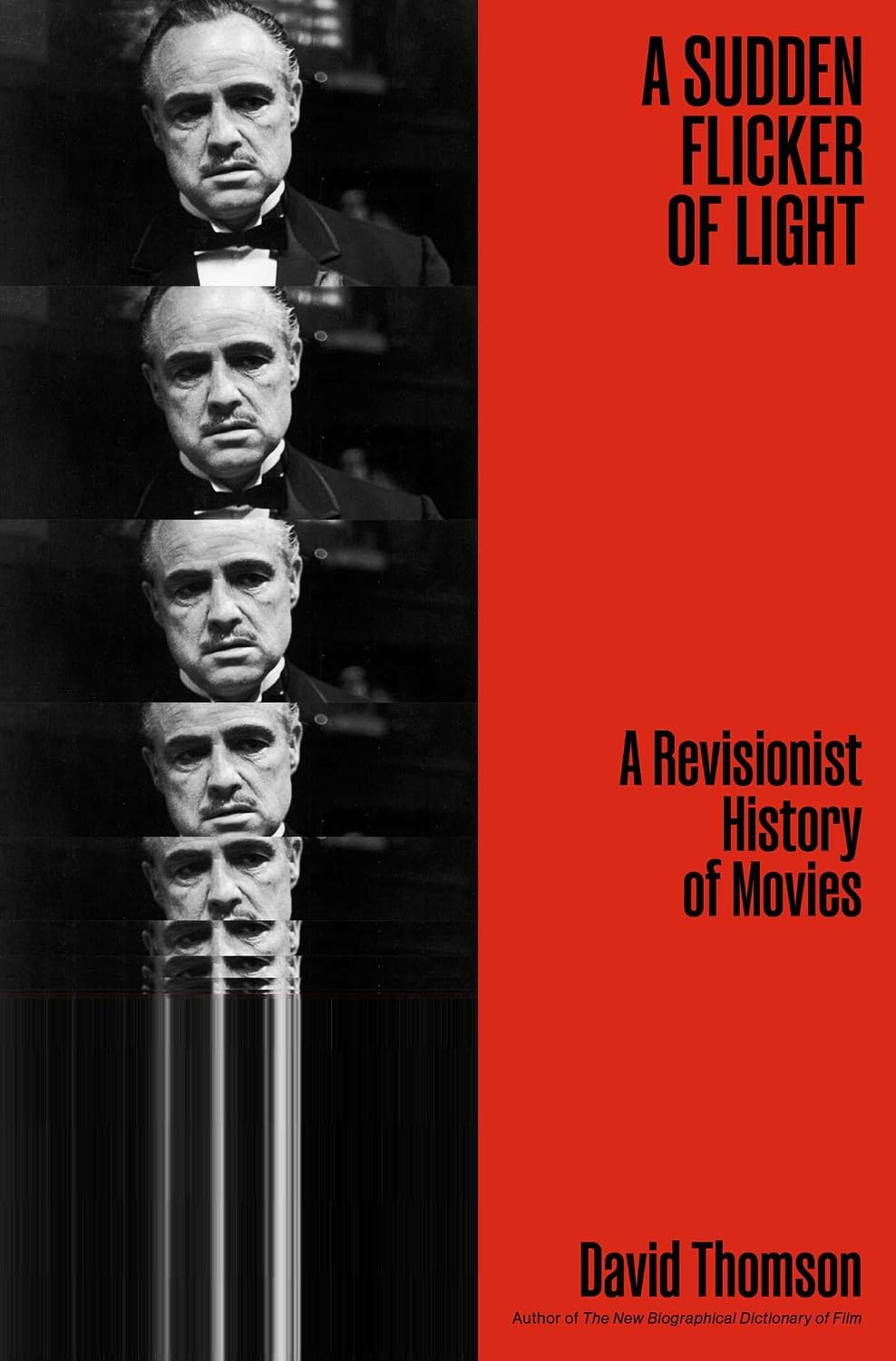
The America of 2026 is no country for old men — or at least not the 85-year-old David Thomson, author of a new book, A Sudden Flicker of Light, that calls into question the medium he has made an illustrious career of chronicling and appreciating.
My lede, of course, riffs on the Coen brothers’ 2007 film version of Cormac McCarthy’s novel No Country for Old Men, both of which Thomson admires. Nonetheless, not only does he harbor revisionist misgivings about the movies, but he also blames the cultural dominance of moving images generally and the electronic devices that purvey them for diminishing us, their viewers, as human beings.
For one thing, Thomson points out, watching a movie doesn’t provide the roominess, the chance to work with “merciful vagueness” or just “to reflect” that reading a book does. Rather, films and videos offer a “narrow-minded intensity [that awes] the viewer into submission or obedience.” “What film does not grasp,” Thomson goes on, “is the largeness of imagination.” That indictment takes me back to a complaint made by the comedian Fred Allen about television’s early-1950s takeover from radio as the preferred in-home source of entertainment:
“The radio listener saw nothing: he had to use his imagination. It was possible for each individual to enjoy the same program according to his…mental capacity. With the high cost of living and the many problems facing him in the modern world, all the poor man had left was his imagination. Television has taken that away from him.”
The same is true, Allen might argue if he were alive today, of laptops and smartphones.
A Sudden Flicker is replete with aperçus in support of Thomson’s argument. Take, for instance, his discussion of “The Godfather,” which he cites as an example of how “feeble” the cinema is when “facing the strength of evil…There is a danger that we adore [the Corleones]…We want to belong to this dreadful family — and nothing in the trilogy of films…ever deters that allegiance.”
Further along, Thomson skewers two hitmakers for the current puerility of most American movies. “In so many respects, [George] Lucas is uninteresting; he has never really thought to advance on his or our teenage attitudes. But with Steven Spielberg, unwittingly yet with zeal and in good humor, he ended the best hope for American cinema.” With “Jaws” and other crowd-pleasers, Thomson asserts, Spielberg “came upon art experimenting with difficulty or doubt, talked if off the edge, and advised those un-American urges to shut down.”
One aspect of the book that gives me pause is its takedown of Alfred Hitchcock. Thomson has previously called out the master of suspense for his overall callousness and preference for storyboarding the whole picture in advance and closing his mind to chance and spontaneity in the actual filming (for more on Hitch, see the entry on him in Thomson’s indispensable The New Biographical Dictionary of Film, now in its sixth edition). In A Sudden Flicker, he elaborates on something else: Hitch’s infatuation with camera angles, which exemplifies his use of “style to conceal life and content.” Maybe so, but I’m troubled by an example Thomson gives to back up this charge.
It’s the scene in “Psycho” where Martin Balsam, as the private eye, Arbogast, enters the house above the Bates Motel, starts to climb the stairs to the second floor, and a “crane shot…rises above him and goes up into the ceiling. [The shot] is radiant and demented,” suggesting that the director “believed in life less than he did in its presentation.”
But when you consider what the crane shot accomplished, it doesn’t look so self-indulgently virtuosic. The arc of the plot called for Mrs. Bates to commit a second murder, but the audience could not be allowed to recognize her as you-know-who in drag — that would have spoiled the film’s shocking climax. The crane shot shifts the viewer’s perspective to avoid that result, and Arbogast’s flailing fall backward down the stairs diverts our attention from the fact that we have yet to see the old lady with any degree of clarity. For this watcher, at least, the shot represents not a diminished belief in life so much as an inspired solution to what must have been a vexing problem.
You, too, may want to take issue with something in A Sudden Flicker of Light, and for that purpose, you will have to read the book with care and reflection. In doing so, you’ll be eschewing the “narrow-minded intensity” imposed by watching a movie.
Dennis Drabelle, a former contributing editor of the late Washington Post Book World, writes frequently on the movies.