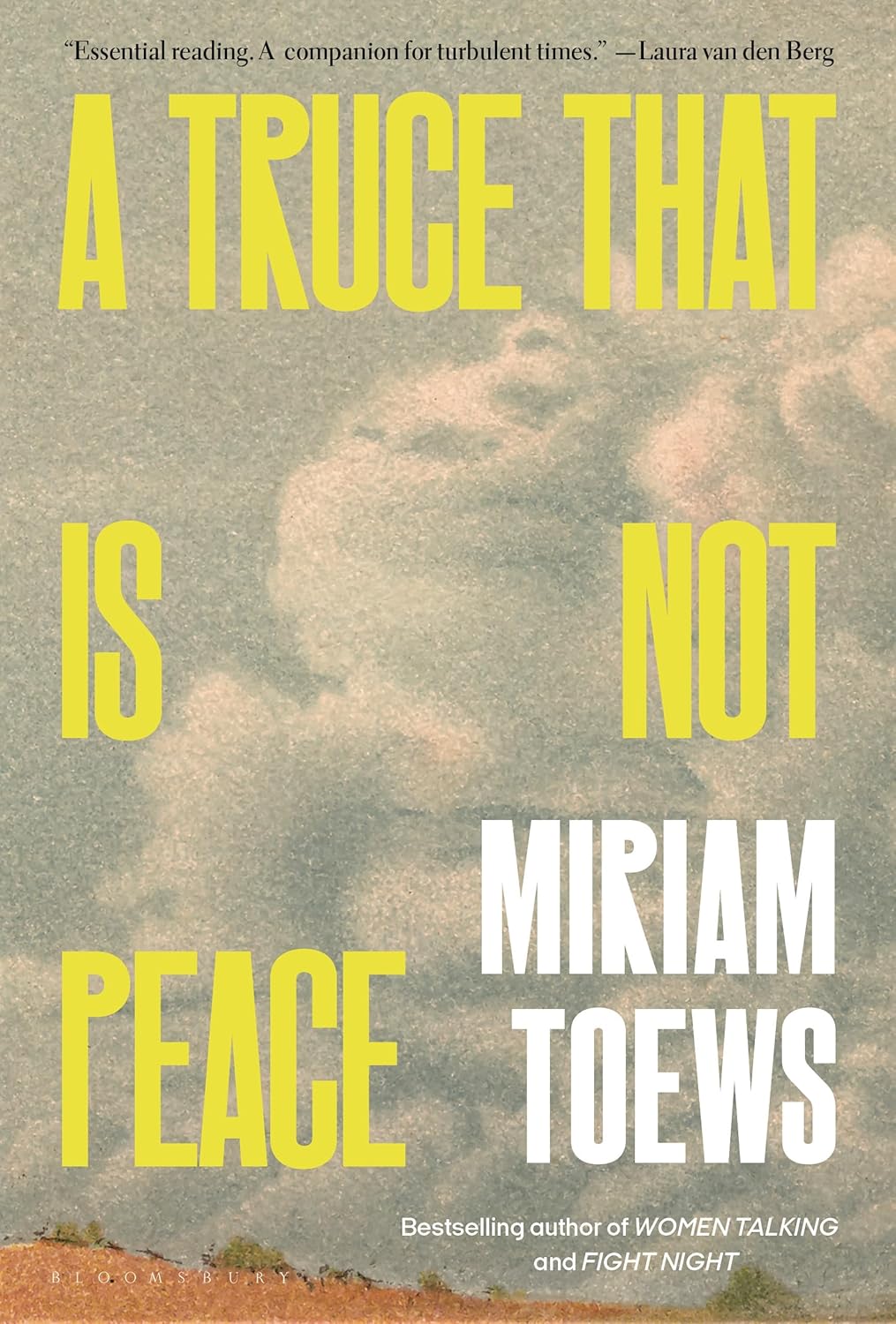
A Truce That Is Not Peace
- By Miriam Toews
- Bloomsbury Publishing
- 192 pp.
- Reviewed by Patricia Ann McNair
- August 27, 2025
The author parries with an imagined interlocutor in this beguiling memoir.
There are some common questions asked at literary festivals and other gatherings of readers and writers and wannabes: “Is this story true?” “What is your process?” “Why do you write?” I suppose they come from a place of sincere curiosity, a desire to understand artistic creation. But I also think we ask these things in hopes of figuring it all out, glimpsing the sleight of hand behind the trick, identifying the ingredients in the secret sauce.
In Miriam Toews’ A Truce That Is Not Peace, the question “Why do I write?” is posed by an imaginary committee curating a fictional writers panel for a made-up literary conference. The director of the Conversación Comité in Mexico City poses it to Toews, who asks for clarification:
“Why do I write? Or…Why write?
“Why do I write, he said.”
This question both launches and underpins the memoir, pulling Toews deeper and deeper into her own questioning of the creative process, especially as it is layered with family obligation, mental illness and wellness, trauma, hope, and anticipatory and achingly present grief. Toews returns again and again to the question because her answers — long explorations of her life, her family, her career — never quite satisfy the comité:
“Please you must simply answer the question: Why Do I Write? What is your reason?”
The fictive organizers see only the surface of these winding narratives, the paths populated by a skunk with distemper that tries to scratch its way into Toews’ home; an ex-husband who lays claim to years of her royalties; a dying mother filled with doubt and humor and a love for Scrabble; a father who orders a ham sandwich (but doesn’t eat it) for what he likely knows will be his last meal; and a sister who, after months of silence and pulling away from those who love her, steps into the path of an oncoming train.
A number of Toews’ passions and obsessions are exposed in these pages, too, like wind and cold weather and her children and grandchildren and recurring dreams of long hallways and an inability to get out of the way of danger. And writing. Always writing. Blank pages and words arranged and rearranged and defined and discarded.
In a recent New Yorker interview by Deborah Treisman, Toews said about A Truce That Is Not Peace, “I had been thinking a lot about writing and about not writing and about silence and about my sister and her death — which is central to the book — and just kind of the futility of it all, but then again also my need to write. I was having these long internal arguments with myself, building up walls and knocking them down at the same time.”
We see this struggle. Whenever Toews tries to plumb the process and purpose of creation, she distrusts and ridicules what she comes up with. “Douchebag” she labels the answers. “Doooooooouchebag.” In response to a description of Jackson Pollock’s paintings being packed with symbols without tipping into narrative, she writes:
“Narrative is something dirty, to be avoided — I understand this. I understand narrative as failure. Failure is the story, but the story itself is also failure. On its own it will always fail to do the thing it sets out to do — which is to tell the truth. (Douchebag!)”
By switching sides in the arguments she herself mounts, Toews presents her material in a kaleidoscopic structure. Time moves forward and back, moments linger in the present. She uses letters (real? Recreated?) and vignettes and quotes and slivers of research. One especially fine section is a play on an intake interview by a psychiatrist after Toews came close to ending her own life. She intersperses legitimate questions with memories from different times in her life when she felt alive and less than so.
The book’s six sections dip into their own unique content and themes that overlap and heighten the memoir as a whole. We come to understand that the author’s identity was formed in a similar, patched-together way — her family religion (Mennonite) and roles (daughter, wife, sister, mother, grandmother, partner), as well as her need to create, are all part of who she is now: hopeful, grief-struck, and persevering.
But let’s not overlook the writing, the fine, fine writing. Lyrical yet plainspoken, vivid and rich. There is intimacy in what Toews is willing to share and in the way she chooses to share it. Reading this memoir is like reading a journal: private, surprising, and vulnerable.
“Why do I write?” the imagined comité asks over and over again before rejecting Toews’ answers and, ultimately, her participation at the conference. It’s a shame, really. The answer to their question is here — sometimes whispered, sometimes howled. If only they would listen.
Patricia Ann McNair is an associate professor emerita in Creative Writing at Columbia College Chicago. Her most recent book is a second edition of the story collection The Temple of Air; the original publication was named Chicago Writers Association Book of the Year. Responsible Adults (stories), was a Legacy Series selection by Cornerstone Press, and And These Are the Good Times (essays) was a Montaigne Medal finalist. McNair lives in Xátiva, Spain.