A World Appears: A Journey into Consciousness
- By Michael Pollan
- Penguin Press
- 320 pp.
- Reviewed by Teddy Duncan Jr.
- March 13, 2026
Are we aware enough to grasp awareness?
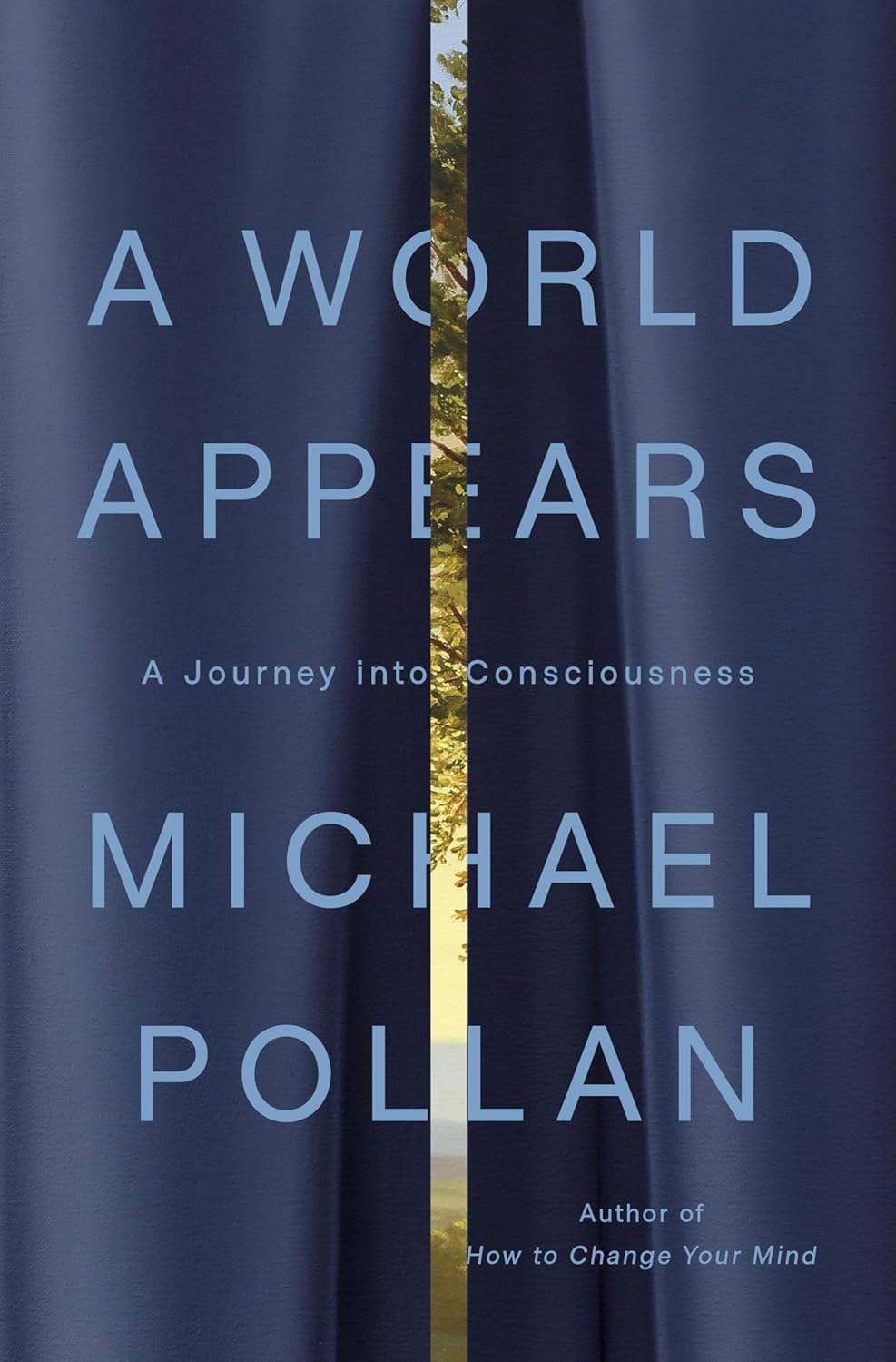
Michael Pollan’s 10th book, A World Appears, is a series of questions — a “journey” — addressing progressively more complex strata of experience in order to reveal the nature of consciousness. It asks, above all: How do subjective states emerge from brain tissue, the supposed nexus of all experience? How can corporality produce something incorporeal like feelings and thoughts? Why does a world appear when I close my eyes?
Pollan situates himself as a representative of the tensions inherent in consciousness: He refuses to rely on “magic,” meaning any metaphysical explanations for consciousness, and rejects pure empiricism, recalling an old chemistry teacher who tried to reduce humans to their chemical components. Because Pollan is a self-confessed agnostic — though his position seems slightly unmoored after the extended excursion into psychedelics he recounts in his last two books, This Is Your Mind on Plants and How to Change Your Mind — consciousness is an intractable problem for him. If you think the universe is “dead and purposeless” (like he claims many “assume”), then the existence of consciousness is desperately enigmatic, perhaps even totally unknowable.
In other words, minus an extramundane component, the very fact of consciousness seems impossible to explain. (Even a monotheistic God doesn’t tell us how subjectivity arises from neuronal activity or what consciousness is.) Consciousness is the ultimate mystery, and it’s that ineffable void which propels Pollan’s book through neuroscience, the philosophy of being, cognition, psychoanalysis, hypnosis, and literature.
The author acknowledges, start to end, that he can’t resolve this “hard problem” of consciousness, squarely positioning his approach as open-ended and provisional, contingent on the newest available knowledge. Before venturing into the abyss of consciousness scholarship, he judiciously insists that even he is unsure whether his questions are answerable.
To contend with them, Pollan must pass through different modes of experience — like sentience and feeling and self — moving from proto-consciousness (mere sentience) to meta-consciousness (the state of reflecting on consciousness). Through this passage of complexity, he explores plant consciousness, machine feeling, animal interiority, and the artificiality of human selfhood.
Pollan’s examination of plant consciousness and AI, spanning large portions of the book’s first half, contests the definitional boundaries of consciousness, threatening to cede territory normally attributed only to people or animals. But the author largely dismisses these threats; he shows the notion of machine consciousness to be tenuous, an analogy missing the point of subjectivity. Plant “consciousness” likewise becomes an overstatement.
Pollan is known for his approachable blend of personal and journalistic science writing, and A World Appears pushes those abilities to their absolute limits, with a perceptive reader likely wondering what has been omitted or only partially revealed. Necessary to Pollan’s project is his capacity to inject his opinions while appearing entirely neutral, to refract through his own views on consciousness the available information on the subject. The trick is generally deployed with grace; some theories are discarded, others are embraced.
Narratively, A World Appears lacks the experiential edge of his last two books. However, the comparison may be unfair. His psychedelic (or “drug”) books were predicated on the kind of firsthand experiences that are impossible to replicate in a study of consciousness research. One can’t expect an exercise in auto-phenomenology, with Pollan ruminating on his own mind for 300-plus pages. Yet despite the book’s lack of long, descriptive accounts of LSD trips, etc., there remain ample instances of the author inserting himself in the action: He undergoes hypnosis, has lunch with researchers, and articulates his own views on subjectivity throughout.
At one point, there’s a genuinely hilarious moment when Pollan is told by a consciousness expert that he lacks an inner life, a pronouncement that makes the author comically defensive. Playing into the scene, Pollan writes, “My interiority, he seemed to be suggesting, was sparsely furnished.”
These moments invoke the purpose of the book’s tenor. One reads a work on consciousness by Pollan — rather than by a philosopher or a researcher — because of the very thing he asserts is essential: Being human means we cannot have consciousness without the corollary of experience, even when that experience involves lunching with a scientist with “piercing pale-blue eyes” and a “full beard” and being informed that we lack an inner life (while writing a book on interiority).
Teddy Duncan Jr. is the author of Interpreting Meat: Theorizing the Commodification and Consumption of Animals. His freelance writing has appeared in publications such as the Observer, Document Journal, Inside Higher Ed, Compact Magazine, ASAP Journal, and others. His scholarly work is in Between the Species, Latin American Literary Review, the International Review of Zizek Studies, the Midwest Quarterly, and the Journal of Excellence in College Teaching. He can be reached at [email protected].