Across the Universe: The Past, Present, and Future of the Crossword Puzzle
- By Natan Last
- Pantheon
- 336 pp.
- Reviewed by Antoaneta Tileva
- January 30, 2026
An overly wordy ode to word games and the nerds who love them.
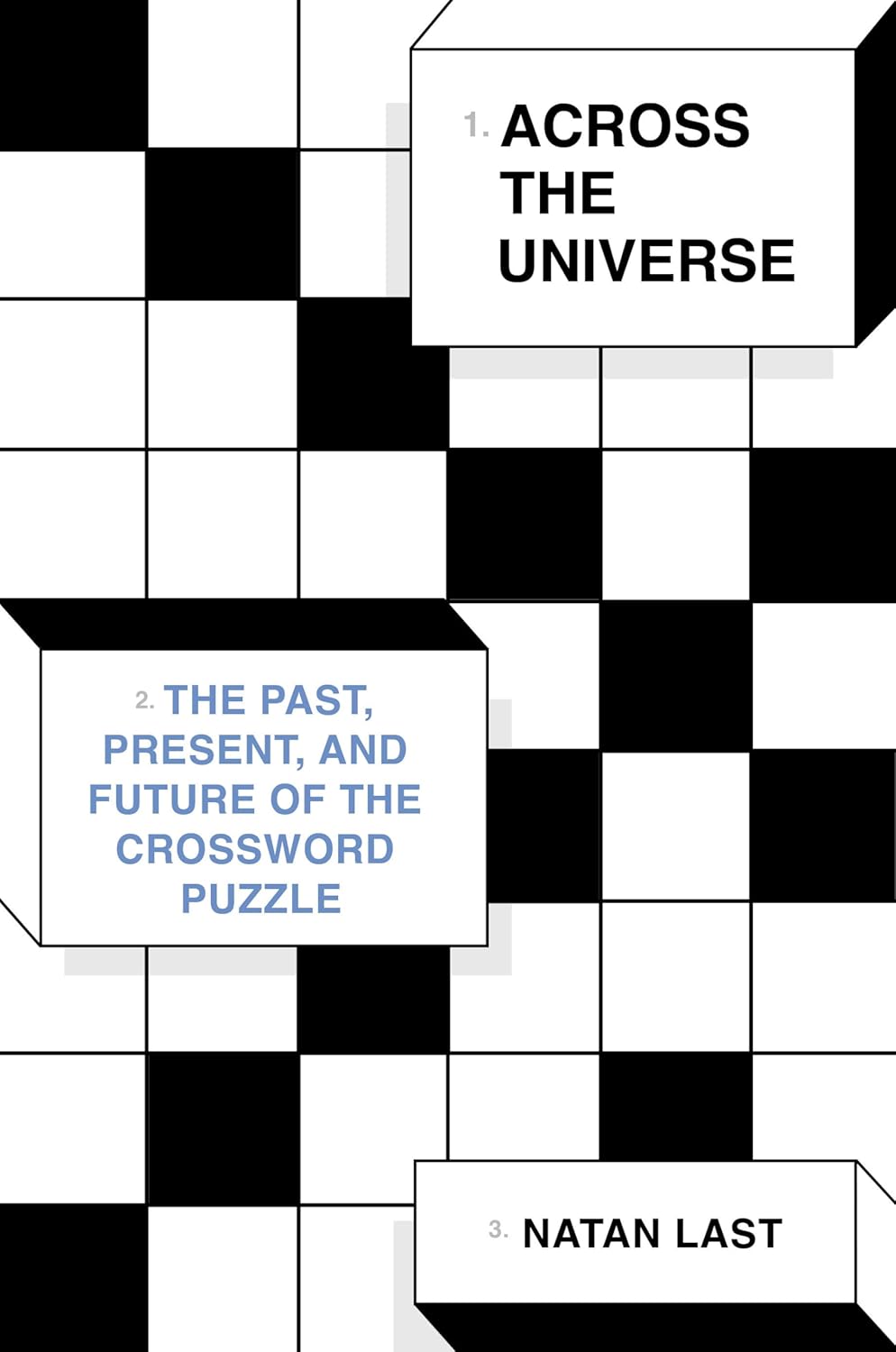
As a cruciverbalist czarina (you try coming up with a better alliteration!), I thought I’d be down, up, and generally all over Across the Universe, Natan Last’s celebration of all things crossword. Instead, I found it nothing short of a Sisyphean slog. This book is not so much a love song to crossword puzzles as it is a highly intellectual but not-so-intelligible serenade by an author who enjoys the sound of his own warbling a bit too much.
Last’s facility with crosswordese and language is unparalleled, but it also often requires a rereading of his serpentine circumlocution, which gives the book a noxious air of “the gentleman doth prolix too much.” Take this sentence, for example, which describes the moans puzzle-solvers often utter at puns: “But a groan is not the body implicating fairness, only taste; ‘I see what you did there’ is a registering of annoyance just as much as a literal acknowledgment.” Or try this passage, in which the author comments on his 2009 summer internship with New York Times Puzzlemaster Will Shortz:
“The environment offered, or we projected a sense that survival required a leery competence, one correlated with age, responsibility: riding the subway alone, knowing which strangers to talk to, and so on. But fluency with highbrow media — of which the Times puzzle was an exemplum — could act like a cultural fake ID.”
It’s a bit much.
Still, stories from the then-18-year-old intern’s experience are among the most interesting parts of the book, including anecdotes about how the “avuncular” Shortz eats like a “latchkey kid” and names Green Day as his favorite band. (We will forgive Last for describing buildings in Manhattan as being “huddled like gargoyles made of terra-cotta and limestone, reliefs and colonettes like ears leaning to ingest the scuttlebutt from City Hall.”)
Across the Universe also explores the crossword’s impact on and reflection of popular culture. On the origins of the puzzle in 1913, Last writes, “Whatever its narcotic middle-class charm, the crossword — like many American triumphs — is the invention of an immigrant, Arthur Wynne.” Given the puzzle’s burgeoning popularity in the 1920s and 1930s, a moral panic of sorts spread that people would be too busy solving crosswords to function; the New York Times would not even publish them until the 1940s.
Chapters on “crossword diplomacy” and crossword politics are also compelling. In “The Melting Pot of the Crossword,” Last tells the story of crossword constructor Mangesh Ghogre of Mumbai, a recipient of an EB-1A visa (the “super special person” visa) for his skill. Ghogre started doing crosswords to broaden his English vocabulary. “He could grok a puzzle’s linguistic quirks even if, some eight thousand miles away from the US, he didn’t always understand their context.” This chapter captures the magic of crosswords so perfectly.
Last’s discussion of clue politics is also amusing. In 2022, the answer “clean coal” to the clue “Greener energy source” stirred up quite a bit of dust. And a crossword I recently did had the clue “Creator of some bubbles,” with “corporate greed” as the answer. Ha!
Above all, the book is an ebullient celebration of crosswordese — a language replete with florid wordplay, puns, palindromes, and various other jocular antics. Seasoned cruciverbalists know, for instance, that the words oboe, epee, and ocher often make appearances (oboe, in fact, has been used in over 200 New York Times crosswords). Another clue I see quite often is “a real humdinger”: beaut.
Ethnicity-centric clues also hold their own — such as “bhindi masala component”: okra or atta, the flour used in chapattis — as does Princess Leia, who reigns supreme in crosswords (and for whom Last came up with an especially good groan-inducing clue: “Film character known for her buns”).
Across the Universe, then, will be a fun read for some, although it requires quite a bit of mettle to muddle through Last’s overstuffed prose. But it will never be as much fun as doing an actual crossword. Luckily, it’s not trying to be…I don’t think.
Antoaneta Tileva, Ph.D., is a Bulgarian transplant who has lived in the DC area since she arrived here at age 12. She is an intensely curious cultural anthropologist and a lover of all sorts of pun-ditry and dad jokes. She teaches at American University’s School of International Service. She is a very mean cruciverbalista and foodie-ista and a not-so-mean feminista. Don’t challenge her to a hip-hop-quoting contest because you will be resoundingly thrashed.