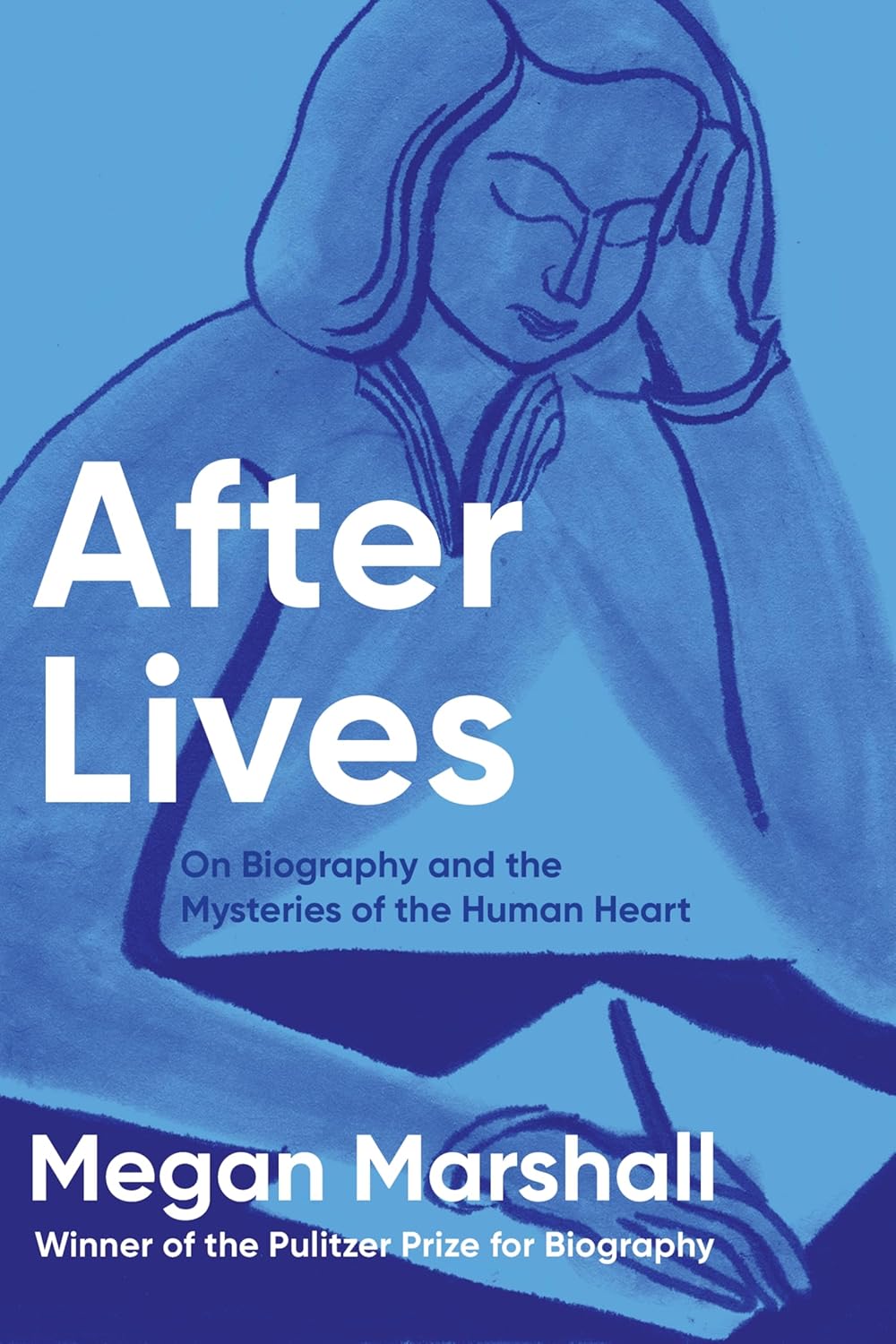
After Lives: On Biography and the Mysteries of the Human Heart
- By Megan Marshall
- Mariner Books
- 208 pp.
- Reviewed by Kitty Kelley
- September 8, 2025
A master biographer tells her own poignant story.
Imagine Nancy Drew with a Phi Beta Kappa key and you’ll glimpse the phenomenon of Megan Marshall, who many cite as the patron saint of biographers. And biographers need such patronage because they’re frequently dismissed as the pesky stepchildren of historians.
With a degree from Harvard, Marshall, 71, is a professor emerita at Emerson College and winner of the 2014 Pulitzer Prize for Biography for Margaret Fuller: A New American Life. She also received the BIO Award, the highest honor given by the Biographers International Organization. Her other prize-winning works, which feature trailblazing women of the 19th century whose lives had been ignored, are The Peabody Sisters: Three Women Who Ignited American Romanticism (2005) and Elizabeth Bishop: A Miracle for Breakfast (2017).
Now comes Marshall’s memoir, After Lives: On Biography and the Mysteries of the Human Heart, a feminist manifesto of sorts and a sparkling jewel, especially for those who labor to understand humanity. Marshall’s gem is not a flashy diamond but more a translucent opal that shimmers with layers of iridescent color. So read her elegant pages like you would sip a martini. Don’t gulp.
You’ll learn that writing a biography is like solving a mystery. You make a chronology of the life: you collect clues, read documents, visit gravesites, search libraries, follow leads, and do innumerable interviews. After months, maybe years, you realize that you can’t know everything about a life, but you must find its essence. So you forge ahead, believing Ben Franklin’s dictum that energy and persistence conquer all. Soon, you’ll learn, as Marshall writes, “…there are memories that can’t be verified, questions that can’t be answered.”
When you feel overwhelmed and start to flail (all biographers do), you’ll find sustenance in remembering that Marshall spent 20 years researching and writing The Peabody Sisters, which was a finalist for the Pulitzer. Not all biographers will be so honored, but at the end of your bountiful slog, the months that melt into years, you might well agree with President John F. Kennedy, who said:
“What makes journalism so fascinating and biography so interesting is the struggle to answer that single question: ‘What’s he like?’”
Marshall’s jewel, which she defines as “a cultural history of the self,” is faceted, offering eight essays that recall her life, professional and personal, including the upheavals of growing up with a mentally unstable father, who suffered from manic depression and lost his way to alcoholism. This forced her mother to go to work to support the family of three children and relinquish her dreams of becoming an artist. The saddest line in this book is Marshall’s recollection of her mother’s aborted career as a painter, noting the easel that “stayed folded up in the garage.”
Each of the essays in this miniature memoir explores portals to the past with lessons on pursuing the future, and the most significant lesson is to never stop searching, never stop asking questions, which Marshall does throughout her pages. “Do the objects that survive from our childhoods…bear witness to our ongoing lives?” Yes, she says. “As T.S. Eliot understood, things are what make fiction, poetry, drama, and the emotions they stir, feel real, true.”
With probing insight, the professor recalls the women in her family — her grandmother, her mother, her aunt — and notes they were all left-handed and each was forced to forget life beyond the kitchen. Society ignored left-handed struggles for years; left-handed scissors were not invented until 1972, but by then, Marshall, who writes with her right hand, decided, “I was done with left-handed women.”
Not really. With scholarly diligence, she then explores the malady of left-handedness and discovers controversial statistics, particularly about the life span of lefties, who appear to die six years earlier than their right-handed relatives. Acknowledging hers is a less-than-scientific study, the right-handed professor notes that “no writer on left-handedness disputes the long history of prejudice that may contribute to a shortened life span.”
She points out that the Anglo-Saxon root word for “left” — lyft — means “weak” or “broken,” adding dispiriting connotations:
“One never studies to get a ‘left’ answer on a test or hopes to be found ‘in the left’ — even as one might be left out, left behind, or make a solitary dinner of leftovers. An idea that comes out of left field is unexpected, if not unwelcome, and a left-handed compliment can hurt.”
In the longest essay, Marshall reflects on her friendship with high-school classmate Jonathan Jackson, when she lived in Pasadena. The 17-year-old was killed in 1970 trying to free his brother, George Jackson, who was one of the so-called Soledad Brothers, three inmates charged with killing a guard at California’s Soledad State Prison. Jonathan’s guns belonged to the political activist Angela Davis, who was jailed, tried, and acquitted in 1972 of any wrongdoing in the incident. Looking back on the murderous mayhem, Marshall asks, “What did it all amount to?”
Instead of making thunderous proclamations, as some professors might, this one, described by Dwight Garner in the New York Times as among “the front rank of American biographers,” seeks answers. Through her writings, Megan Marshall has sought to “learn what I could from others: how to live, how not to live, what it means to live.” Now, she’s sharing that wisdom in this penetrating memoir.
Kitty Kelley is the author of seven number-one New York Times bestseller biographies, including Nancy Reagan, Jackie Oh!, and Elizabeth Taylor: The Last Star. She is on the board of the Independent and is a recipient of the PEN Oakland/Gary Webb Anti-Censorship Award. In 2023, she was honored with the Biographers International Organization’s BIO Award, which is given annually to a writer who has made major contributions to the advancement of the art and craft of biography.