Agnes Lives!: A Novel
- By Hallie Elizabeth Newton
- Bloomsbury Publishing
- 256 pp.
- Reviewed by Madeleine de Visé
- August 13, 2026
A woman is sick of it all, and readers will be, too.
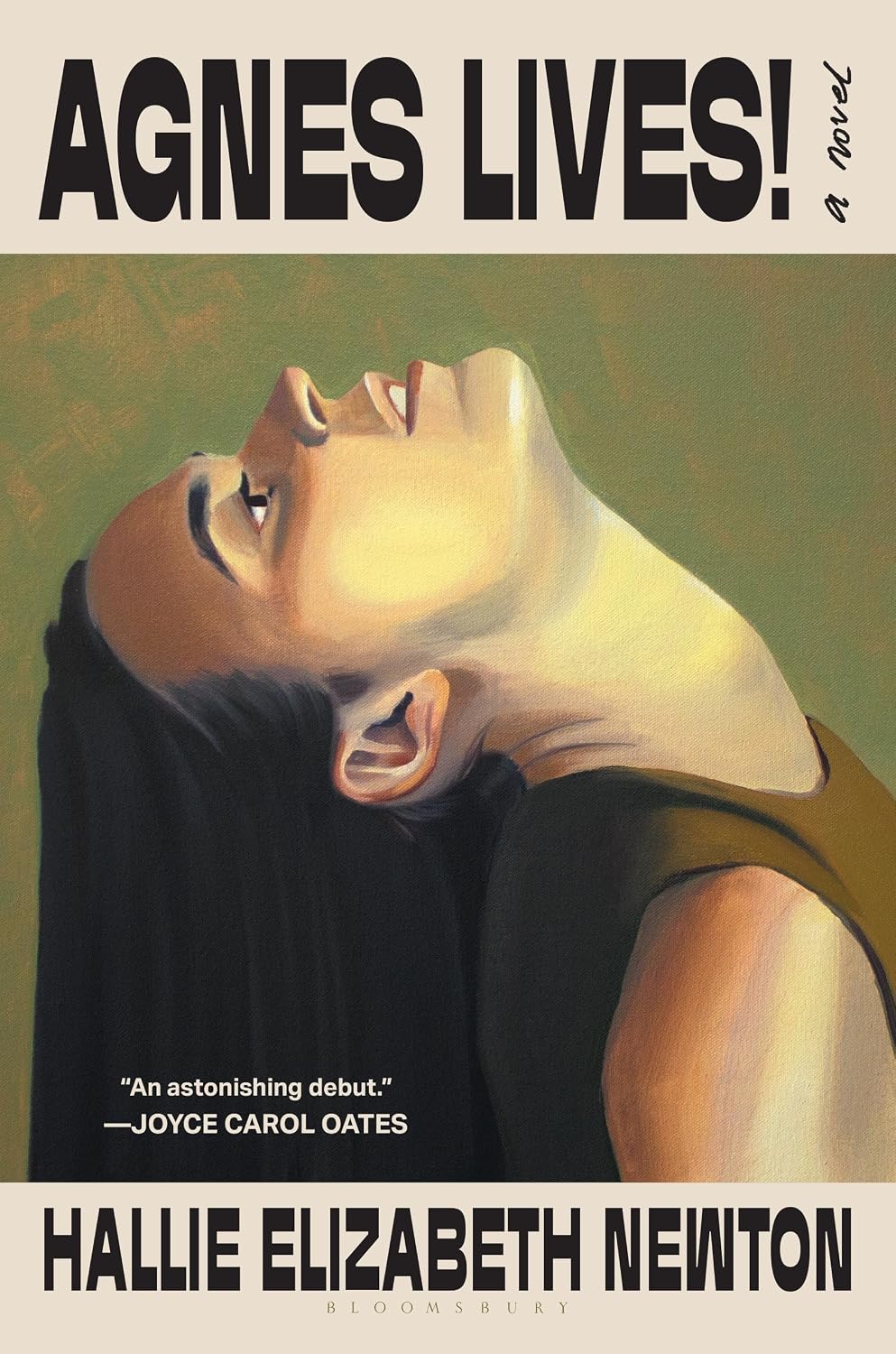
Though at first I wrote it off as an Ottessa Moshfegh dupe, Agnes Lives! surprised me with its innovatively depressing take on the bestial-white-woman trope. I diagnose Agnes as a child of postmodernism and écriture féminine, which explains its resemblance to Moshfegh, Melissa Broder, and other writers obliquely responsible for the making of the streaming hit “Yellow Jackets.” If only Hallie Elizabeth Newton’s debut were feminist in the “women deserve to live” sense rather than in the “women deserve to die” one. But that’s my bias talking.
Agnes Maurer, a Yale graduate whose literary references indicate a more-than-passing interest in her English major, lives in a world written by men. Her father is an aging B-list director who set the scene for her early on; his reputation precedes her. These days, Agnes’ current and former partners represent a variety of creative professions, but Agnes herself is rarely credited as a writer, producer, or even collaborator — not even of her own life. At best, she is a muse; at worst, a consolation prize. Such is the strange privilege of her life: Though her dying wish is to direct the scene of her own death, it is nigh on impossible to find someone who respects Agnes enough to kill her.
Even the police seem hellbent on containing her like an escaped zoo animal rather than neutralizing the real threat she poses. I read the first half of the book groaning out loud, wishing she’d just take matters into her own hands and get it over with. It’s challenging to empathize with or pity a character who, even in a bandage dress reeking of urine, can still sit down to eat in an expensive restaurant. But around halfway through, I got over myself and began to just feel sad.
The thing is: Agnes has a love problem. It would seem that growing up both coddled and objectified is not conducive to healthy adult relationships. Though she is apparently heterosexual, her sole loving relationship was with a man who couldn’t desire her. It’s the relationship I was dying to hear more about — the one thing that makes Agnes legibly human. But her Gay Best Friend is dead when the novel begins, and we’re left wondering if it’s the grief of his loss driving her to the brink or if it was simply the last straw.
I kept thinking of Bret Easton Ellis, whose name Agnes invokes, as a version of her missing other half. Ellis wrote about a killer in the Big Apple; Agnes is looking for someone to kill her there. I want to set her up with Patrick Bateman and see what happens — or at least with the cast of “Girls.” She could use a friend.
Most other claustrophobic novels I’ve read are really about a relationship. The titular heroine of Dorothy Baker’s Cassandra at the Wedding reminds me a little of Agnes, but Cassandra’s interactions with her family serve to frame the reader’s understanding of her. Agnes Lives! is a story told entirely in monologue, often stream-of-consciousness. It’s like squeezing into an itchy costume with her in Times Square and struggling to get a look through its mouth while she describes the world to you. Whatever she sees, it’s dark in there, and she’s not letting you out.
For such a depressing novel, I hoped to get a good cry out of it — but this was no Hit Parade of Tears. I finished Agnes feeling pissed off and a little wounded, as if the story had betrayed me. Its reveals were unsurprising yet somehow utterly draining. I thought about lending my copy to someone it might really shock, but that just seemed shallow. What I wanted from this book was to feel like I was rooting for someone. After finishing it, I don’t know that I’m even rooting for myself.
Maybe what I’m trying to say is that Agnes is a little bit older, strung-out, and lonelier than I anticipated. She has patiently endured male violence, but rather than fight or flee, she bafflingly throws herself at the feet of the patriarchy and demands that it follow through on its implicit threats against her. Rather than seek revenge or vigilante justice, Agnes embraces accelerationism. There is no room for hope in her manifesto.
Madeleine de Visé is an editorial intern at Pangyrus, a literary magazine based in Cambridge. Formerly a bookseller in Baltimore, they now work remotely out of Takoma Park, MD.