Agrippa: A Novel of Ancient Rome’s Descent into Dictatorship
- By Robert Harris
- Doubleday
- 384 pp.
- Reviewed by David O. Stewart
- August 25, 2026
A dynamic figure from antiquity is rendered oddly lifeless.
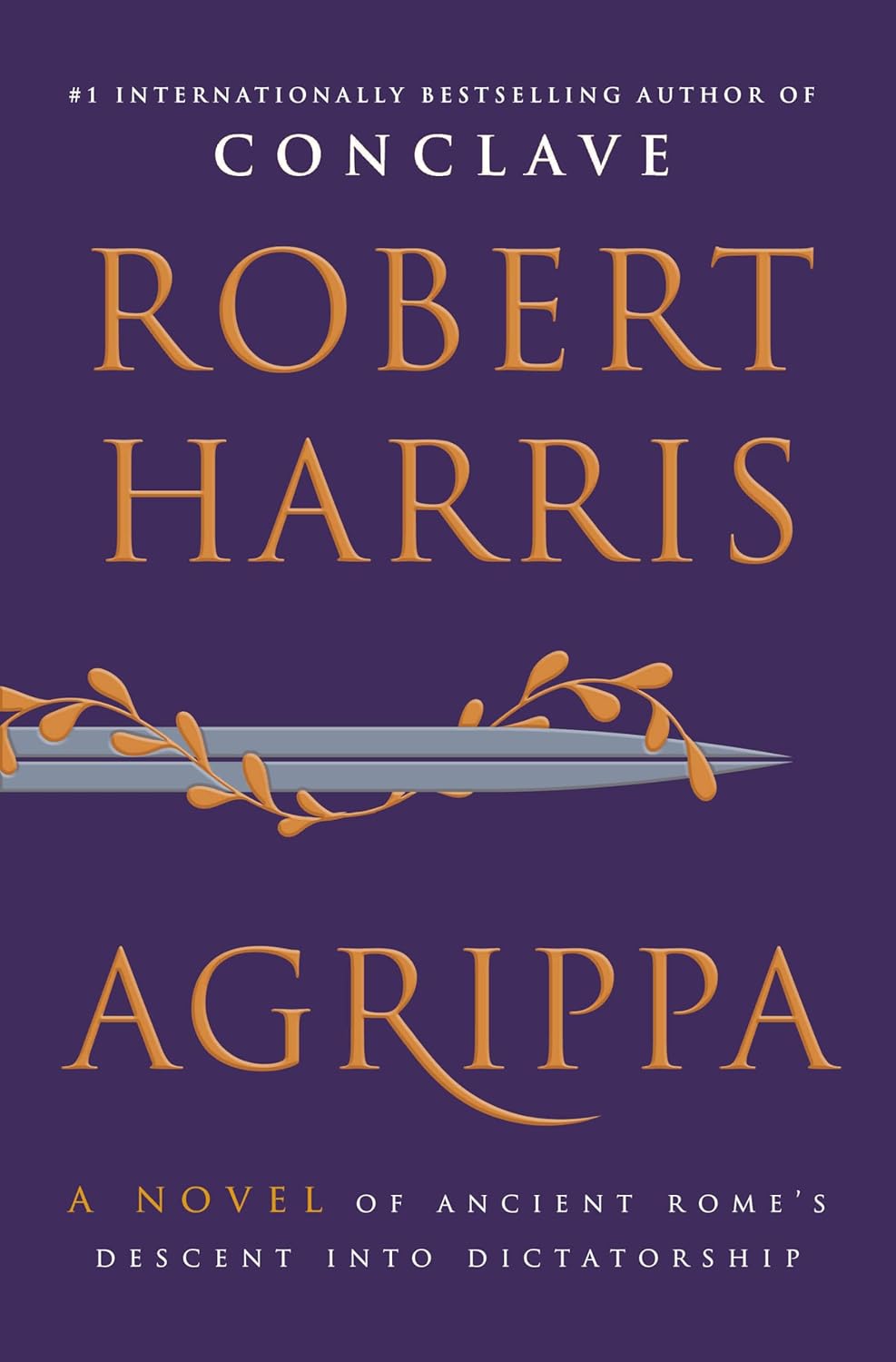
For his 18th historical novel, Britisher Robert Harris returns to Ancient Rome, the scene of his outstanding Cicero trilogy (Imperium, Conspirata, and Dictator). His central character this time is Agrippa, critical ally to the emperor Augustus, military leader, and builder of imperial works.
Agrippa has the strengths of most Harris novels: a strong sense of the story’s time, place, and culture, many historical insights, and sure-footed storytelling. Unfortunately for this reader, however, his protagonist turns out to be a bit dull.
Presented as a man’s man, a grim and deadly fighter, someone who achieves every task he sets out to perform, Agrippa is loyal and true (except to the women he divorces to advance his career). Augustus makes brilliant use of those qualities as he schemes his way to preeminence in the ancient world. In their schoolboy days, Agrippa protects Augustus from bullies, then helps his friend convert a slender connection to the slain dictator of Rome, the great Julius (Caesar, of course), into his own massive career.
On multiple occasions, Augustus betrays his steadfast friend, freezing him out of fame and power so the emperor can have it all. Augustus always wins. For good reasons, Agrippa never takes him on. After all, the devious Augustus was certain to kill anyone who stood in his way. Yet when left alone with the desperately ill Augustus, Harris’ Agrippa does not even consider seizing the opportunity to dispatch the man who has both made his career and thwarted it.
This is an Agrippa with little inner life. He marries women selected for him by Augustus, despising one and cuckolded by another (the emperor’s daughter, no less). The reader waits for emotional rage, vituperation, vengeance. And waits.
But no. Agrippa has battles to win, roads and giant construction projects to build, so he shrugs, takes a deep breath, and sets his shoulder to the wheel of duty. This is the tale of a natural henchman, an instinctive No. 2. Shakespeare wrote two plays featuring Agrippa’s contemporary and rival, Mark Antony, a man who dared greatly, loved dangerously, and ended ignominiously. Agrippa defeated Antony at the Battle of Actium, but it is Antony whose fame endures, who still claims our imaginations.
Indeed, Agrippa’s closest family connection to ultimate Roman power came long after his death, when a grandson became the emperor Caligula, his name ever since a byword for debauchery and evil. Oh, well.
Somewhat vexing is the promise in the book’s subtitle to reveal “Rome’s Descent into Dictatorship.” Perhaps the writer hoped to match the drift of today’s politics by crafting an instructive saga of how autocracy supplants popular governments. Perhaps he meant for us to see the emptiness of Agrippa’s public life as a harbinger of where we are headed.
But the narrative forgets that goal and instead wants us to admire Agrippa. No one, least of all Agrippa, mourns the loss of republican ways. Augustus, like Julius and Pompey and Crassus and Brutus before him, wants power. Roman politics are bloody and vicious at the book’s start and stay that way to the end.
There are, as in all Harris novels, lovely touches. Traveling through an area ravaged by war, Agrippa observes, “War, which I had once so relished, was gouged into the countryside like an open wound.” Agrippa compares a person writing a memoir — the ostensible structure for the novel is that Agrippa is writing his — to someone “telling stories aloud to himself in an empty room.” Sadly, though, one begins to wish he would hurry up with it.
Consider instead checking out Harris’ aforementioned Cicero trilogy, his Act of Oblivion (a fascinating chapter of American history that you don’t know), Munich (Nazism brought to chilling life), or Conclave (the bare-knuckled politics of choosing a pope).
David O. Stewart’s most recent book is The Democracy We Must Keep: Seven Founders, Nine Documents, and the Ideas that Shaped America. His historical novels include the “Deception” series, beginning with The Lincoln Deception.