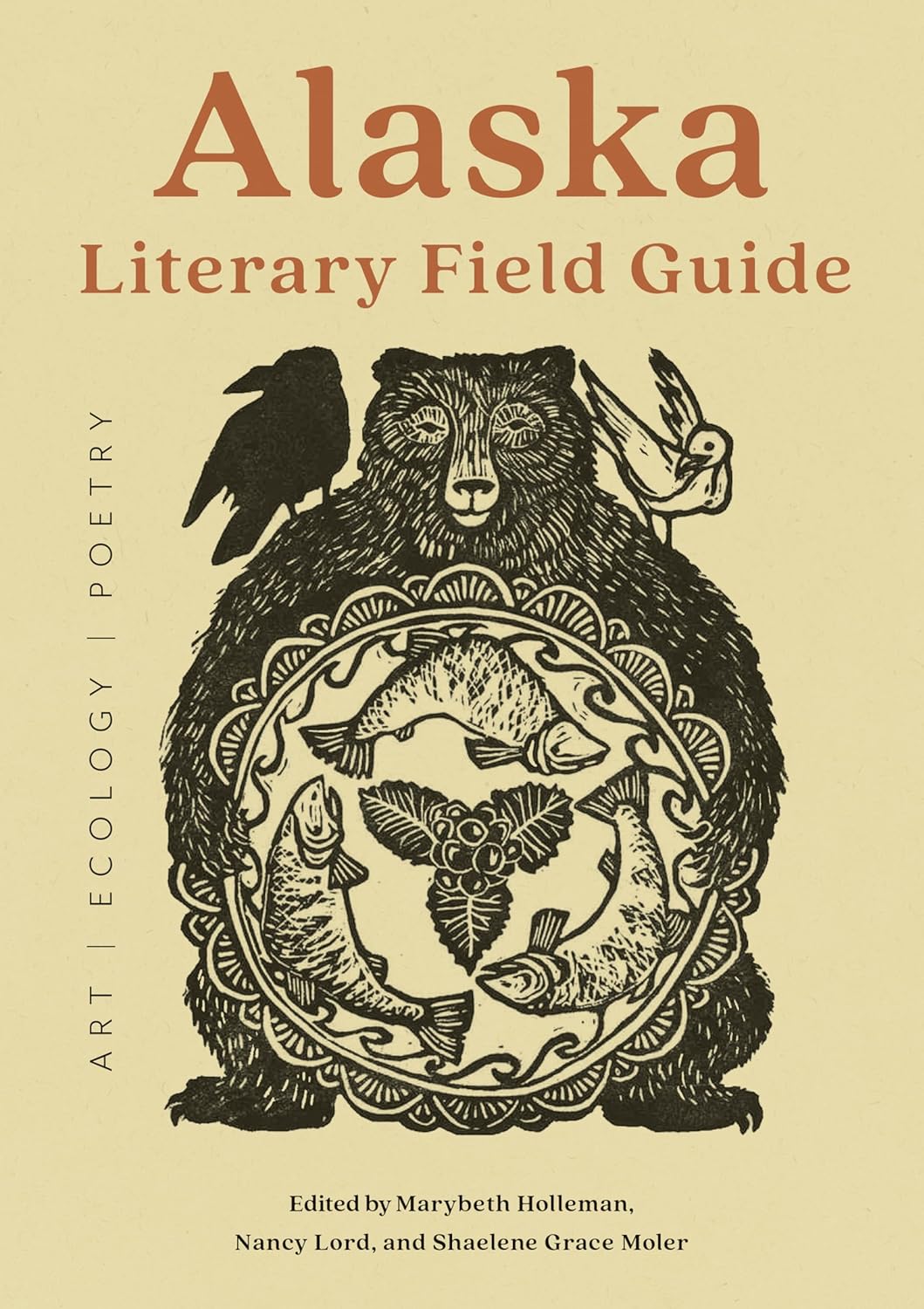
Alaska Literary Field Guide: Art, Ecology, Poetry
- Edited by Marybeth Holleman, Nancy Lord, and Shaelene Grace Moler
- Skipstone
- 336 pp.
- Reviewed by Tara Campbell
- April 8, 2026
A book as vibrant and varied as the land it portrays.
Imagine a creature that can survive in a treeless landscape with only four inches of precipitation per year. Its nasal passages form spirals inside its skull, managing the flow of temperature and moisture in and out. Its young mature quickly, able to walk over 10 miles within a couple days of birth, and both its males and females grow horns. These creatures have hooves that can splay, spreading like snowshoes for stability, and hoof pads that morph according to the season: spongier in summer for traction, furrier in winter for warmth.
Over time, the edges of their hooves grow sharper and curved, allowing for greater grip on ice, better digging in snow for food, and (get this!) faster swimming than any human. These animals have dual coats; the hairs of the outer coat are hollow tubes filled with honeycomb-shaped pockets of air. And their eyes! They change color, turning gold in summer to reflect more light outward (like built-in sunglasses) and blue in winter to allow more light in for better vision in the dark.
This is no alien transplant to Earth: It’s caribou. And it’s just one of the fascinating entries in the Alaska Literary Field Guide. Like the other such guides that inspired it (the book’s introduction credits the Cascadia Field Guide, The Sonoran Desert: A Literary Field Guide, and A Literary Field Guide to Southern Appalachia), this one combines art, ecology, and poetry, giving equal weight to all three.
Editors Marybeth Holleman, Nancy Lord, and Shaelene Grace Moler break my home state into six ecoregions: Marine Waters; Intertidal & Coastal Shores; Temperate Rainforest & Coastal Mountains; Boreal Forest; Rivers, Lakes & Wetlands; and Tundra. Because these regions don’t have absolute borders — and can, indeed, overlap — they aren’t marked on the maps at the front of the book, which might cause consternation for readers trying to envision precise locations. This work, however, adopts a more holistic approach to the idea of place, inviting us to dive into the areas’ sounds, smells, and sensations rather than their specific locales.
Each region is represented through a description, an image, and a poem. Then, within each ecoregion, a selection of animals, plants, and landforms is similarly highlighted. In addition to the expected flora and fauna (e.g., fireweed, Sitka spruce, moose, Beluga whales, etc.), I was interested to see the extent to which landforms are treated as “beings” within a given ecoregion. In the Intertidal & Coastal Shores ecoregion, a section on “Tideline” follows “Bald Eagle.” “Volcano” is acknowledged on the same level as “Brown Bear” and “Devil’s Club.” “Aurora Borealis” is tucked into the Boreal Forest section between “Gray Wolf” and “Ermine.” Even “Sastrugi,” patterned ridges and crests that the wind drives into hard-packed snow, are portrayed as beings. This treating of land, plants, and animals as coequal parts of nature (and coequal to humans) is consistent with the approach the editors describe as “influenced by and respectful of Indigenous worldviews…[t]o consider that everything has agency and spirit, has an inalienable right to exist and deserves respect.”
Although I was born and raised in Alaska, I found myself continually discovering new things about animals, regions, or even whole species and land formations I’d never heard of. I’ve probably walked past chaga a million times without realizing it. And if not for this book, I’d never have been aware of pingo or pushki or the fact that “although Alaska makes up only 17 percent of the total area of the United States, it accounts for one-third of the country’s surface freshwater.”
The most immediately striking feature of the guide is its full-color format, showing the artwork off to its greatest advantage. The imagery accompanying each entry is vibrant and precise in depicting the state’s diverse regions and lifeforms (except for a tiny blip in which a halibut is rendered with its eyes on the left instead of the right). The work of 20 different artists has been curated for an overall effect of warmth and fullness. The visuals alone are worth the price of the book.
The poetry is just as varied and includes haiku, visual poetry, and prose poetry. Some of it is primarily descriptive in nature, which can seem a bit repetitive after the ecological write-up of the entity it’s covering. But in many instances, the poetry acts as an expansion on the theme, capturing the awe of experiencing an animal or phenomenon and giving a glimpse into people’s relationship with nature. One such offering is “Magpie at Twilight” by Tom Sexton:
I watch a magpie walking back and forth
in a puddle that will be frozen by morning.
It pauses to adjust its long iridescent tail.
Three ravens are watching from a cable wire.
They seem to know when it’s best to keep quiet.
The magpie turns its head for a better look
at me, beakless, shivering in my down jacket.
“Noah sent me out with the dove,” it chatters
before it turns away, falls silent for a moment.
The ravens tilt their heads, chortle in disbelief.
I love how the human is the outsider here, lacking a beak and ill-prepared for the cold in his borrowed feathers. Poems like this one go beyond restating facts about a topic; they harness moments of encountering other beings and processing one’s own position in the natural world.
Reading the Cascadia Field Guide a couple years ago, I was struck by the often whimsical nature of the narrative, clearly written for the layperson. The Alaska guide’s narratives are more matter-of-fact, geared more toward sharing information about the environments than marveling at the wonder of them. There’s a steady drumbeat of ecological peril throughout the book, too, noting how human impacts like climate change, pollution, habitat loss, and overfishing/hunting have harmed animals and ecosystems. And every so often, technical terms like “colonial bryozoans,” “cryoconite,” “phytoplankton productivity,” and “deglaciated” pop up, interrupting the literary flow.
Another comparison I couldn’t help but make between the two books: As in the Cascadia guide, the Alaska guide’s editors announce their intention to use the word “being” instead of “species” and to capitalize the names of those beings (Bear instead of bear, for example). The Cascadia guide, though, is more consistent in the practice than the Alaska one, which slips often into the use of “species” and capitalizes names but still uses the plural.
It’s a small difference, but to my ear, Gray Wolf is a character — a being — whereas Gray Wolves are animals. My impression might be due to my exposure in childhood to Indigenous stories about Raven, Beaver, Bear, etc., and this may have been the very reason the editors decided not to use that approach. Their introduction makes clear that they didn’t want to encroach on Indigenous storytelling traditions.
It’s a tall order to encapsulate a state as large as Alaska in one book. The Alaska Literary Field Guide is as capacious as the land it describes, bringing together artistic, ecological, Indigenous, and literary ways of understanding the state’s vast and varied environments. It’s a captivating and worthwhile read.
Tara Campbell is a writer, teacher, Kimbilio Fellow, and fiction co-editor at Barrelhouse Magazine. She teaches flash fiction and speculative fiction and is the author of two novels — including, most recently, City of Dancing Gargoyles — two hybrid collections of poetry and prose, and two short-story collections.
.png)