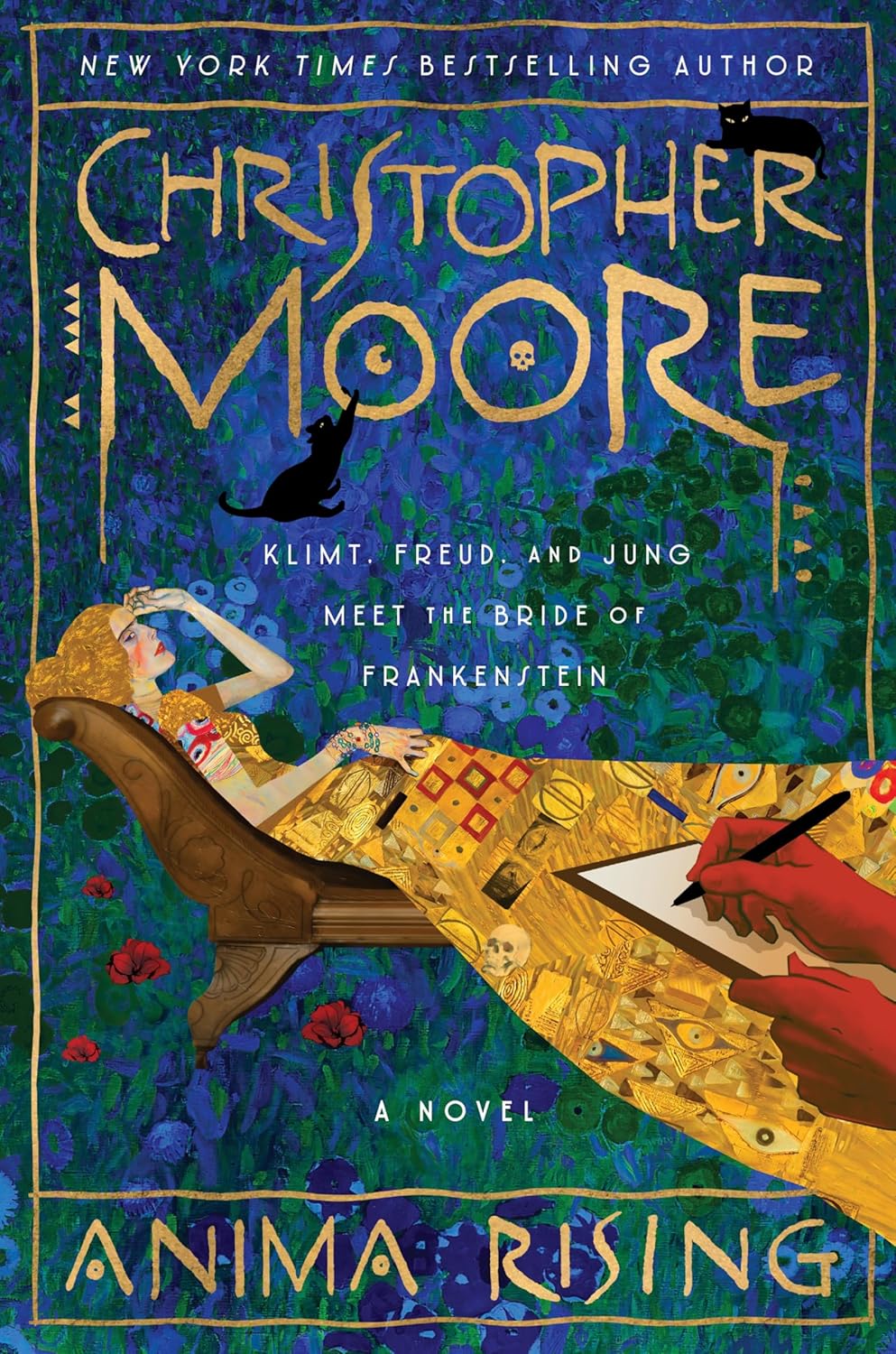
Anima Rising: A Novel
- By Christopher Moore
- William Morrow
- 400 pp.
- Reviewed by Drew Gallagher
- June 10, 2025
Gustav Klimt, Sigmund Freud, and the Bride of Frankenstein walk into a bar…
There’s been much hand-wringing lately about the value of the humanities. Some within the government are even attempting to override individual schools’ curriculum decisions because they see no need for arts-based education. (This is laughable when you consider that our current secretary of education hails from the realm of pure theater — the World Wrestling Federation.)
Author Christopher Moore has consistently provided readers with entertaining novels to dice up such assaults against the arts, and his outstanding Anima Rising is another example of why we need both the humanities and the humanity of Moore.
In this latest romp, his 19th, he takes us to pre-World War I Vienna — arguably the epicenter of artistic brilliance at the time — and then proceeds to take dozens of creative liberties with history. At the story’s opening, Gustav Klimt is making his way home after a night of carousing when he happens upon a dead, nude woman floating in the Danube Canal. Klimt, who built his reputation by painting naked women (most of them alive), is fascinated by the pale creature and pulls her to shore. Not wanting to draw attention to his late-night wandering or involvement with the body, Klimt decides not to call the police. When he detects a faint pulse in the clearly-not-a-corpse corpse, hilarity ensues.
One hallmark of a Christopher Moore novel is that you quickly know when you’re inside one. Shakespearean plays are recast with squirrels or serpents; Dashiell Hammett’s Chinatown is rendered limp by erectile dysfunction. Boundaries aren’t so much blurred as bludgeoned. So don’t suspend disbelief; tie it up and gag it. (In Anima Rising, the amusement starts before page one with a trigger warning: Do not listen to the audio version with the kids in the car unless you hope to lose custody one day.)
Okay, back to Austria. Klimt’s efforts to conceal the revived “Judith” — who, it turns out, was murdered decades earlier to become the Bride of Frankenstein — from the menagerie of models he paints during the day is unsuccessful, which makes sense given that she’s accompanied by a large dog named Geoff who occasionally turns into an even larger wolf. Still, the models take a liking to Judith and inform her that she’ll probably have to have sex with Klimt like they do. (Spoiler alert: He doesn’t sleep with her, but it’s out of fear of Geoff, not out of valor.)
Also kicking around Vienna is Sigmund Freud, whom Klimt knows in passing. In an attempt to help Judith remember who she might’ve once been, Klimt sends her to the famed psychoanalyst, who believes her inability to remember the past is tied to wanting to have sex with her father when she was a child. (Everything’s Oedipal with this guy, isn’t it?) Judith, however, thinks her amnesia is more likely related to the fact that she’s died and been reborn four times. She tells Freud what little she can about her past, including memories of a man who treated her well:
“I think he was kind. He gave me soup.”
“I see.” Freud wrote in his notebook. She could hear the scratch of his pen.
“It wasn’t penis soup, if that’s what you’re thinking.”
“Why would you think I was thinking that?”
“Because you think everything relates to the penis.”
“That is not true, Fraulein — er, Judith. We must see if you can remember your surname.”
“You’re thinking of penises right now, aren’t you?”
Freud, getting nowhere, sends her to his pal Karl Jung to have a look. (Freud and Jung did have a very public falling-out in real life, but it had nothing to do with Mary Shelley’s fictive betrothed. Or so the mainstream media would have you believe.) The remainder of Anima Rising follows Judith as she sorts out her past, searches for her true identity, and tries to figure out who’s secretly following her. There are elements of intrigue, yes, but mostly there are elements of comedic genius. In the face of the animus rising in our own world, silly stories lighten the mood. Like we’ll always need the humanities, we’ll always need Christopher Moore.
Drew Gallagher is a freelance writer in Fredericksburg, Virginia. He is the second-most-prolific book reviewer and first video book reviewer in the 140-year history of the Free Lance-Star newspaper. He writes a weekly humor column for the FXBG Advance that you can pay for (or you can just click a tab that lets you read it for free, which is what his friends and family do).