Authority: Essays
- By Andrea Long Chu
- Farrar, Straus and Giroux
- 288 pp.
- Reviewed by Nick Havey
- June 2, 2025
An extraordinary treatise on what it means to be critical.
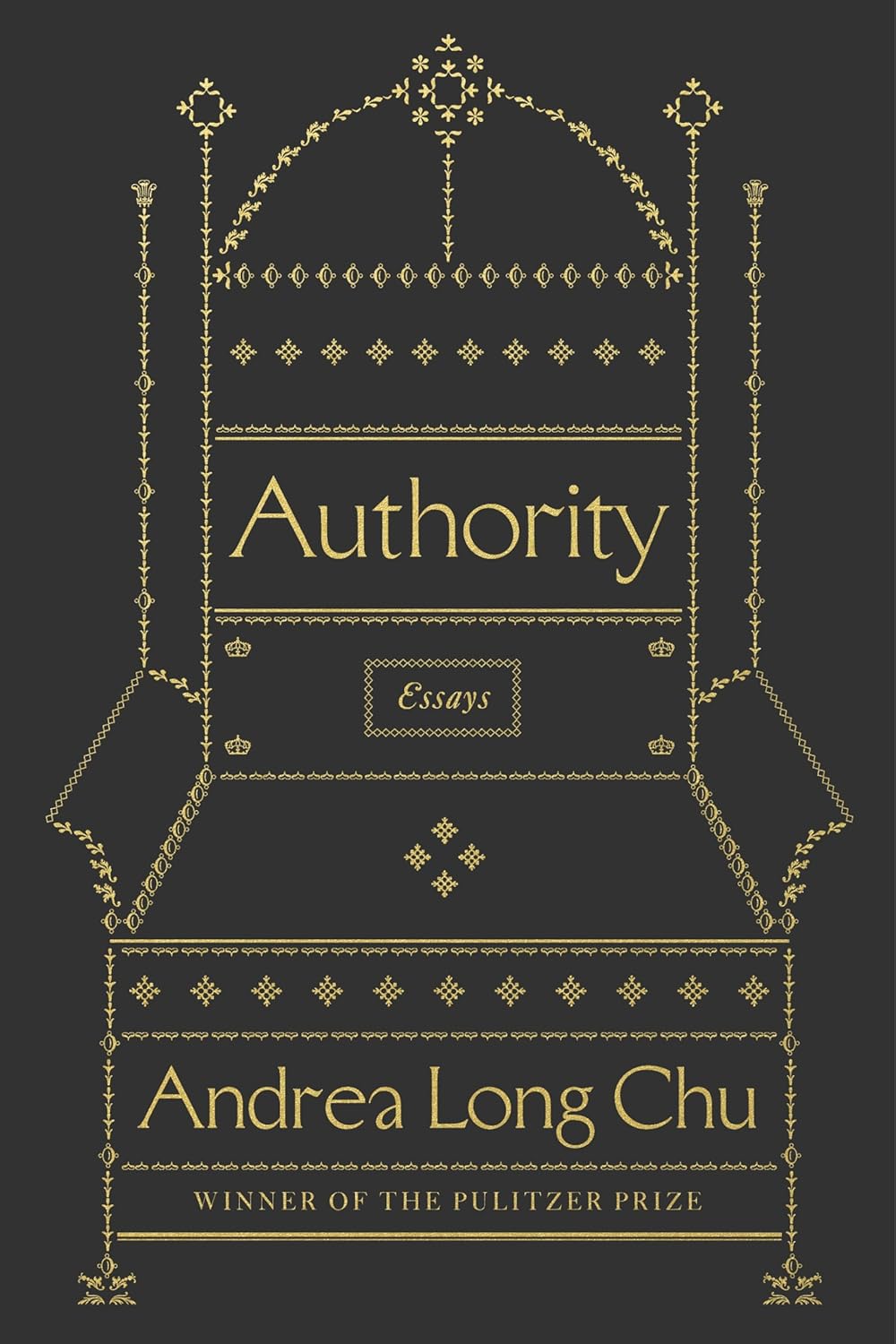
I don’t hate many books, but I do hate Hanya Yanagihara’s novel A Little Life. Thankfully, so does Pulitzer Prize-winning critic Andrea Long Chu. Mutual disgust for something is an incredible way to connect, and her 2022 New York Magazine essay eviscerating Yanagihara’s indulgent, absurdist queer saga endeared me to her when it was first published and again as I plowed my way through her new collection of essays on criticism and culture, Authority.
Ironically, I generally also loathe books of essays — often, they’re a lame excuse for an assemblage of unrelated previous writings to be sold under the thinnest of unifying themes — but Chu’s Authority is anything but lame or ununified. It’s a masterwork in criticism and an ode to the form itself.
At its core, Authority considers the oft-posed possibility that the field of criticism is, and has always been, in crisis, and that “authority” itself is a mutable, moving target. It is, therefore, logistically challenging to be a critic today because capitalism, the expansiveness of the modern cultural sphere, and the endangered nature of criticism as a profession make it nigh impossible to engage critically (or with any real authority) on any topic.
Chu makes this argument using some of the best examples of modern criticism: her own writing. Her essay about A Little Life is so intellectually detailed — not only considering the novel but also Yanagihara’s other work, which contextualizes the book and paints a concerning picture of the author’s perspective — that it ends up offering the reader more to think about than the relatively empty tome (which clearly considers itself weighty and poignant) did.
Chu’s genre analysis of the Showtime hit “Yellowjackets” invokes chemistry to discuss and critique the genre-bending that drives the show’s narrative engine. Her essay about Andrew Lloyd Webber is deliciously vicious and funny while also being so fact-packed that you’d think she was under contract to write his biography. Her observations are so consistently excellent that they inspire you to form opinions about content you haven’t even consumed (hello, “Yellowstone”) and to reconsider some that you have (for me, it may be the works of Ottessa Moshfegh, an author as insufferably self-important as Bret Easton Ellis).
The collection’s titular piece both rebukes authority as a concept and cements Chu’s status as an inimitable thinker and critic. (Authority, after all, is meaningless unless and until it’s demonstrated.) The book is a call to arms, one that Chu herself has wisely taken up given her strengths. She deserves an honorary doctorate in philosophy for carefully, concisely, and thoroughly describing the ontological — and, at times, hagiological — lineage of authority.
This is a book that made me want to be a better critic and writer, and one that reminded me exactly why it is I seek out Chu’s writing wherever it’s published. “Why shouldn’t a book review be personal?” she asks in one of her essays. “It is my understanding that persons are where books come from.”
If she’s the one doing the reviewing, I’m there.
Nick Havey is director of Institutional Research at the American Association of Colleges of Nursing, a thriller and mystery writer, and a lover of all fiction. His work has appeared in the Compulsive Reader, Lambda Literary, and a number of peer-reviewed journals.
.png)