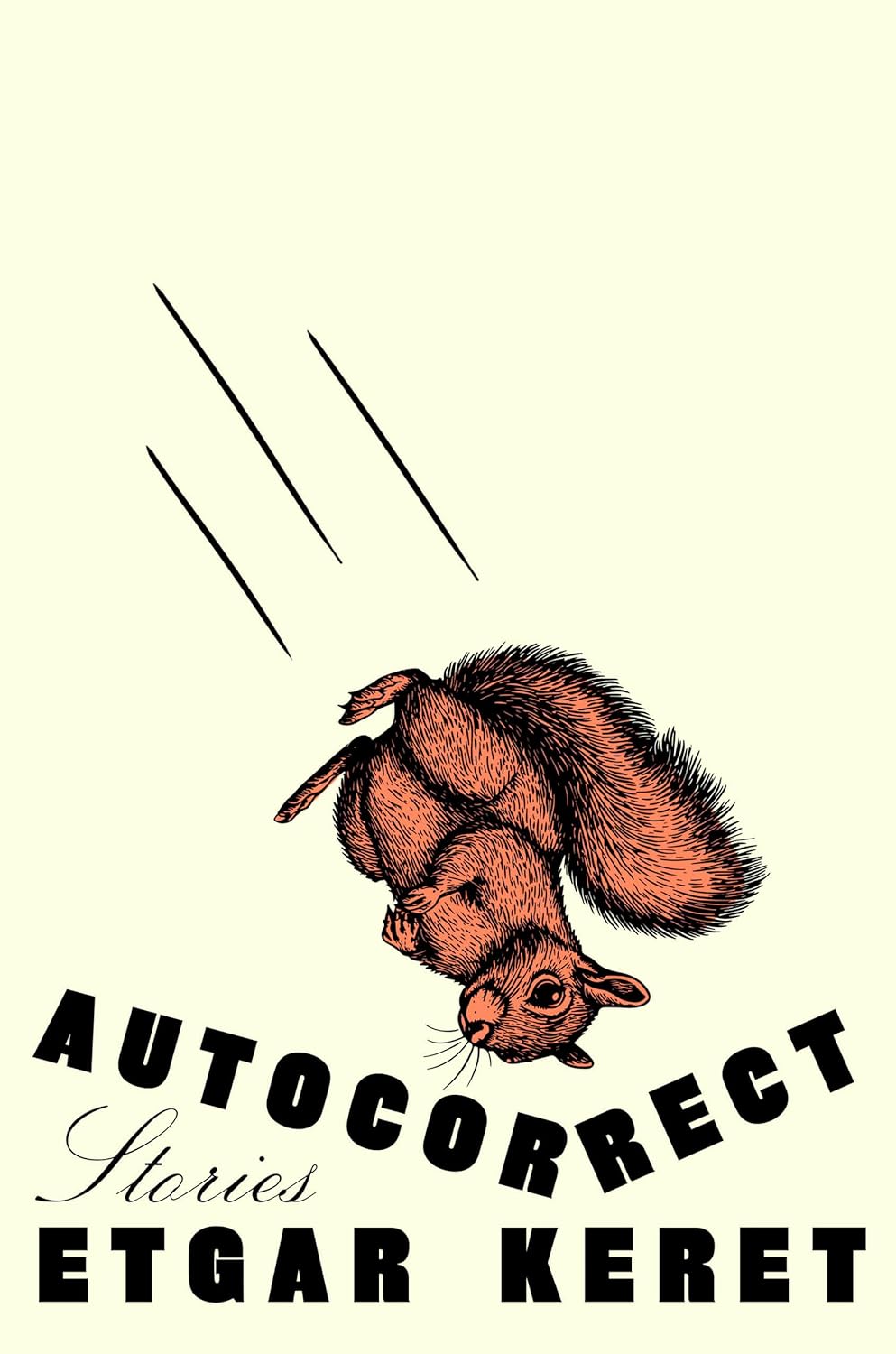
Autocorrect: Stories
- By Etgar Keret; translated by Jessica Cohen and Sondra Silverston
- Riverhead Books
- 208 pp.
- Reviewed by Karl Straub
- August 26, 2025
These fantastical tales reveal poignant everyday truths.
When you find yourself in the thrall of short-story writer Etgar Keret’s fiendishly addictive work, the condition will likely last for some time before you stop to wonder not so much how he does it, but what, exactly, it is that he’s doing.
In his latest collection, Autocorrect, Keret has generated 33 more in his seemingly endless flow of short tales, all of them easy to read but tough to pigeonhole. Page-turning entertainment doesn’t usually wrestle with such thorny metaphysical questions or pack in as much mystery as these stories do.
Keret populates his narratives with characters tripped up by their own bad calls or simply buffeted by an indifferent fate. Some stumble backward into good fortune after a series of tragedies and mishaps; others just get the tragedies and mishaps — no good fortune for them.
And, sometimes, it’s hard to tell who the villains are.
Keret’s work resists any attempt to glibly summarize his style or intentions, and the reader searching for clarity of purpose is apt to find Keret’s terrain slippery indeed. You’ll hear echoes of Ray Bradbury and Richard Matheson and their moral fabulism in many of these offerings, but you’re just as liable to find moments that remind you of Isaac Bashevis Singer and Bernard Malamud.
It may help to consider that Keret is an admirer of Kafka, Vonnegut, and Donald Barthelme. Like those luminaries, he blurs the line between the absurd and the appalling and relies (but only when necessary) on tight editing to sustain the illusion of comic or tragic improvisation.
No storyteller ambles less dramatically than Keret into bleak territory, but it’s also true that no storyteller is better equipped than the Israeli writer to slip a joke in where you didn’t think there was room. Comic writing springs up in his direst scrubland. Significantly, Keret is a fan of the Coen brothers, especially their gangster picture “Miller’s Crossing,” a film where the jokes are so carefully hidden that many viewers have pronounced it a grim misfire.
In Keret’s story “The Future Is Not What It Used to Be,” the quips aren’t quite so obscured:
“Because who are Alexander the Great, Joan of Arc, Leonardo da Vinci, Ludwig Wittgenstein, and Steve Jobs, if not a bunch of fatsos from the future who managed to prove, time after time, that it’s much easier to change the world than to cut out sugar and carbs?”
Tone, Keret has said, is more important to him than plot and character. He sees tone not so much as a thing that makes plot and character obsolete but rather as something that helps him find out who the characters are and helps him develop the plot. In “Eating Olives at the End of the World,” the tone is sardonic:
“The world is about to end and I’m eating olives. The original plan was pizza, but when I walked into the grocery store and saw all the empty shelves, I realized I could forget about pizza dough and tomato sauce. I tried talking to the cashier at the express line, an older lady who was Skyping with someone in Spanish on her cell phone, but she answered me without even glancing up. She looked devastated. ‘They bought everything,’ she murmured, ‘all that’s left is menstrual pads and pickles.’”
Keret’s premises often appear to typecast a story as science fiction or fantasy, but you won’t find any spaceships or elves in his fiction. Instead, he uses genre to find offbeat plot ideas that help him get at something about humans that’s been bugging him. And when something is bugging him, he takes refuge in irony, in tragedy observed from an odd angle, and in characters and situations that can veer organically from charming to grotesque. Each story’s tone is carefully calibrated to get at the emotional richness underneath the surface. Take this scene from “Genesis, Chapter 0”:
“It’s frustrating to not be able to take her for a walk in the park every week, frustrating to try and make her laugh over Zoom, frustrating to sit on a plane for fourteen hours just to tease her with one ‘Cuckoo!’ before Georgina says it’s late and the girl is tired, and then taking an UberX back to the hotel with a driver who smells like garlic.”
The author calls his work “subjective realism,” by which he means he’s concerned with the emotional reality of his material rather than with the reality of our physical world. Roughly half the pieces in Autocorrect depend on the breaking of the laws of time, physics, and so forth, but Keret never bends the most solemn law: No matter how outré or outlandish the events in his stories, his empathy for his characters always runs deep.
Karl Straub is a writer and music educator. He writes about music, books, film, television, and sociology at karlstraub.substack.com.