Being Thomas Jefferson: An Intimate History
- By Andrew Burstein
- Bloomsbury Publishing
- 480 pp.
- Reviewed by Peter Cozzens
- January 12, 2026
This worthy volume adds to our understanding of the enigmatic Founder.
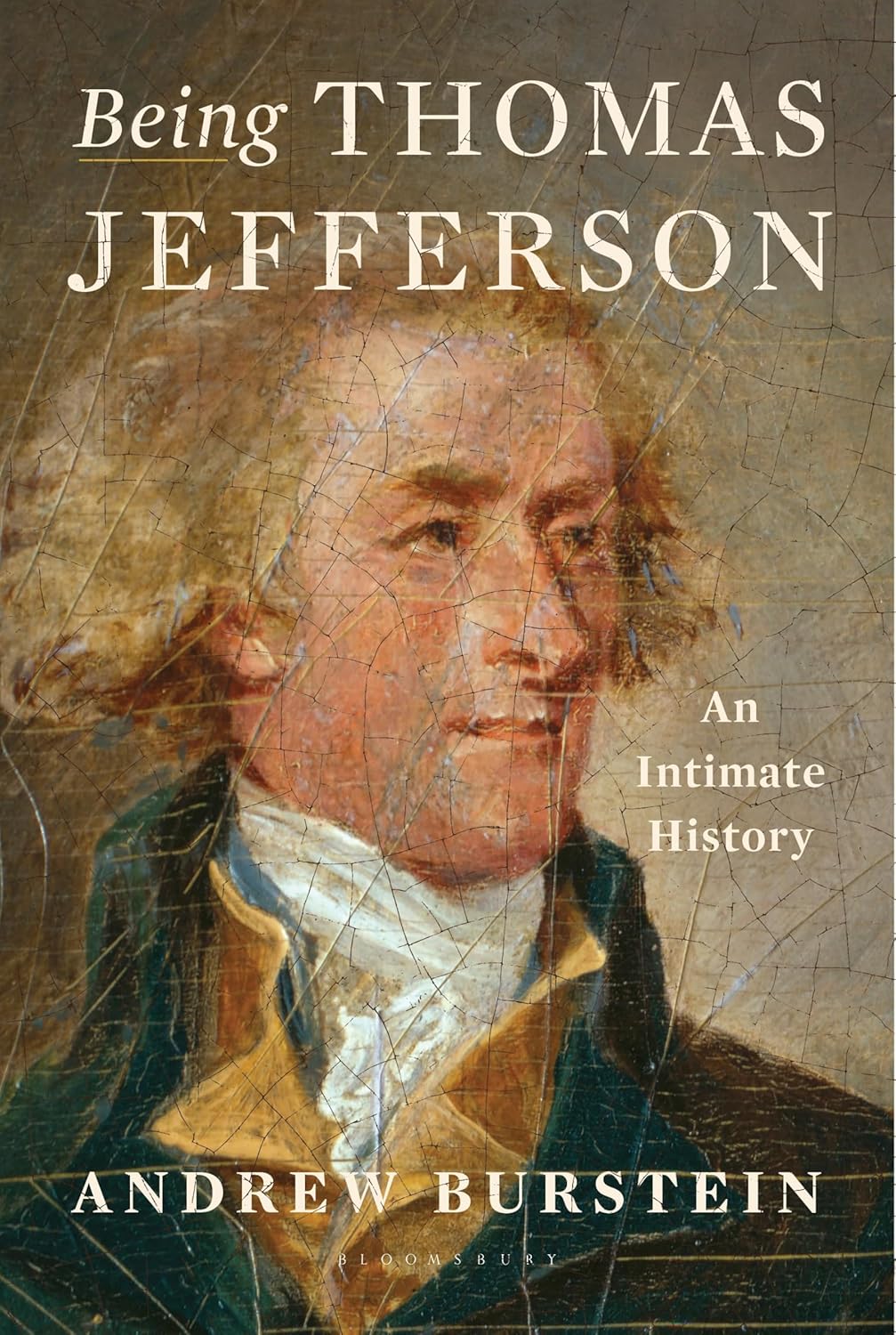
Thomas Jefferson was a complicated man. His towering achievements — author of the Declaration of Independence, first secretary of state, third president, and founder of the University of Virginia — are widely known. He has been both venerated as the intellectual author of the American Revolution and vilified as a slaveholder who carried on a long-term affair with the enslaved half-sister of his late wife. His inner life, however, has eluded biographers, who have variously referred to him as “impenetrable” and “the hardest to sound to the depths of being.”
In Being Thomas Jefferson: An Intimate History, the distinguished historian of early American politics and culture Andrew Burstein untangles the public from the private man, and in so doing presents a riveting, deeply human study certain to engage the emotions of the reader.
Burstein’s work is balanced; his three decades of study of Jefferson have not blinded him to the Virginian’s shortcomings or to the profound contradictions in his character. Indeed, it is his interpretation of these contradictions that makes Being Thomas Jefferson a uniquely valuable contribution to the literature on our third president. Jefferson emerges as a bookish introvert with an inescapable desire for public office, outwardly restrained but intent on controlling his environment, a consummate rationalizer unable to acknowledge his errors, capable of deep and abiding affection as well as bitter and lasting hatreds. He possessed a burning need to shape his legacy.
Burstein’s penetrating insights are grounded in the historical record, not speculation or “psychobabble.” In Jefferson’s case, the source material is prodigious. He wrote some 18,000 pieces of correspondence and kept a 656-page record of every letter he sent or received. Burstein makes this the framework of the book. Jefferson lived in “an age of typography,” he writes, in which many of the personal letters of eminent men were meant to convey their deepest convictions, which propriety dictated be held in check publicly.
As Burstein explains, “A polished, discriminating style was valued as a manifestation of one’s identity, a way of sharing while adroitly establishing public credentials…Jefferson was famously artful in this manner…[and] extraordinarily adept at communicating emotion on the page.” Nevertheless, “his words require considerable decoding.” It is the author’s ability to convincingly interpret Jefferson’s writings and those of his contemporaries that gives Being Thomas Jefferson its authoritative voice for understanding the inner man, his contradictions, and his motivations.
Burstein also illuminates individuals who had a marked influence on Jefferson but who have been undervalued or passed largely unnoticed. Foremost among these was the Marquis de Condorcet, with whom Jefferson forged a critical friendship during his five years as minister to France. A student of Voltaire, Condorcet was a progressive voice in monarchical France who embraced Enlightenment rationalism. Their friendship represented a true meeting of minds. Both were committed to constitutional law and the cause of human dignity. They were, Burstein observes, “idealists in a time of strife.” Both were optimistic about the future of humanity and society. Jefferson adopted much of Condorcet’s thinking at a transformative moment in his political career. He would take their shared Enlightenment values with him into President George Washington’s cabinet.
Where Condorcet and Jefferson differed was in their views on women’s rights and slavery. Condorcet championed the participation of women in political life. Jefferson came to respect many of the accomplished women he knew, especially in France, but he opposed any role for them in politics. Condorcet also believed that Blacks could be assimilated into the mainstream of a republican society without any loss to Anglo-American values. Jefferson most decidedly did not. While he wrote eloquently about the moral wrongs of slavery, Jefferson personally benefited from the institution and, as president, was instrumental in entrenching it in American society.
Any discussion of Jefferson and slavery must consider his relationship with his teenaged slave Sally Hemings, his late wife’s half-sister. Because Jefferson never wrote of her, Burstein is unable to provide any significant insights into what attracted Jefferson to the girl. But he was an ardent pursuer of beauty, so Burstein suggests she was beautiful. He assumes Jefferson felt tenderness toward Hemings but no inclination to elevate her from her subordinate position in the Monticello orbit. Burstein posits that the loss of his wife so devastated Jefferson that he was unwilling to expose himself again to such pain. Rather than remarry, as was customary in Southern society, he took a concubine with whom he could maintain a sexually active life without deep emotional involvement. Burstein summarizes the relationship in the context of Jefferson’s nature thusly:
“I am suggesting that we should reckon with the ‘Saly Hemings story’ as we do with evidence of Jefferson’s personal anxieties as these emerge in all he wrote over the years. He rationalized almost effortlessly. On the basis of his extensive reading and thinking, he was convinced that he knew what was best. He felt morally secure. He doled out advice. He willfully shaped his legacy (or at least tried to), and he managed his little mountain [Monticello] as he saw fit.”
In Jefferson’s feud with Alexander Hamilton over the future of the federal government, which Burstein explores in depth, he delves into the darker side of Jefferson’s psyche. Toward this political rival who orchestrated his removal from the Washington administration, Jefferson felt the deepest “contempt and disgust.” He was unable to recognize any good in an enemy, whom he could only traduce, and against whom he maintained smoldering revulsion. In the political arena, Hamilton “didn’t just frustrate Jefferson. He was the better Machiavellian.”
Being Thomas Jefferson is not a comprehensive biography, nor does it strive to be. Rather, Burstein employs the key events of Jefferson’s life to probe the inner man to a degree no other biographer has attempted, and he succeeds brilliantly. This groundbreaking work should be considered critical reading as we celebrate the 250th anniversary of Jefferson’s greatest achievement, the Declaration of Independence.
[Editor’s note: Peter Cozzens will appear at the Gaithersburg Book Festival in Gaithersburg, MD, on Saturday, May 16th. Learn more here.]
Peter Cozzens is the award-winning author of multiple works of U.S. history, including, most recently, Deadwood: Gold, Guns, and Greed in the American West.