Black Bag: A Novel
- By Luke Kennard
- Zando
- 352 pp.
- Reviewed by Chris Rutledge
- May 12, 2026
Why’s that dude in a sack?
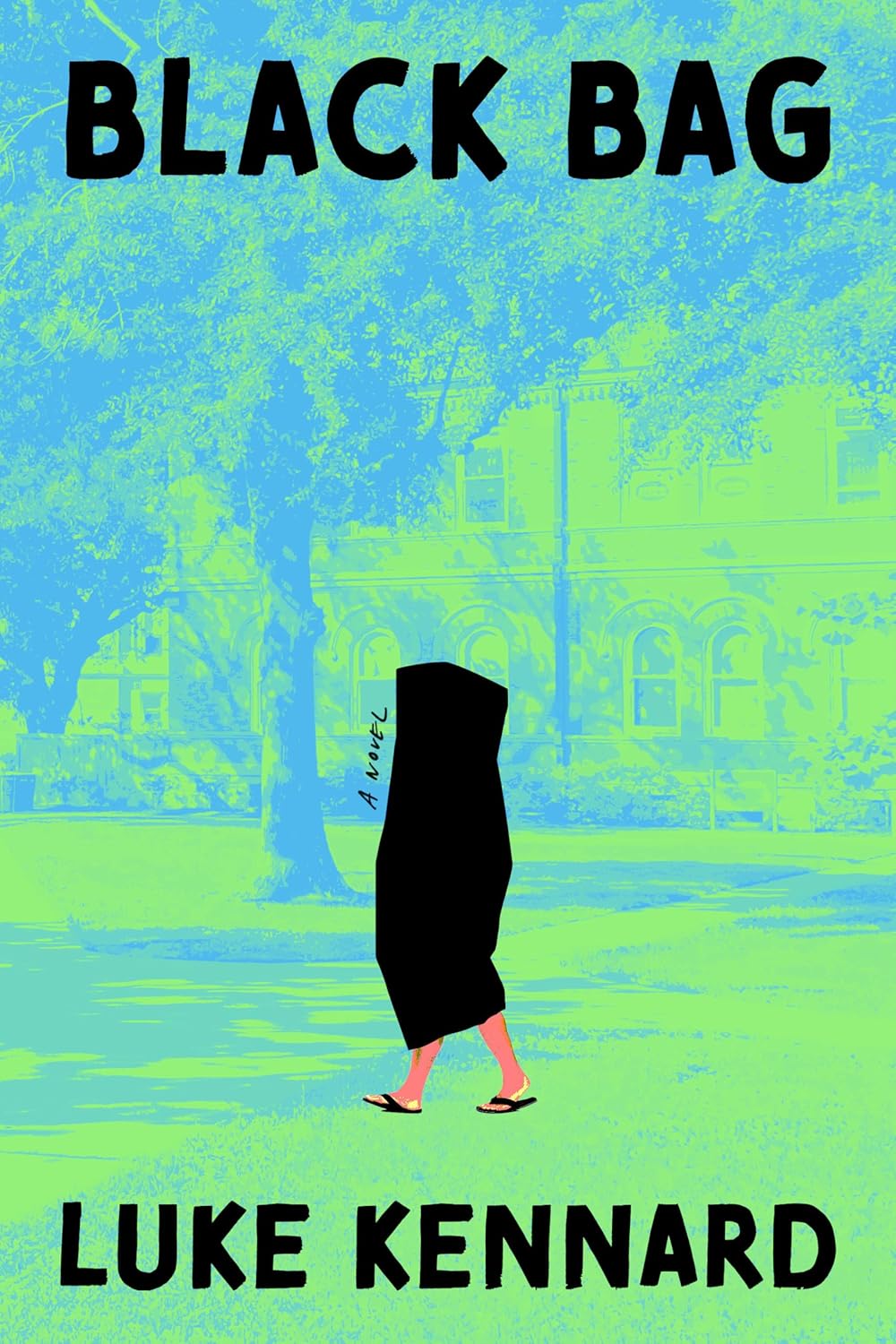
Black Bag establishes itself early on as a unique work. The multilayered satire is a campus novel for the postmodern age, and in author Luke Kennard’s deft hands, the subject matter is handled effectively.
The story is narrated by a 37-year-old, out-of-work London actor who responds to an unusual ad:
“Male actor required for psychological inquiry. Nonspeaking, but discretion and devotion to restrictive performance requirements obligatory. Duration 3–4 months, start ASAP, pref immediate. No experience in discipline (Psychology) necessary. Short/slight stature preferred certainly no more than 5’8” but shorter if possible (Legs). Fee to be discussed. Contact Dr. Paul Blend &c.”
Soon, the unnamed narrator lands the role, which requires him to lie quietly in Professor Blend’s classroom while zipped inside a leather sack. Just why he’s doing this is a mystery, and we come to wonder how the students will react.
The plot is a call-back to a real-life 1967 experiment by Charles Goetzinger, a professor at Oregon State University, designed to demonstrate the “mere-exposure effect,” which holds that ongoing proximity to an object leads to warm feelings toward it. Reported a contemporaneous Associated Press article, “A mysterious student has been attending a class…enveloped in a big black bag. Only his bare feet show. Each Monday, Wednesday, and Friday at 11:00 A.M. the Black Bag sits on a small table near the back of the classroom…Goetzinger said the students’ attitude changed from hostility toward the Black Bag to curiosity and finally to friendship.”
The novel satirizes numerous targets. It is a robust send-up of academia and of students’ obsessive quest for good grades and accolades rather than for knowledge. One might expect the students here to express curiosity over the shrouded figure at the back of the room, but no. The narrator simply blends in until, he remarks, “not one of the students reacts when they see me in the seminar room.”
Contrary to what the actual experiment showed — that repeated exposure leads to affection — the students in Black Bag grow increasingly distressed over how the narrator’s continued presence impacts their own interests, reaching a point where they become “a little hostile.” Why are they paying good money for this nonsense?
The novel also skewers consumerism and the inevitable conformity it leads to. The narrator may be the one sporting a sack, but his “classmates,” whether they intend to or not, blend together by all wearing the same “smart, drab…black trousers, white shirt or blouse…[or] luxury hoodies, white or a bright primary color, with an embroidered logo.” Indeed, they take offense at the creature in their midst who dares to transgress the official dress code of today’s undergrad, even though he’s the most stylistically iconoclastic of the bunch.
The author, too, aims his pen at crypto, that inscrutable darling of modern capitalism. The narrator’s friend Claudio hatches a plan to make a few bucks off the experiment, explaining that investors would get to “own a little bit of the performance.” When the narrator rightly questions how those investors would gain anything, Claudio replies, “They sell their stake…or they keep hold of the asset…people will get to hear about how it’s appreciating, because I’ll tell them.”
Of course, toxic masculinity goes hand-in-hand with the crypto-bro cult, but here, Kennard (to his credit) offers a degree of sympathy. Guys are expected to be both stoic and in touch with their feelings, and shame “runs under masculinity like a great and powerful river.” The black bag’s followers are, above all, lost boys “mostly frightened and crazy and very easily misled. They just want someone to be nice to them, but they don’t know how to ask for that.”
Its social commentary aside, Black Bag’s biggest strength lies in the colorfulness of its cast. The narrator, the students, Professor Blend, and Claudio exist both as send-ups of stereotypes and as warnings about the precariousness of our times. (One scene involving some hapless young men could’ve come straight from Fight Club.) All in all, this is a fun novel that will make readers laugh, think, and possibly yearn for the safety of their own comforting sack.
Chris Rutledge is a husband, father, writer, nonprofit professional, and community member living in Silver Spring, MD. Besides the Independent, his work has appeared in Kirkus Reviews, American Book Review, and countless intemperate Facebook posts, which will surely get him into trouble one day.
.png)