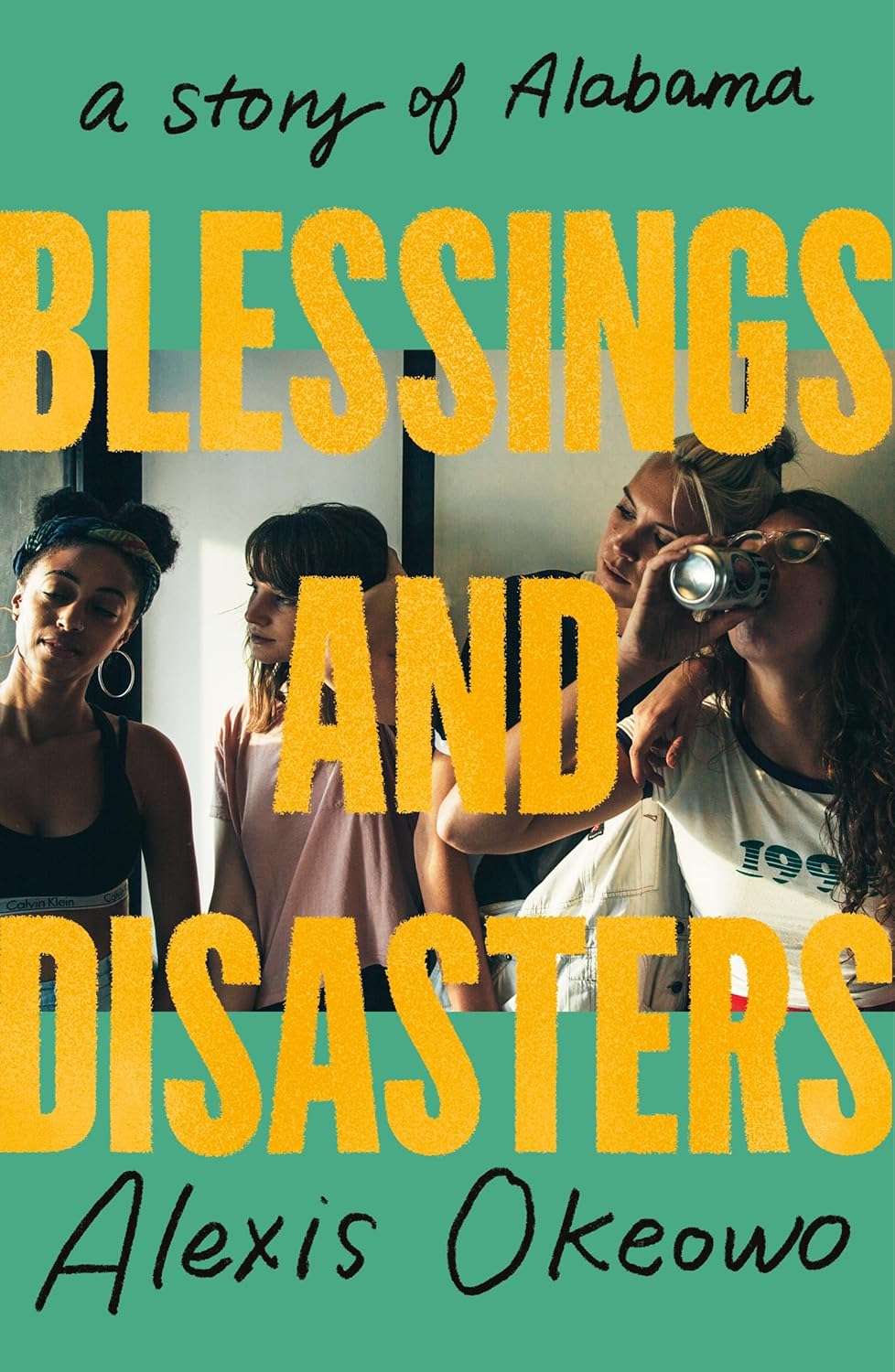
Blessings and Disasters: A Story of Alabama
- By Alexis Okeowo
- Henry Holt & Co.
- 272 pp.
- Reviewed by Shelby Smoak
- August 22, 2025
Minority voices ring out in this affecting memoir of the South.
The American South may be called many things, but “uncomplicated” certainly isn’t one of them. Rooted in racial ambiguity and tainted by the stain of slavery and secession, the South navigates a thin margin between being on the right and wrong side of history. It’s a similar binary tension that author Alexis Okeowo explores in her new memoir, Blessings and Disasters.
Born to Nigerian parents and raised in Montgomery, Alabama — the one-time temporary seat of the Confederacy — Okeowo peels away the complex layers of identity when you’re someone like her who exists in the margins, where they are “simultaneously part of and outside the Black/white racial binary that has long defined” her home state.
“In Alabama,” she surmises, “we exist at the border of blessing and disaster.”
Alabama is the hero here, as the author filters its history through the lives of everyday people mostly from minority groups. Its landscape is often tagged as “too racist, too religious, too backward,” but Okeowo hopes to shine a light on the stories of Alabama left out of this “official narrative.” She sets up her task by asking what happens “[w]hen the little-known, the inconvenient, and the unexpected parts of the story are presented as the story itself?”
The book opens with the Muscogee, the tribe who first owned the land that would become Alabama and who were among the 20,000 Creeks living in the region. Okeowo tells of their shrinking property, their fight for sovereignty, and their eventual impoverished life on “the res.” The narrative here (aside from its surprising revelation that Alabama has an Indian reservation) differs little from the kind found in countless history books: Native Americans forced from their land go on to birth a new generation of warriors whose heroic battles — here, it’s the Red Stick War, also known as the Creek War of 1813-1814 — are inevitably lost to white men (in this case, Andrew Jackson).
But Okeowo enlivens the tale by bringing in characters like Poarch Creek descendant Stephanie Bryan, who serves to carry the saga forward into the present day. Bryan grew up poor on the res but became a local political leader and successful businesswoman, helping build the billion-dollar gambling empire the Creeks now run in the state.
No journalistic memoir about Alabama would be complete without portraying the African American experience, and Okeowo ably covers the intentional disenfranchisement of Black voters post-Reconstruction, when white lawmakers established a “web of rules” that “ensure[d] Black Alabamians could not exercise their rights as citizens.” As most already know, literacy tests and poll taxes were some of the obstacles faced by Black voters following the Civil War. Here, too, though, Okeowo brings in an interesting contemporary perspective by introducing readers to a trio of white Civil War reenactors. As the three relive long-ago battles in the company of their present-day 33rd Alabama Infantry Regiment, Okeowo sprinkles in the history, affectingly bridging the gap between then and now.
The most politically charged portrait in the memoir belongs to Tina Johnson, who became an outspoken critic of 2017 U.S. Senate hopeful Roy Moore. Her story of lost relationships, loser men, and motherhood is gripping in itself, but Okeowo elevates the portrayal by parsing the fallout from Johnson’s assertions against Moore, who’d been accused of sexual assault by an intern. He quickly dismissed the claim, but Johnson came forward with her own recollection about Moore, who, when Johnson was a young girl, “grabbed her so far up her thighs” that she “felt his fingers in her vagina.”
Vindication ostensibly came when Moore — amid a storm of allegations similar to Johnson’s — lost his bid for office, but the author details the fallout for Johnson, too, who endured such intense public backlash for speaking out that she was forced to leave the state for several years. Who really won here? Okeowo seems to ask.
By highlighting such human drama, Okeowo gives her memoir the kind of soul not found in drily factual tomes. So, if you’re looking for a data-driven history of Alabama, this isn’t your book (nor was it meant to be). But if you want a work that fills in the gaps found in textbooks, the kind left when marginalized voices are ignored, then Blessings and Disasters is for you. Through clear-eyed storytelling that never devolves into condescension or anger, Okeowo seems to be following William Faulkner’s advice: “To understand the world, you must first understand a place like Mississippi.” Alabama is Okeowo’s Mississippi.
Shelby Smoak is a writer and musician living along the North Carolina coast. His book, Bleeder: A Memoir (Michigan State University Press), received praise from sources as diverse as the Minneapolis Star Tribune, Library Journal, and Glamour, and has won several awards, including “Best of the Best” by the American Library Association. He was also featured on local TV and radio, including NPR. Awarded a PEN/American grant for writers living with HIV, Smoak holds a Ph.D. in literature and an M.A. in English. He works as the community-relations and education manager in rare blood disorders for Sanofi.