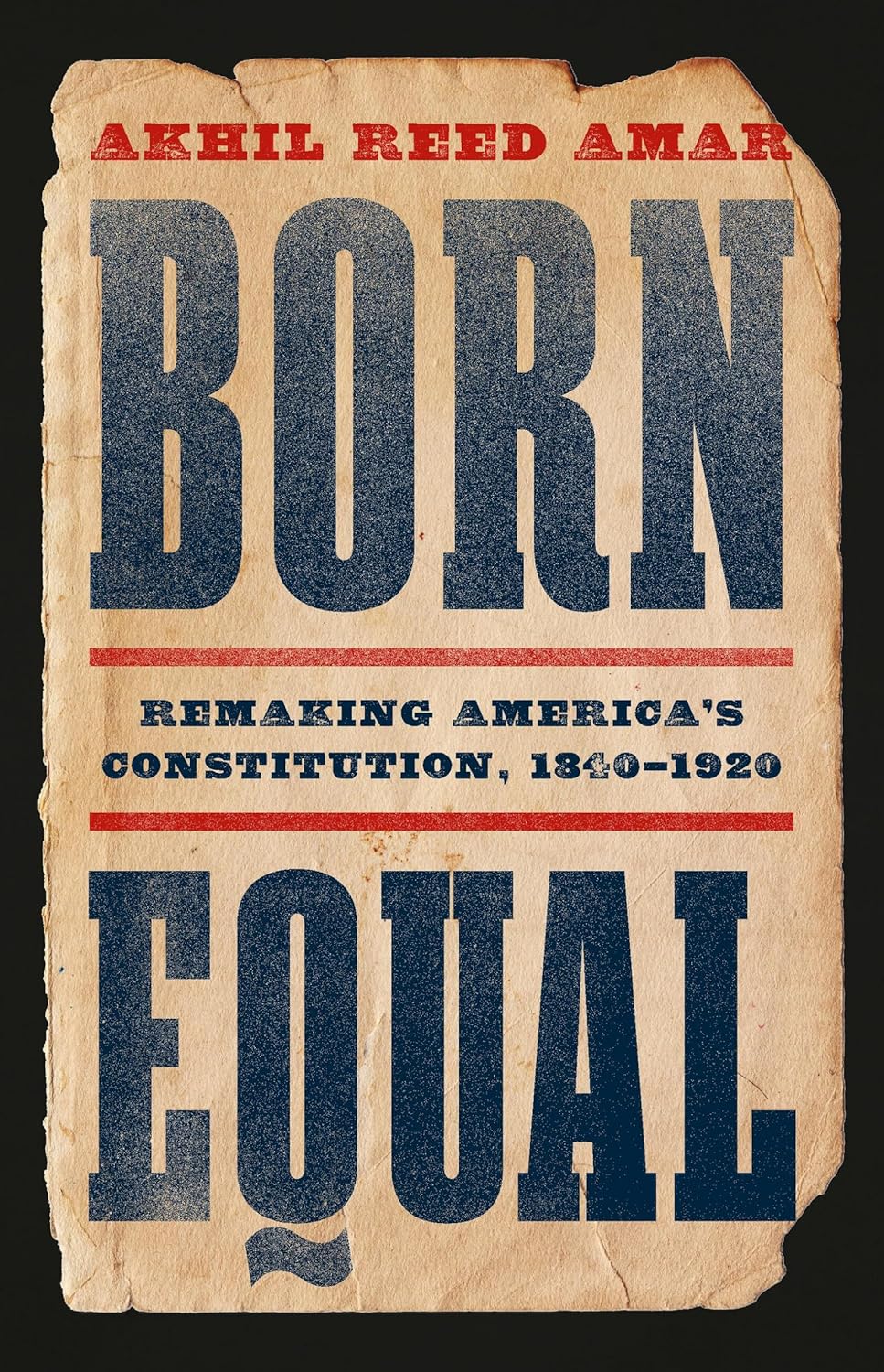
Born Equal: Remaking America’s Constitution, 1840-1920
- By Akhil Reed Amar
- Basic Books
- 736 pp.
- Reviewed by Jonathan Sallet
- October 20, 2025
Can an “originalist” view of birthright citizenship go either way?
Is the Declaration of Independence good law? Is it a form of law at all? In any event, is it a helpful guide for jurists in interpreting the U.S. Constitution? For example, should a judge today consider it a more- or less-important source than, say, the 1773 edition of Samuel Johnson’s dictionary? (See District of Columbia v. Heller, a landmark 2008 Second Amendment case in which semantics figured prominently.)
These questions lie at the center of Akhil Reed Amar’s Born Equal, the second volume in a planned trilogy on the constitutional history of the United States. Although writing for a generalist audience, Amar, Sterling Professor of Law and Political Science at Yale, makes plain that his goal is to explain to judges why the Constitution protects “birth equality,” a concept that he sees expressed in the nation’s core documents, from the Declaration of Independence to the post-Civil War amendments (13th, 14th, and 15th) and the 19th Amendment (woman’s suffrage).
The throughline of the book is Amar’s desire for judges to adopt an “originalist approach” that not only interprets the Constitution in light of its original aims and purposes but, importantly, understands the meaning of originalism in the spirit of figures like Justice John Harlan (the elder), Justice Hugo Black, and Dr. Martin Luther King Jr.
Originalism is hotly contested ground. Today, it is associated with conservative thinking exemplified by recent Supreme Court decisions seemingly guided by history and tradition rather than by an imperative to view 18th-century principles through a modern lens. Leading examples include Dobbs v. Jackson Women’s Health Organization, which nullified Roe v. Wade, and New York State Rifle and Pistol Association v. Bruen, which held that the Second Amendment protects the right to carry firearms in public.
The book spans four-score years, 1840-1920, pivotal decades in the quest for constitutional equality. In telling his story, Amar adopts a conversational approach of using shortened names for his main protagonists. “JQA” (John Quincy Adams) is the post-president member of Congress who opposes slavery; “Elizabeth” (Cady Stanton) marshals early support for women’s suffrage; “Harriet” (Beecher Stowe) inspires at least part of the nation; and “Frederick” (Douglass) espouses equal treatment for African Americans and women.
But atop the mountain stands “Abraham,” the constitutionalist, fusing the broadened ambitions of the Declaration of Independence with the textual provisions of the Constitution. President Lincoln thereby built a foundation for concluding that the principles underlying “a more perfect union” justified the abolition of slavery, the codification of civil rights, and universal voting rights for adult citizens.
Amar takes pains to emphasize his view that the most important originalists in U.S. history are not our right-leaning modern jurists. For example, he details Lincoln’s lawyerly analysis to support a constitutional vision that fulfils the implicit (if not the expressly worded) promise of the Declaration of Independence: moving toward equality for all.
This is inspiring stuff, but here’s the thing: Conservative jurists embrace key conclusions that Amar identifies with Lincolnian originalism — say, that Plessy v. Ferguson’s vindication of racial segregation was wrong (and, although his history does not reach into the 1950s, that Brown v. Board of Education was right). And, for instance, Justice Clarence Thomas’ self-styled originalist opinion in Students for Fair Admission v. Harvard, the case ruling that the university’s race-conscious admissions process was unconstitutional (in which Thomas quoted Amar’s earlier views approvingly).
Which leads to a pressing question in today’s constitutional moment: Does Professor Amar’s Lincolnian originalism differ from the prevailing conservative approach? In an op-ed, he expressed the view that Dobbs was correct in overruling Roe v. Wade, and in an appearance before the Federalist Society, he criticized the Harvard race-based admissions policy that was ruled unconstitutional. Yet he also endorsed Justice Powell’s approach in Bakke, which held that the consideration of race as a factor in college admissions is permissible.
We’re about to find out where the author truly stands. Birthright citizenship is at the heart of this book and announced in its title. In a postscript, Amar rejects President Donald Trump’s executive order that, as he puts it, aims to decitizenize a wide swath of individuals born in America to noncitizen parents. He believes such babies are American whether or not their parents are citizens or were even lawfully in the country at the time of their birth. His application of originalism here is rooted in the words of the 14th Amendment and the circumstances of its adoption and includes the language of the Civil Rights Act of 1866.
For its part, the Trump administration, too, claims originalism to justify its desire to end birthright citizenship, asserting, in a more roundabout fashion, that the guarantee of the 14th Amendment’s Citizenship Clause does not reach “children born to aliens present temporarily and children born to aliens illegally in the United States.” Why not? Because such individuals allegedly owe no allegiance to America and thus fall outside the 14th Amendment’s requirement that citizens be “subject to the jurisdiction” of the United States.
What to do when two claims of originalism clash? Simple textualism might provide the answer — e.g., such children are clearly under the jurisdiction of federal laws — but Amar, in another writing, compellingly explains why the “Lincolnian adaptation of the Declaration of Independence” provides additional support for the principle of birth equality. In my opinion, he is absolutely correct.
This history of Lincolnian originalism is inspiring, and its lessons for modern judicial interpretations of the U.S. Constitution are manifold. But there’s no denying that originalism does not function like Babbage’s mechanical calculator, whose extra-human answers are free from doubt. It is a written document we are interpreting, and where the text is ambiguous, originalists of varying stripes can read the surrounding circumstances differently. This is not a weakness in Professor Amar’s approach, butit is a caution: There’s no removing judgment from judging.
Jonathan Sallet, a senior research fellow at the Harvard Kennedy School, was once a law clerk to Supreme Court Justice Lewis F. Powell Jr. The views expressed here are his own and do not represent the views of any institution or agency.