Brand New Beat: The Wild Rise of Rolling Stone Magazine
- By Peter Richardson
- University of California Press
- 368 pp.
- Reviewed by Douglas C. MacLeod Jr.
- April 29, 2026
An exceptional chronicle of the hip newsstand mainstay.
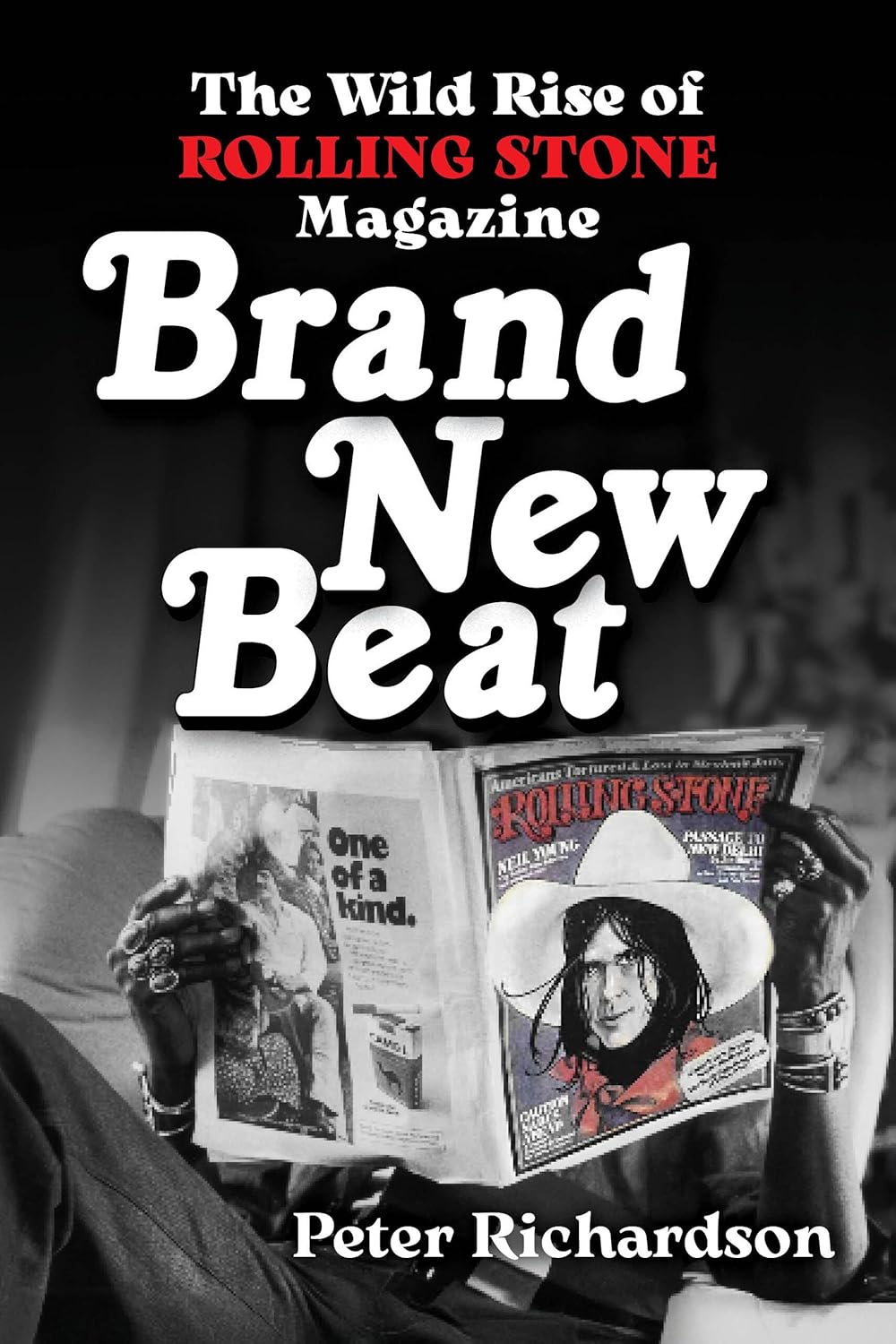
Peter Richardson’s Brand New Beat: The Wild Rise of Rolling Stone Magazine, an all-encompassing account of one of the most iconic periodicals of the 20th and 21st centuries, is an articulate and touching love letter both to writers and to the art of writing.
Before the age of AI, easy-to-scroll-through websites, and impersonal Zoom meetings, scribes like Cameron Crowe, Hunter S. Thompson, Tom Wolfe, and others sat in front of beat-up typewriters in drug-fueled hazes and pecked away until they came up with their next pieces of precise prose. Their ideas were original, their interviews were raw, and their hands hurt. Throbbing with piss and vinegar, these journalists were ready to sound off with hard-hitting critiques and commentary.
Richardson appreciatively points out that Rolling Stone’s editors and contributors opined — with panache and a great deal of care — on whatever pop-culture topics suited them, and he demonstrates his admiration via his book’s four distinct parts. He first explores the magazine’s 1967 birth in the Bay Area; next, its slow but steady move into the mainstream; then, its continued expansion and editorial shift during the 1970s; and, finally, its gonzo leanings during what co-founder Jann Wenner would call the magazine’s golden age.
As well-known and influential as Rolling Stone was and is, Richardson is honest about its tumultuous and “sprawling” history, while also praising it for being a staple of the American zeitgeist since its inception. According to the author, four things have kept the magazine relevant: its complicated relationship with the counterculture; its “conception of rock music and its significance”; its connections with the Free Speech Movement and with Ramparts, another San Francisco magazine; and its unique narrative take on politics, which exposed how unobjective the mainstream media could be.
Each of these themes is carefully presented in extreme detail, and Richardson attempts to blow any misconceptions about Rolling Stone out of the water — the most egregious being that it’s a magazine about the music industry written by a bunch of hippies. Perpetuating this calumny would, he claims, “underestimate both the counterculture and the magazine that covered it.”
Rolling Stone’s early contributors, including Ralph J. Gleason, Ben Fong-Torres, Robert Christgau, and Jon Landau — many of whom lived in San Francisco during the apex of Haight-Ashbury’s Beatnik scene — were polished pros who understood that rock ‘n’ roll, politics, and culture were linked. This led to erudite but accessible articles devoted to a variety of noteworthy topics that just so happened to revolve around music: the Summer of Love; LSD; conservatives’ outrage over hippies; John Lennon; the deadly stabbing at Altamont; Woodstock; the deaths of Jimi Hendrix and Janis Joplin; Vietnam — the list goes on.
But Brand New Beat is more than a sweeping chronicle of a magazine and its creators. Richardson’s impressive work is also a timeline of what was happening in America during the 1960s and 1970s. By weaving a chapter-by-chapter tapestry that expertly combines popular culture, economics, politics, and social shifts, the author has crafted an able study of American-style capitalism and the volatile space it inhabits.
In his final chapters, Richardson speaks of how, in the magazine’s early days, misogyny was the norm. The 1960s workforce, after all, was male-dominated and patriarchal. But the rise of the feminist movement in the 1970s meant a tonal shift was needed. Rolling Stone changed with the times by hiring more women writers and editors. With these changes came a rise in the magazine’s readership and more diversity in its tone. Marianne Partridge, Judith Sims, Ellen Willis, and others joined the team, making the magazine more inclusive by broadening its editorial remit.
Richardson spends much of the book speaking about Rolling Stone as a juggernaut of publishing, one that seems always to have its finger on the pulse. Throughout Brand New Beat, he offers a master class in how to tell the story of a cultural icon. When singular voices and quality material come together, magic can happen, and Rolling Stone is testament to that.
Dr. Douglas C. MacLeod Jr. is a professor of composition and communication at SUNY Cobleskill Ag & Tech. He is also a freelance book reviewer who has worked for both peer-reviewed journals and periodicals. He writes regularly for Rain Taxi, the Feathered Quill, Kirkus, On the Seawall, and ArtsFuse, and his work can be read in a variety of other online and print publications. He lives in New York with his wife, Patty, and his dog, Fifi.