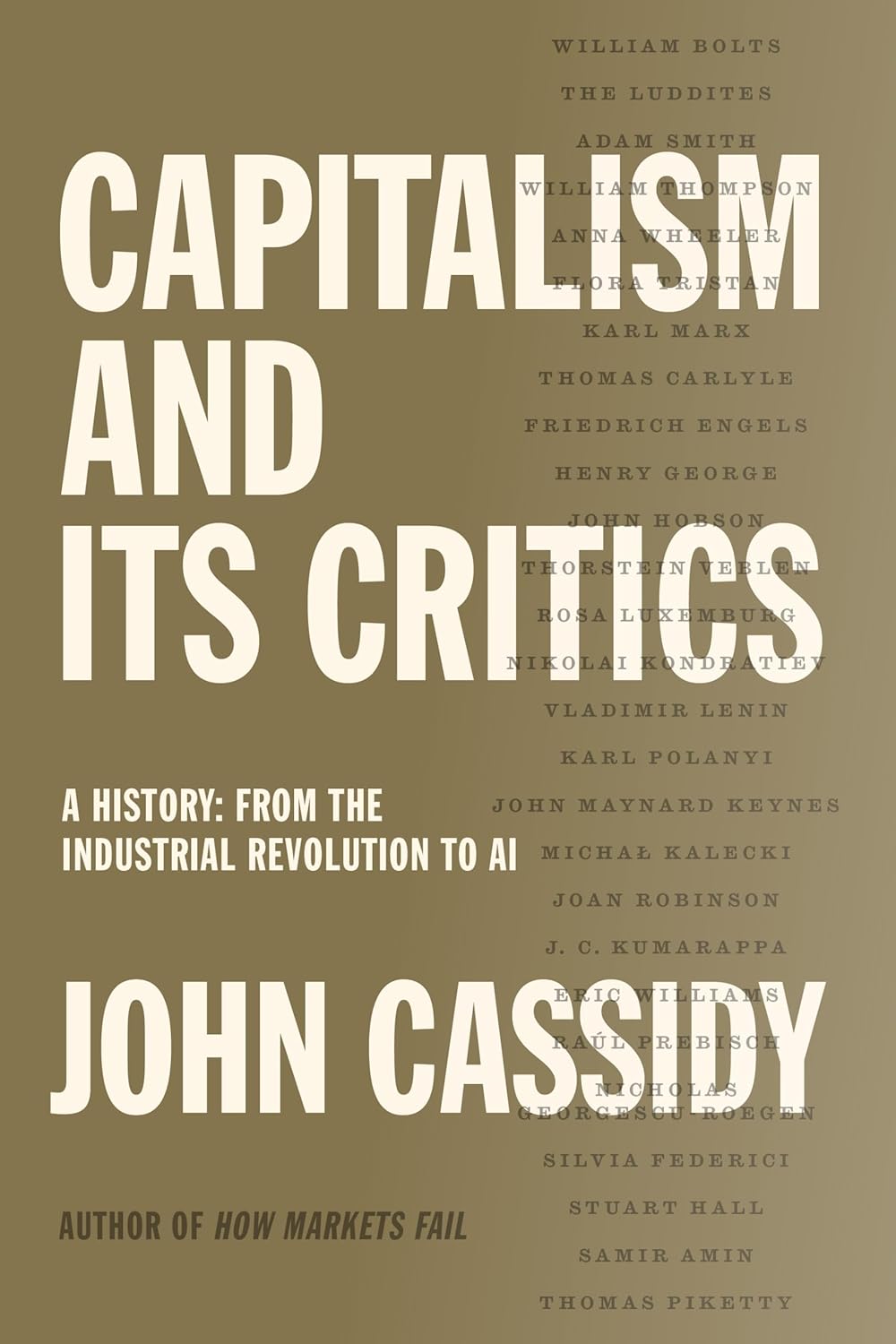
Capitalism and Its Critics: A History: From the Industrial Revolution to AI
- By John Cassidy
- Farrar, Straus and Giroux
- 624 pp.
- Reviewed by Sunil Dasgupta
- May 22, 2025
A worthy addition to your economics bookshelf.
With Donald Trump’s victory in November 2024, has capitalism — along with its enabler, democracy — finally failed? (Or failed once more?) While some would reject the notion out of hand, given that Trump’s election could be considered a voter-led ratification of all he’s about to do to America’s piggy bank, it turns out that many have long predicted the downfall of capitalism and democracy’s inability to contain the consequences thereof.
In Capitalism and Its Critics, Oxford-educated author John Cassidy, a staff writer at the New Yorker, argues that, indeed, criticism of capitalism was born alongside the original thing and that they’ve been twinning ever since.
Cassidy’s narrative starts in the 1700s with William Bolts, who did not like Robert Clive, his boss at the East India Company. Clive was the company’s mid-18th-century representative in Calcutta and, eventually, the first governor of the Bengal Presidency. Clive sent Bolts back home to England, where he blew the whistle on the malpractices of mercantile capitalism, including the use of violence against Indian cloth producers and the creation of monopolies that overcharged and overtaxed customers while corporate overseers siphoned off profits for themselves. In just three short years as governor, Clive became one of the richest men in all of Britain.
With the news of this predation, history’s best-known economist, Adam Smith, wrote The Wealth of Nations, which would become — and remains — the bible of economics. In the 1776 tome, Smith argued for a better version of capitalism, one in which governments leave markets alone, allowing prices to be determined by the invisible hand at the intersection of freely generated demand and freely provided supply.
The Industrial Revolution arrived soon thereafter to shake the promise of capitalism not just on the Subcontinent but in Europe proper. Displacement from the countryside combined with abominable living conditions in cities — think Oliver Twist — led to another round of recriminations. By the mid-1800s, the German émigré to Britain Karl Marx produced his magnum opus, Das Kapital, wherein he asserted capitalism caused class conflict — the exploitation of workers by the bourgeois — and was doomed to end in bloody revolution.
For at least 100 years now, it’s been fashionable to say that Marx was right in his analysis but wrong in his prediction. The transformation into free-market economies has been traumatizing almost everywhere for reasons Marx recognized, but mass wealth (when it finally arrived in the 20th century) came riding in on free trade and investment as much as it did alongside unions, pensions, and free public education.
The more recognizably modern section of Cassidy’s book starts with the Russian Revolution and the rise and fall of Nikolai Kondratiev, whose idea of long cycles in capitalist production negated Marx. Kondratiev was himself a Socialist Revolutionary, but SRs (as they were then called) were really moderates, at least compared to the radical Bolsheviks. Lenin disagreed with Kondratiev but still allowed his input into the heralded New Economic Plan in the Soviet Union. Later, Stalin, ever the contrarian, had Kondratiev killed.
The British economist John Maynard Keynes helped revive 20th-century capitalism after the downcycle of the Great Depression and two world wars. Keynes recognized that the market for labor and capital didn’t work like the market for goods and services. When the cost of labor (wages) fell, demand for workers did not increase. Similarly, when the cost of capital — interest rates — fell, businesses didn’t necessarily invest more money.
Keynes proposed that, as a way to mitigate cyclical downturns, government help grow aggregate demand, even by printing money if necessary. He meant his prescription to apply primarily to recessions, but deficit spending of the kind he advocated has been used to support the welfare state, technological innovation, infrastructure, the G.I. Bill, and, belatedly, pandemic checks.
Non-interventionist economists such as Friedrich Hayek, Joseph Schumpeter, and Milton Friedman rebelled against Keynesian spending, the New Deal state, and the resulting over-taxation. The rise of Margaret Thatcher and Ronald Reagan in the 1970s and 1980s brought these ideas into the mainstream, reasserting liberty by lowering the tax rate. Under Democrat Bill Clinton in the 1990s, the U.S. adopted the first set of comprehensive welfare reforms. Under Republican George W. Bush in the 2000s, America dramatically cut the top tax rates. For the next 20 years, the U.S. economy moved on parallel Keynesian and Hayekian tracks, relying on federal spending to jumpstart the economy as tax cuts ballooned the national debt.
Internationally, the postwar economic regime of free trade, investment, and immigration led Latin America to falter but Asia to make a spectacular rise. Japan, Korea, Taiwan, and finally China and India closed the inequality gap between countries even as inequality grew within them. In the U.S., tax cuts and stagnating wages caused deep divides that led to the rise of Trumpism as a political force by 2015. Thomas Piketty, the prince of the 2010s economic realm, spotlighted class conflict in the new Gilded Age, where billionaires ruled and the working class was left behind. Piketty knowingly named his seminal book Capital in the Twenty-First Century, following Marx himself.
There can be no book on capitalism (or review of one) without addressing the most urgent question of all: Can the world support endless capitalist expansion? In 1971, Nicholas Georgescu-Roegen, a Romania-born economist, published The Entropy Law and the Economic Process, which warned that the depletion of natural resources limits economic growth. It sparked an environmental movement that would seek to change capitalism one more time; clean-air and clean-water laws were passed. But in the aggregate, consumption around the world has only increased, both in rich countries and in previously poor ones. The political fight of today is largely over what should — or even can — be done about climate change.
Most of this, we know already. So, while Cassidy’s sweep through history doesn’t offer any searing insights, it is comprehensive in an ECON101 way. You may agree with his approach and conclusions or not, and you might take issue with the book’s scant attention to AI, despite the promise of its subtitle. For me, the most glaring omission is that of Amartya Sen, the Indian economist who famously wrote of famines not as crop failures but as the product of policy choices and the absence of a free press.
No matter. Capitalism and Its Critics is an excellent history of economic thought and an able precursor to deeper readings of the kind assigned to students in micro- and macroeconomics courses. Not only can professors easily supplement the provocateurs Cassidy missed, we can use the fact of their omission to launch classroom discussions. As someone who teaches political economy, I believe this one is a keeper.
Sunil Dasgupta teaches politics and government at UMBC at the Universities at Shady Grove.