Carryout: Stories
- By Hasan Dudar
- University of Iowa Press
- 228 pp.
- Reviewed by Mike Maggio
- July 30, 2026
Palestinian refugees settle in Toledo, Ohio, and struggle to adapt to their new culture.
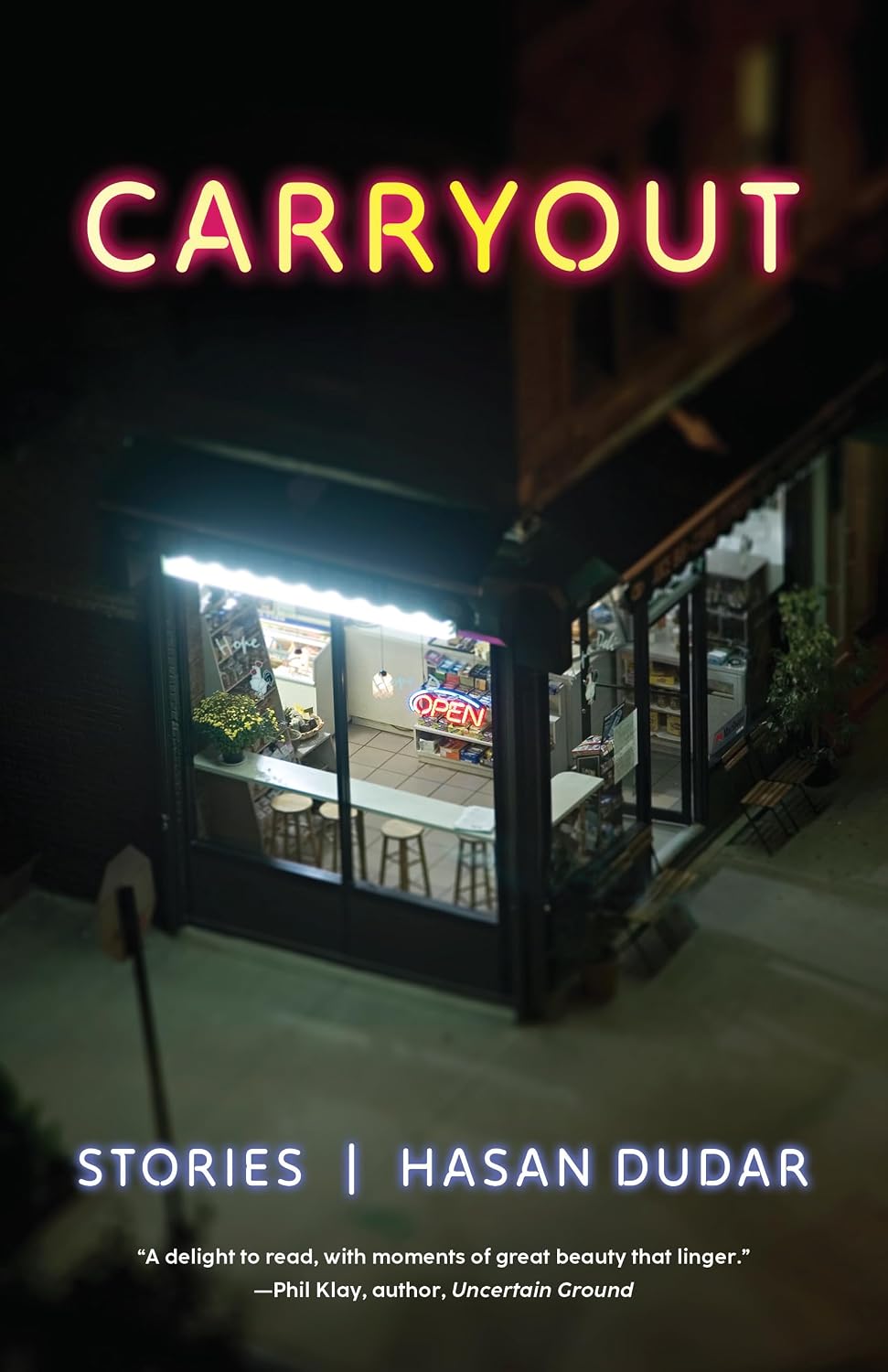
Hasan Dudar’s debut, Carryout, is billed as “stories,” yet these tales interlink to form a complete whole that one could rightly refer to as a novel-in-stories. The book follows Palestinian refugees from Lebanon who immigrate to Toledo, Ohio, where they attempt to discover, in their own way, the American Dream.
But just what is that dream?
Ziad, the sire of the Idilbi family, marries Salma, and together they raise a family in the shadow of a deteriorating Rust Belt city. To make ends meet, he opens a corner store that caters to a precarious working class during a time when industrial America is barely hanging on. Like many immigrants who attempt to assimilate, the Idilbis endure racism and bigotry because of their skin color and Muslim background. And, like Toledo itself, their store struggles to hang on.
Struggle, it seems, is the major theme here, for we are confronted with a city that struggles to survive deindustrialization and a mostly white, blue-collar population that struggles to preserve its identity, one threatened by an influx of immigrants and a loss of jobs. Then there are the Idilbis and their compatriots, who struggle with the loss of their cultural identity and their inability (or unwillingness) to integrate into the strange new world they find themselves in.
One of the stories, “A Virtuous Fat,” sums up this last point succinctly, for it deals directly with the American vs. non-American, white vs. non-white dilemma that Arabs and other immigrant groups face. In it, Nawal, Ziad’s only daughter, is talking with her friend Nadia, whose family has changed its last name from the Arabic Safir to the Americanized Safire and who attends Catholic school during the week and Muslim Sunday school at the local mosque:
“Well. we’re not changing our last name to Safire,” [Nawal] said, “So we can act like we’re American or something.”
“I am American,” [Nadia] said. “My mom’s white. Isn’t that how it goes?”
That was the one thing she had that I didn’t. Being American. And to Arabs, and to anyone raised around them, that meant white, sadly. And because 1didn’t see myself as white, and because others didn’t either, I hardly ever called myself an American — not in that sense. I was a something other. And I was mostly fine with that. Unless it was implied by someone else, of course. Because, as little sense as it may make, it’s one thing to exclude yourself and another thing to be excluded by someone else. And Nadia, who had been excluded in more ways than me, knew how much it would hurt.
Here lies the crux of Dudar’s narrative and the dilemma facing all immigrants, not just Arabs. How is one supposed to assimilate into a society that, for the most part, shuns you because of your otherness? And the next question that arises is this: Should immigrants assimilate — and, if so, how — or should they maintain an insular existence in an isolated enclave?
Certainly, at the beginning of the 20th century, Jews faced the same problem as Italians and other immigrant groups. Today, it’s Arabs or Haitians or Hispanics — the list goes on and on. How, then, does one achieve the American Dream when it’s constantly kept from you because of your faith, skin color, upbringing, or birthplace?
Dudar’s stories capture these dilemmas with grace and dignity. Some of his characters, indeed, cling to their past while others, like Walid, who wants to be a poet but who comes from a culture that prefers doctors and engineers, reach for a future that melds his Arabic heritage with an American one.
The author’s prose is clean and flows beautifully, and the collection’s overarching theme speaks to all immigrants. My only criticism is that the stories are told in first person, making it difficult at times to know who is speaking from one story to the next. (This, however, gets clarified as each individual tale progresses.) Ultimately, Carryout is a wonderful debut from a talented writer who joins a chorus of new ethnic voices entering the literary world.
Al di là del mare/Across the Sea: Contemporary Italian and Italian American Poetry, edited by Mike Maggio, is a bilingual compilation of poetry due out from Bordighera Press this fall.