Castles: A Fortified History of the World
- By Dan Jones
- Viking
- 416 pp.
- Reviewed by William Schwartz
- November 26, 2026
An uneven, Eurocentric look at the formidable fortresses.
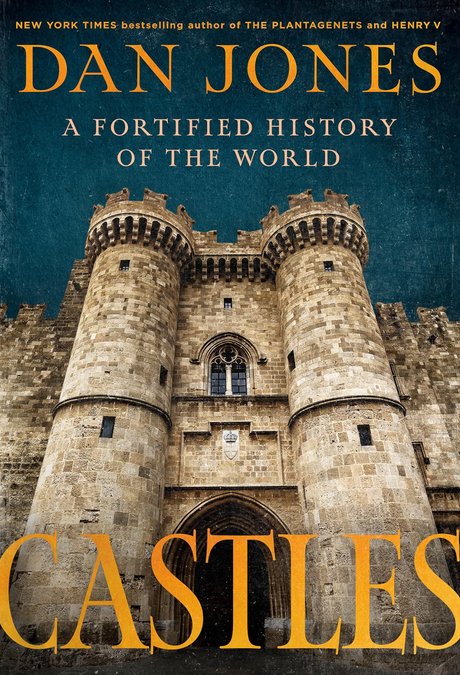
What exactly is a castle, anyway? In the introduction to his new book, Castles, author Dan Jones includes a curious section wherein medieval historian R. Allen Brown, one of the foremost authorities on the structures, can’t really come up with a coherent definition. Regrettably, neither can Jones.
By foregrounding the matter, he calls attention to the general difficulty of the task he set for himself: writing a book that claims to be a “fortified history of the world” from the Bronze Age to the nuclear age. Alas, Jones isn’t quite up to the challenge. Less a coherent history than a series of anecdotes and vignettes, Castles doesn’t wield much grand-narrative authority.
While these stories are certainly amusing, the main problem with them is that Jones is clearly more interested in the extent to which they are entertaining than in whether they adhere to — and bolster — his thesis. After reading Castles, I can easily recall certain details of note, like how the famed Trojan Horse was actually intended as an offering to the gods, and how the real trick was getting the Trojans to steal it instead of burning it like they were supposed to.
What does this have to do with castles? Beats me. We all know Troy was impossible to besiege; that’s what was famous about it.
The extended section on how William the Conqueror used castles as a panoptical terror campaign over England is a lot of fun, too. Unfortunately, its discussion of the castles themselves is almost entirely secondary. While Jones tries to explain how and why some castles are structurally different and similar to one another, his efforts are hobbled by the fact that he provides no technical diagrams. Each chapter is prefaced with an artistic rendering of a castle, which is interesting but not terribly edifying.
This becomes less of an issue in later chapters, which increasingly deal with castles as an abstract or romantic concept rather than as a structure with practical function. But, even here, Jones doesn’t demonstrate a good grasp of his material. After his stirring depiction of William the Conqueror as being, well, a conqueror who went on killing long after it was necessary, it’s odd to see the author depict the Taino who destroyed Christopher Columbus’ first castle in Haiti as slaughterers who felt no festive goodwill for the Villa de Navidad.
Jones’ weirdly dispassionate description of the conquistadors implies uncomfortable loyalties, as well, as do his accounts of the American Civil War and campaigns against Indigenous peoples. It’s unclear whether he realizes this juxtaposition gives the impression that he only thinks white lives matter, or if this focus is just an accidental byproduct of the fact that he finds castles in Europe more interesting than those found elsewhere.
Jones does not even acknowledge that structures which could plausibly be called castles existed in sub-Saharan Africa, and he literally interrupts the only chapter that goes into depth on Asian castles to discuss Hadrian’s Wall. Somehow, he doesn’t similarly digress in Europe-centric chapters to discuss, say, Tang Dynasty China’s siege of Goguryeo-era Ansi Fortress, although it’s a good example of the kind of warfare that made castles necessary in the first place.
Likewise, Jones’ discussion of castles’ demise as a practical instrument of war — though convincingly documented as resulting from the invention of rifled cannons in the mid-19th century, which made them far easier to destroy from a safe distance — lacks gravity because it hasn’t been demonstrated to us that they were ever impenetrable to begin with.
While I learned a fair amount from the book, the information is scattershot, and its scope is dubious. If you pick up Castles eager to learn for yourself about the once-formidable structures, you’ll do well to take its claims with a grain of gunpowder.
William Schwartz is a freelance writer living in Southern Illinois. He has reviewed wide varieties of media, including South Korean dramas, upscale graphic novels, vintage videogame media, and much more.