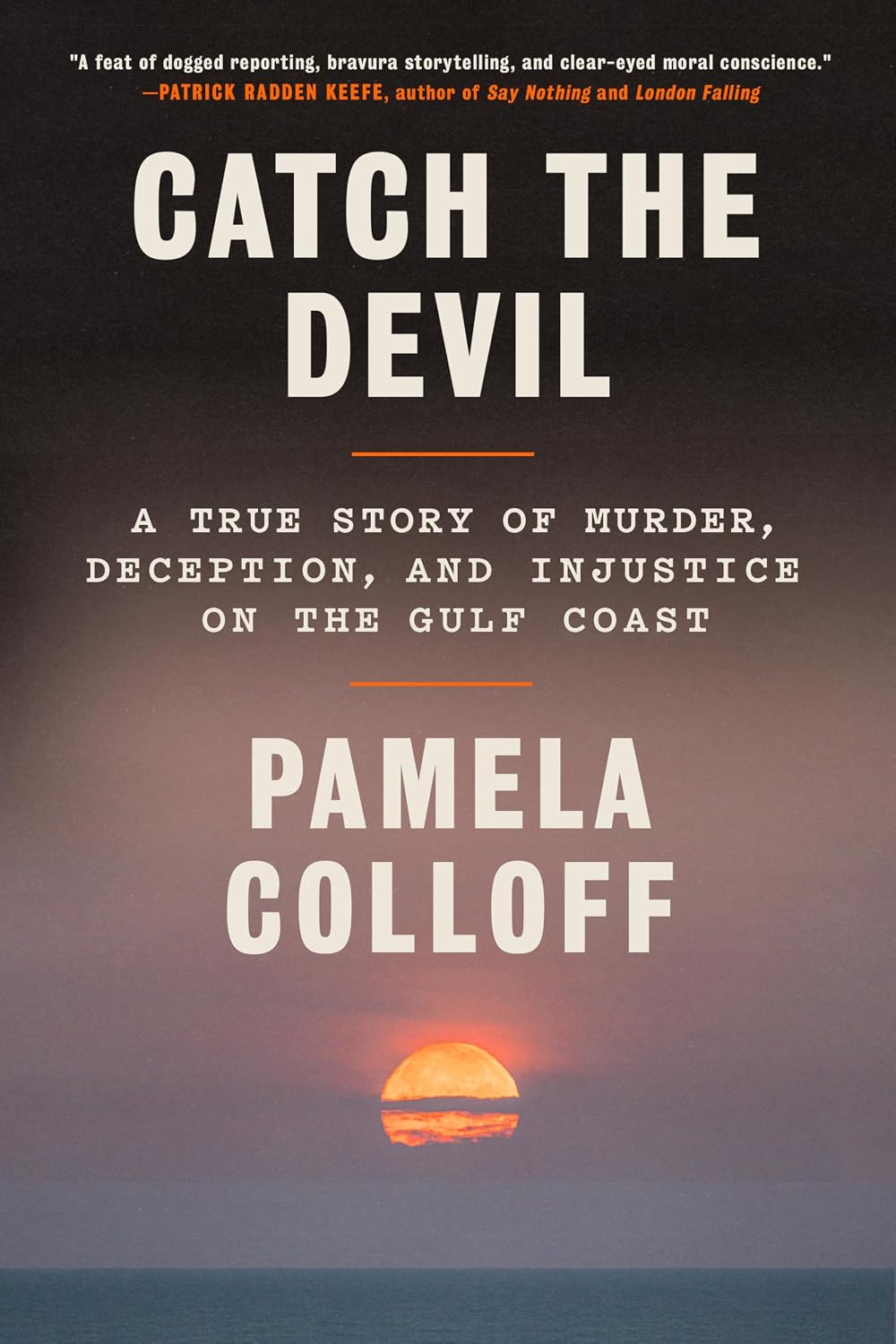
Catch the Devil: A True Story of Murder, Deception, and Injustice on the Gulf Coast
- By Pamela Colloff
- Knopf
- 320 pp.
- Reviewed by Diane Kiesel
- August 19, 2026
A superb, sobering look at a courtroom con artist.
There’s an old expression: “You’ve got to make a deal with a sinner to catch the devil.” In Pamela Colloff’s marvelous new book, Catch the Devil, the sinner is Paul Skalnik, a malevolent sex abuser, bigamist, conman, wife-beater, thief, and frequent jailbird. Whenever his crimes caught up with him, he floated away from trouble by offering up the head of a bigger fish on a platter.
Although nobody in his right mind would buy a used car from the guy, prosecutors relied on Skalnik’s jailhouse snitching to convict defendants, mostly in Pinellas County, Florida. In trusting this unsavory character, complicit cops and lawyers got it backward. They didn’t catch the devil; they made sweetheart deals with him.
Ethical prosecutors know that snitches who trade information to save their own hides are problematic; proceed with caution. Since 2017, at least a dozen states have passed laws to curb or regulate the practice. But Colloff didn’t find many who questioned relying on Skalnik as a closer. Moreover, she met with Skalnik in a federal prison near the end of his life, but he never explained how he’d heard more confessions than a Catholic priest. As a former prosecutor for legendary New York County district attorney Robert M. Morgenthau — whose mantra was to “do justice,” and who eschewed capital punishment — I found this book horrifying. It should be required reading for every law student who hopes to handle criminal cases.
Skalnik was a police officer for all of 13 months until he was forced to resign for writing bad checks. He later posed as an airline executive, law student, luxury-car dealer, real-estate broker, and international man of mystery. He claimed ownership of offshore bank accounts, yachts, and high-end cars while racking up nine marriages (some simultaneous) and separating his wives from their cash.
In 1978, he fell into his biggest con — snitching — after being jailed for passing bad checks in Houston (while on probation for the same crime in Florida). Desperate, he contacted an acquaintance who was an investigator for the local D.A., offering to help nail a trio of activists awaiting trial for inciting a riot over the death of a Mexican American Army veteran in police custody. Skalnik claimed one of them confessed to him in the lockup. Skalnik’s testimony secured the trio’s conviction, providing him with a get-out-of-jail-free card and a future ace in the hole to use when needed.
A fourth marriage brought him to Pinellas County in 1980, where he was soon arrested for proposing to another woman with a fake diamond ring and bilking her out of thousands of dollars. While awaiting trial, jailhouse confessions dropped into his lap. “Prosecutors did not challenge the idea that Skalnik had obtained three confessions in three different murder cases in less than a summer,” writes Colloff. By 1984, Skalnik would testify against or give information to authorities about 27 defendants in the county jail. In return, he got great deals in his own cases, including the shocking dismissal of his indictment for molesting a 12-year-old girl, a crime punishable by up to 15 years in prison in Florida.
Skalnik’s involvement in the trial for the 1985 stabbing death of troubled Pinellas County teenager Shelly Boggio dominates the book. His testimony helped send James Dailey to death row, where, after exhausting his appeals, he remains to this day. Boggio’s nude body was found floating in the Intercoastal Waterway. The night before her death, she partied with three men, including Dailey, a Vietnam vet who struggled with alcohol and drug addiction. There was no forensic evidence pointing to a killer, and there were conflicting accounts regarding which of the three men were last seen with her. One, Jack Pearcy, admitted to cutting Boggio but fingered Dailey as the killer.
The strongest circumstantial evidence against Dailey was the wet pants he was wearing the morning of the murder and the fact that, like the other two men, he blew out of town the next day. Arrested months later, Dailey gave a lame explanation for the pants — that he’d gone into the water to retrieve a Frisbee he’d been tossing with Pearcy the morning of the crime. Nonetheless, the case was weak until Skalnik, in jail on a parole violation, worked his magic.
Dailey spent 10 months in jail without making a peep about the case. He was moved to Skalnik’s floor 18 days before he was scheduled to go to trial and, within two days, allegedly confessed to Skalnik that he’d stabbed Boggio. Skalnik’s testimony sealed Dailey’s fate. He was convicted of first-degree murder and sentenced to death.
Skalnik was released due to his cooperation but skipped out on his own pending case. Later arrested in Texas for stealing a $6,100 Rolex, he was returned to Florida for bail-jumping. Angry at being back behind bars, Skalnik played his best card by filing a motion accusing prosecutors of knowingly eliciting false testimony from him. Ironically, the same prosecutors who for years urged juries to believe Skalnik now asked the court to consider him a liar. If successful, Skalnik’s motion would threaten to upend multiple convictions. To shut him up, prosecutors offered yet another sweetheart plea deal.
Skalnik went home to Texas; alas, it was not Florida. After his arrest in Galveston in the early 1990s for sexually assaulting the teenage daughter of one of his wives, the prosecutor there said he was “grandiose, delusional, and…[suffering from] narcissistic-personality disorder. He boasted that he was with the FBI…[and] the CIA, and none of it checked out. It’s hard to believe prosecutors relied on him.”
For once, he was prosecuted with vigor, which left him no choice but to plead no contest in exchange for a 10-year sentence. Skalnik died in March 2020 without ever admitting he’d lied in the Dailey case (or any other, for that matter). Given that Florida has no statute of limitations for perjury in capital cases, it would not have been in his interest to do so. Dailey is still alive after four decades on death row, waiting to see if — or when — Florida will execute him.
Diane Kiesel is a retired judge. She is currently an adjunct professor of law and author. Her latest book, When Charlie Met Joan: The Tragedy of the Chaplin Trials and the Failings of American Law, was published in 2025 by University of Michigan Press.