Centennial: The Great Fair of 1876 and the Invention of America’s Future
- By Fergus M. Bordewich
- Knopf
- 272 pp.
- Reviewed by Peggy Kurkowski
- July 22, 2026
An able account of the nation’s 100th-birthday spectacle.
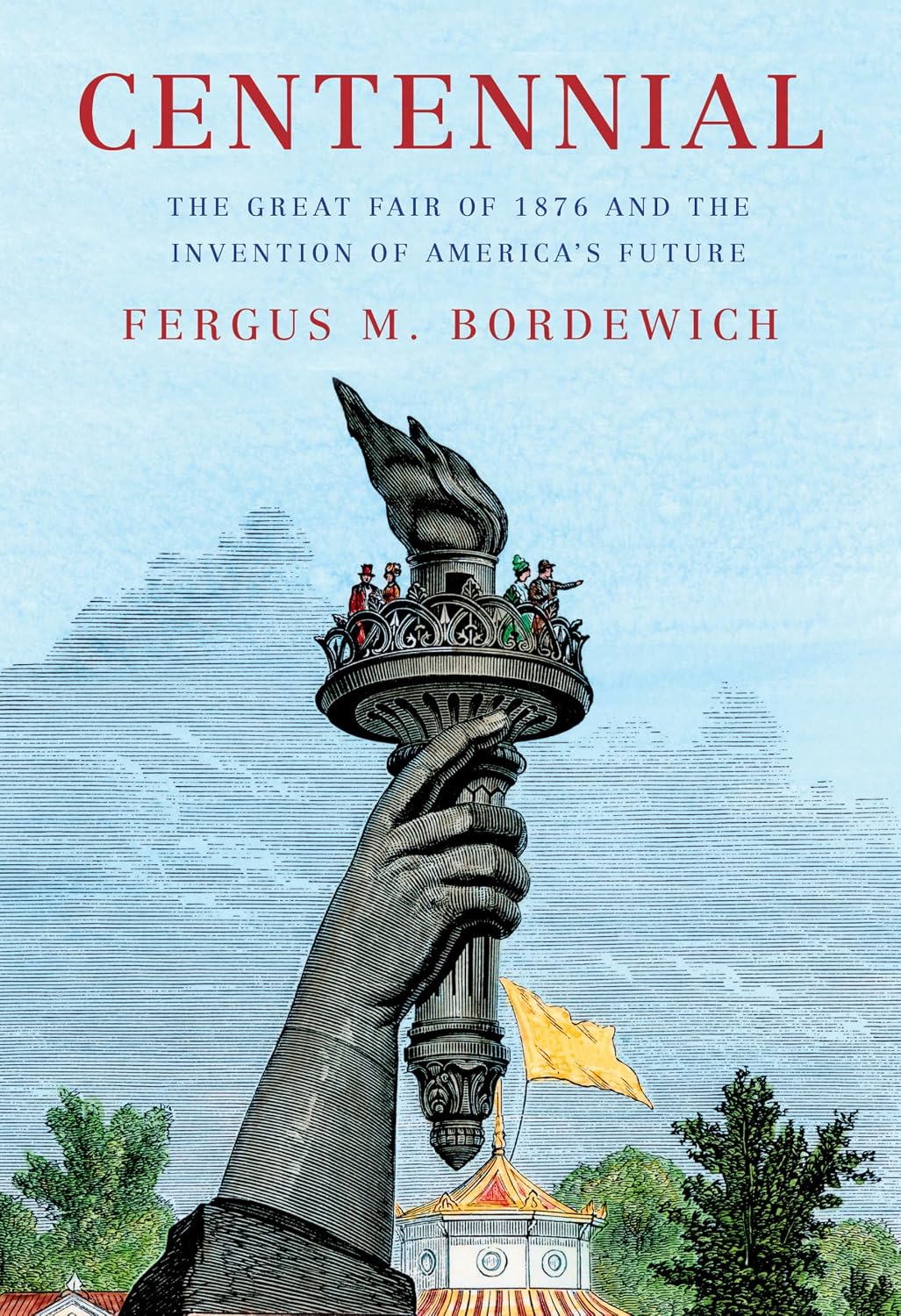
As America turns 250 this summer, it’s worth rewinding to our country’s first milestone birthday in 1876 (and what a party that was!). In Centennial, historian Fergus M. Bordewich takes readers on a wide-ranging tour of the Great Exhibition of 1876, set within a year bursting with consequential turning points.
Held at Fairmount Park in Philadelphia, the Centennial Exhibition officially opened to the public in May 1876 and attracted 10 million Americans — 20 percent of the population — and visitors from around the world during its six-month run. In this breezy read, Bordewich introduces the bold thinkers and inventions spotlighted during the spectacle; from engines to typewriters, the “pulsating hagiography of technology, invention, and capitalism” were on full display and promised a future of “endless prosperity and progress.”
Yet, underneath the tent tops and colorful bunting, the Centennial Exhibition began a period of social and cultural upheaval that extended far into the 20th century. Bordewich uses the lives of four disparate Americans as the lens through which to view this watershed year: Rutherford B. Hayes, Alexander Graham Bell, railroad tycoon Tom Scott, and sculptor Edmonia Lewis. Each embodies an aspect of change and transformation, for both good and ill.
The author intersperses fascinating trivia about the exposition with longer chapters that explore the political health of the nation at 100. He spends time navigating the contentious presidential election of 1876 that saw the “grand bargain” of Hayes’ installment as president over Samuel Tilden in return for ending Reconstruction in the South. Tied closely to this is the experience of Lewis, a talented artist who, as a Black woman, found more freedom and acceptance in Rome than she did in her native land.
Scott and Bell, on the other hand, were “pioneers in the spheres of industry and innovation.” Scott, head of the Pennsylvania Railroad, was one of the Centennial Exhibition’s “most vigorous boosters,” Bordewich notes, invested countless resources in its development, and extolled the wonders of the modern railroad during the event. Bell, meanwhile, wowed judges and fairgoers alike with a demonstration of his “electric wire” that carried voices between two points. Representing the monumental advances in transportation and telecommunication in America, the railroad and telephone embodied “the industrial behemoth the country was fast becoming.”
Throughout the book, Bordewich switches nimbly from prescient observations on Centennial Exhibition displays — such as the overabundance of exhibits and artifacts from the American Revolution — to penetrating insights into what they represented for a nation still mending from its devastating civil war 11 years prior:
“For countless visitors, such inspiring exhibits seemed to hold up the unity of the patriots of 1776 as a model for reconciliation between North and South — at least among the whites.”
Black Americans, though, were rarely seen in the pavilions unless they were there as laborers; except for Lewis, who staffed her own display of sculptures — which included the controversial “The Death of Cleopatra” — Blacks were not allowed to exhibit. Along with portraying the racial animus and discrimination that belied America’s promise of liberty and justice for all, Bordewich sketches the early class and labor rumblings that resulted in strikes, the creation of unions, and the crackdown by big business on the working class. Chapters on women’s rights and evolving roles, as well as on the twilight of Native Americans in the dwindling frontier, depict a young nation still wrestling with what it wanted to be.
The narrative lags, however, as it attempts to shift gears from the expo to these larger currents in culture, industry, and politics. While the preface makes clear the book began as a story about the Centennial Exhibition, the finished product doesn’t read like the comprehensive, fully integrated narrative it aspires to be. Still, the history is well researched and digestible (if not a first-class stitch job). Centennial roves confidently across America during its 100th-birthday year, tracing the future as it was then envisioned — and reminding us how sharply time reshapes what once seemed certain.
Peggy Kurkowski is a professional copywriter for a higher-education IT nonprofit association by day and major history nerd at night. She writes for multiple book-review publications, including Publishers Weekly, Library Journal, BookBrowse Review, Historical Novels Review, Foreword, Shelf Awareness, and the Independent. She hosts her own YouTube channel, “The History Shelf,” where she features and reviews history books (new and old), as well as a variety of fiction. She lives in Colorado with her partner and four adorable, ridiculous dogs.