Centroeuropa
- By Vicente Luis Mora; translated by Rahul Bery
- Bellevue Literary Press
- 192 pp.
- Reviewed by Jennifer Bort Yacovissi
- July 3, 2026
A quirky fairytale replete with a witch, a giant, and lots of corpses.
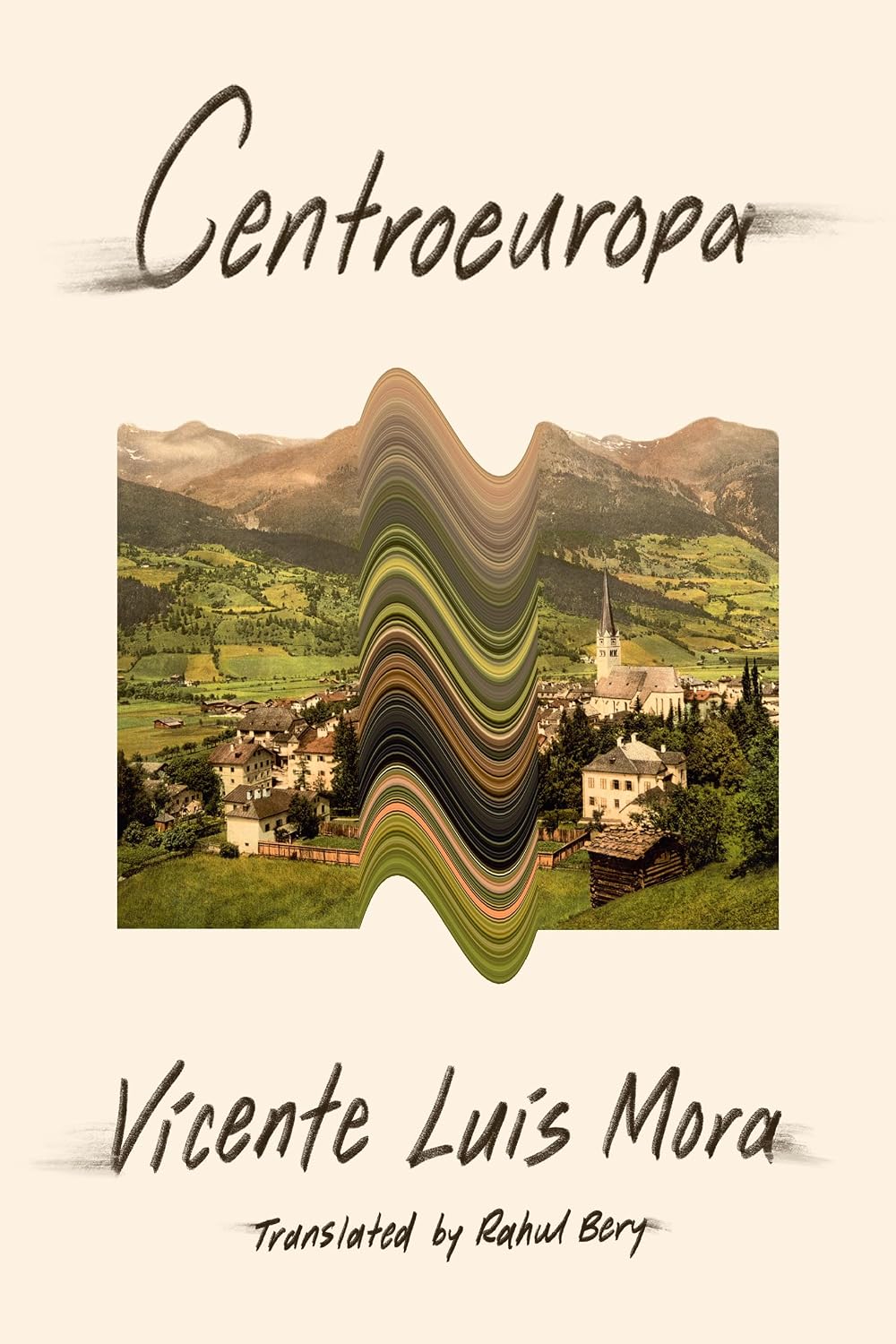
Vicente Luis Mora’s off-kilter Centroeuropa opens with the discovery of a body: “Male, Prussian, hussar soldier, frozen. That was the first body I found while digging in the frozen earth to bury my wife; I say my wife because I never knew her real name, although I will return to that later.”
In two brief sentences, we’re thrown into the deep end, challenged to keep up with the matter-of-fact but digressive and often fantastical tale related by “Redo Hauptshammer, born in a Vienna brothel at some point during the death throes of the eighteenth century.”
Reminiscent of the deadpan chaos of Patrick deWitt, especially his Undermajordomo Minor, Centroeuropa shares the same misty, fairytale quality within a hard reality. The bodies, of course, play a major role: First one, then two, four, eight, and 16 soldiers turn up during Redo’s digging, all from different eras of war in this region of Prussia. Indeed, the last, largest group of corpses is a mystifying contingent wearing uniforms and carrying weapons of advanced and unknown origin that won’t become familiar to local residents until more than a hundred years hence.
Redo stops digging because it’s clear the next set will consist of 32 soldiers, and that no good can come from finding them.
The bodies remain frozen no matter how long they’re aboveground; soldiers from the Roman Empire appear — just as all the others do — as though freshly fallen, captured at the very moment of death.
What is a person to do?
This is supposed to be farmland for crops, and cadaver-free acreage is quickly disappearing. Unwilling to keep digging, Redo takes the only available option and buries wife Odra in the soil under the small house that should have been their happy home.
Her freak-accident death — caused by Prussian soldiers pursuing an escaped French soldier firing into the crowded market square — occurs just as the couple is set to implement the final piece of their well-laid scheme. Adopting new identities, they’d left the brothel behind and planned to begin the farming life by claiming their legally deeded plot in the small municipality of Szonden, on the banks of the Oder River. Despite all joy in life having been snatched away by an errant bullet, Redo, with no place else to go, carries forward with their plan.
Critically, this is the exact moment when the ancient master-and-serf system is beginning to disintegrate. Redo and Odra were set to take possession of the first piece of privately owned farmland in an area where all other farmers remain vassals of the local noble — in this case, Baron von Geoffmann, “the Lord of Szonden” — whose rule is law.
All of this is so new that it’s unclear how Redo is to be treated or even addressed. To a snarky, officious servant, Redo says:
“I wish you a good day of labor and servitude, I’ll think of you in a few hours when I find myself once more in my liberated field, with no master or lord.”
Thus, when the bodies start to pop up on Redo’s land, no one is quite sure what to do about it. The baron, Mayor Altmayer, and the higher-up bureaucrats to whom the buck is passed all feel the bodies are Redo’s problem but object to every solution offered, especially when passers-by spot frozen corpses planted upright among the crops like so many icy scarecrows:
“There they remained, impassive, still frozen, independent of the sun and varying temperatures. From any corner of the land it resembled a macabre chessboard, with all the bodies turned toward the east so that the Oder could gather their gazes and carry away their detained horror forever.”
It becomes crucial to the powers up and down the hierarchy that the carcasses remain hidden and unacknowledged; they are a reminder of what war actually does to individuals and communities. As Redo expounds to Jakob, an historian, professor, and intellectual who becomes a dear friend:
“The citizens of Szonden are not horrified because they are corpses, but because they are young and recognizable, because their eyes are open and their flesh is still fresh, because it looks like their lives were only recently torn from their bodies. This is what no one wants to see. That war puts their sons in the firing line…If the horror is invisible, there is no horror.”
Beyond Jakob, Redo is surrounded by the town’s colorful characters: Hans, the unfailingly helpful peasant farmer next door; Udo, the giant; Johanna, Baron von Geoffmann’s lovely and voluptuous daughter, who keeps trying to seduce Redo; the baron himself; and Ilse, Szonden’s resident witch, who knows all the bodies’ — and Redo’s — secrets.
The reader will almost certainly guess Redo’s core secret, which is teased throughout, but that doesn’t diminish the enjoyment of this quirky, unclassifiable fable whose riddles are related by a self-admitted unreliable narrator. Just go with it.
Jennifer Bort Yacovissi’s novel, Up the Hill to Home, tells the story of four generations of a family in Washington, DC, from the Civil War to the Great Depression. She reviews regularly for the Independent and serves on its board of directors as president. Follow Jenny on Bluesky at @jbywrites.bsky.social.