Charlie and Me: Charles Manson and the Reporter Who Came to Know the Most Famous Mass Murderer in History
- By Mary Neiswender with Kate Neiswender
- Potomac Books
- 192 pp.
- Reviewed by Diane Kiesel
- January 8, 2026
An affecting recollection of time spent with a madman.
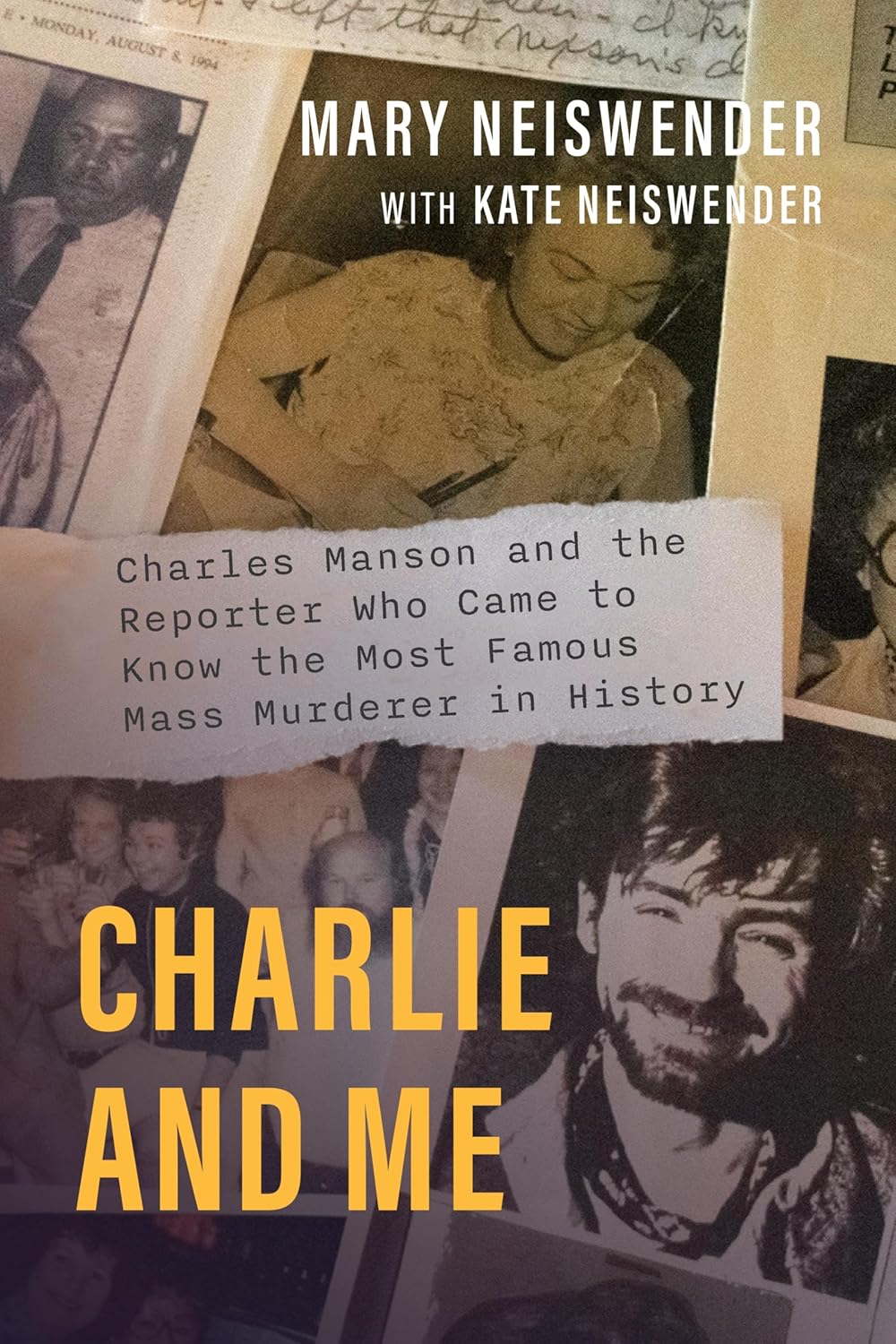
Just as Mel Brooks softens the fictional Führer in “The Producers,” Mary Neiswender (somewhat) humanizes the real Charles Manson in her new book, Charlie and Me. After covering his eight-month trial in 1970-71 for the Long Beach, California, Press-Telegram and interviewing him, Neiswender found him “charming, rakish, intelligent.” Meanwhile, Manson couldn’t keep away, calling her from jail three times a week. Neiswender’s contacts with Charlie were mostly off the record until he died in prison in 2017, when she no longer felt any obligation to honor their agreement.
The author, a pioneering reporter who died in 2025 at 99 (her daughter, Kate, a journalist and lawyer, supervised the book’s final edits), wasn’t fooled by Charlie’s jail-side manner. She recognized he was “violent, unpredictable, and cruel.” She thought he was a killer, although he steadfastly denied it. Yet, she was bold enough to air his side of the story.
“Some have suggested I should feel guilty about giving Manson a voice during his trial,” she wrote. “But I believe it is essential to find out what makes such men tick — how they think, how they operate and how they seduce others to kill.” By getting inside Manson’s strange head and sharing her insights, Neiswender turns a familiar old story into a fascinating new tale.
Who hasn’t heard of the Manson Family and the Tate-LaBianca murders? On August 9, 1969, in Los Angeles, actress Sharon Tate, nearly nine months pregnant with Roman Polanski’s baby, was butchered along with four others. The next night, supermarket executive Leno LaBianca and his wife were slain. The killers were Manson’s followers and were acting on his orders.
They painted the word “pig” in Tate’s blood on her front door and sliced “war” into LaBianca’s belly. Manson and his “Family,” mostly drug-addled young female runaways, fled to Death Valley, where the case went cold until they were arrested three months later for stealing cars. While in jail awaiting trial on those charges, Family member Susan “Sadie” Atkins bragged to cellmates about the Tate killings.
Neiswender snared one of 92 coveted courtroom seats when Manson was tried with Atkins, Leslie Van Houten, and Patricia Krenwinkel. Newsweek dubbed her “the greatest reporter at the trial.” Incredibly, she located witnesses investigators couldn’t: a Tate neighbor who heard shots and screams on August 9th and the student author of an anonymous account in the Harvard Crimson about hitchhiking with prosecution witness Linda Kasabian, whose words in the car differed from her court testimony.
Kasabian, who’d handed Krenwinkel the knife used to kill one of the victims, claimed to have fled in fear, but her fellow hitchhiker said she didn’t seem frightened. Kasabian fed lead prosecutor Vincent Bugliosi the “Helter-Skelter” theory that Manson directed the murders to ignite a race war. (Bugliosi made his own killing with his book of the same title. It sold 7 million copies, becoming the bestselling true-crime book of all time.) Kasabian was given immunity for fingering Manson, but Neiswender dismissed her inconsistent testimony as “highly questionable ramblings” uncorroborated by other evidence.
Both the author and Manson scoffed at Bugliosi’s race-war theory. Atkins’ more plausible explanation was that the Tate-LaBianca murders were staged to engineer the release from jail of Family member Bobby Beausoleil, who, together with Manson, had killed musician Gary Hinman days earlier and written “Helter-Skelter” on the deceased’s apartment wall. Beausoleil was arrested driving Hinman’s car and carrying the bloody murder weapon. Manson hoped that if the homicides seemed similar, police would think they’d nabbed the wrong guy.
Manson’s behavior with Neiswender could be creepy and calls into question why she didn’t end the “relationship,” such as it was. He ordered the uncharged Manson girls to grant her an interview. She went to their ranch to meet them, but while there, Manson called. “How the hell did you know I was here, and how did you get to phone?” she asked him. He didn’t respond.
The trial was a circus, with Manson the ring-leader. He goaded the inexperienced Judge Charles Older (on the bench fewer than three years) into screaming matches, resulting in Manson’s repeated removal from court. He leaped over counsel’s table, attempting to kill the judge with a pencil. Manson carved a swastika into his own forehead. The Nazi theme was big with the Family; they greeted the judge with the “Heil Hitler!” salute. Manson’s excuse:
“If you stand for it (the system) you are part of it.”
But surprisingly, it was Bugliosi whom Neiswender despised. The feeling was mutual. Bugliosi was livid because Neiswender published Manson’s rants. He was so petty, he also became infuriated when she described him in print as “balding.” In court, he threw temper tantrums. During one of Atkins’ frequent ejections from the trial, she tried to snatch papers from the prosecution table, leading Bugliosi to call her a “little bitch” and take a swing at her in front of the jury.
In fact, Bugliosi was universally loathed by reporters. “We took a quick poll, and the press corps voted him the man they’d most like to see go to the gas chamber with Charlie,” she writes. (Neither went; in 1972, the Supreme Court declared the punishment unconstitutional as then applied, and all death sentences were commuted to life in prison.)
After the trial, Manson stayed in touch with Neiswender. His letters are grammatical atrocities filled with whining about how he was railroaded in life (his mother abandoned him, he was raised by his Bible-thumping Kentucky grandmother and wasted his days in reform school or prison) and, of course, how he was railroaded at trial.
Readers will be surprised to learn about Manson’s unsung skills as a crime-fighter. While awaiting trial, he told Neiswender that the cops investigating an infamous murder case involving Jeffrey MacDonald had it wrong. On a North Carolina military base in February 1970, the pregnant wife and two young daughters of Capt. MacDonald, an army surgeon, were murdered in an alleged home invasion, while MacDonald suffered only superficial stab wounds. The word “pig” was written on a headboard, and the apparent Manson-copycat killings were initially blamed on crazed hippies. Manson’s take: Baloney.
“All the murderers I know would go after the husband first,” he explained. “He’d be the biggest one in the house. He would have been killed first. Not left alive. I’d take a long look at him if I were the cops.” If only investigators had reached out to Manson. Instead, it took nearly 10 years for MacDonald to be convicted of the murders.
Diane Kiesel is a retired judge. She is currently an adjunct professor of law and author. Her latest book, When Charlie Met Joan: The Tragedy of the Chaplin Trials and the Failings of American Law, was published last year by University of Michigan Press.