Charlottesville: An American Story
- By Deborah Baker
- Graywolf Press
- 432 pp.
- Reviewed by Chris Rutledge
- July 8, 2025
No, there weren’t “very fine people” on both sides.
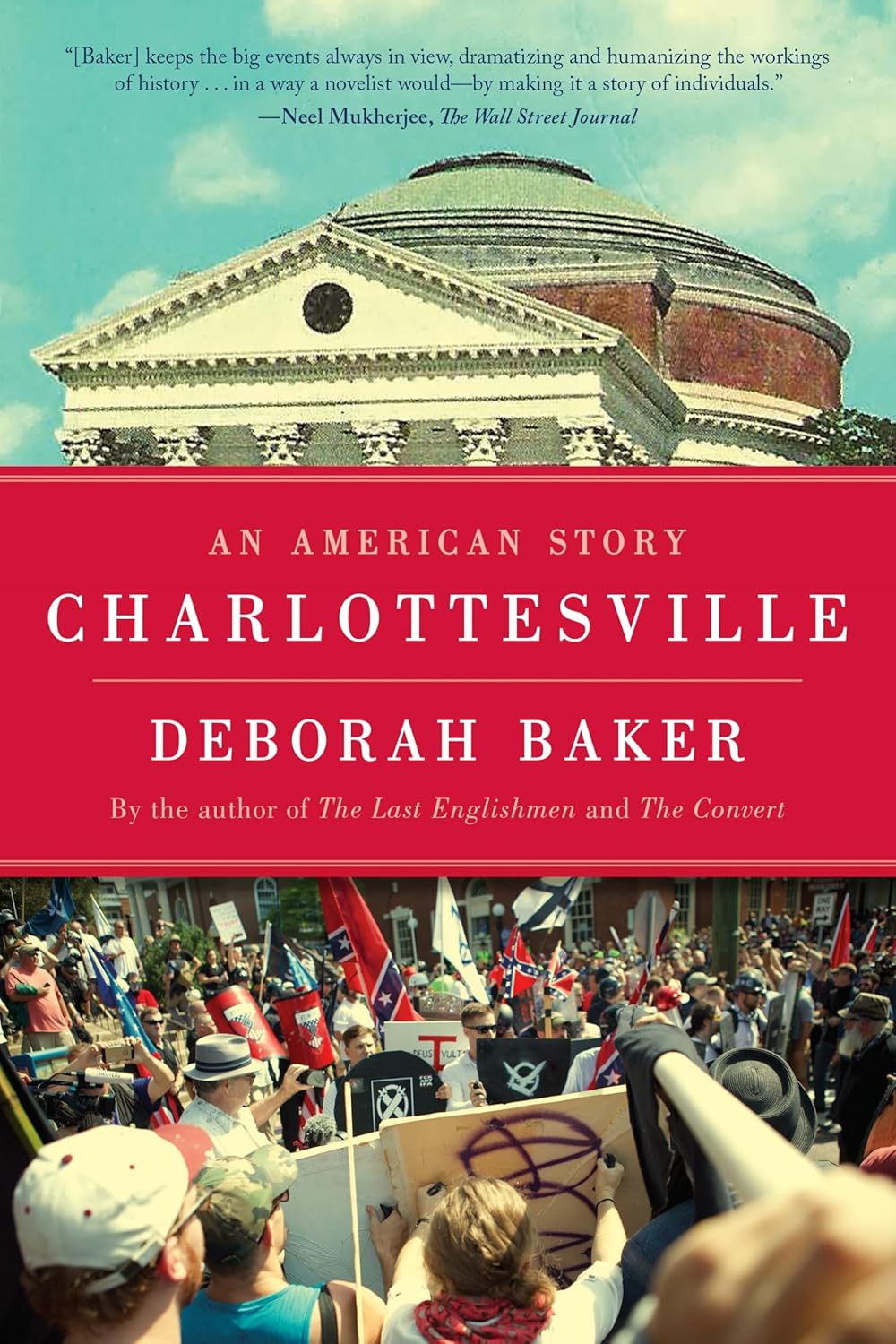
What started in August 2017 as a protest ended up being, in Deborah Baker’s account, “a riot…a media spectacle and a crime scene.” Her new book, Charlottesville: An American Story, details the infamous effort of far-right extremists to prevent the removal of Confederate statues from Charlottesville parks.
It was also an attempt by right-wing forces to strike fear in those who oppose racism. The rally was a wake-up call — the white-nationalist movement in this country is far more widespread and dangerous than many thought, populated by people living in what Baker defines as “an alternate reality where white Americans faced imminent extinction.”
The author is an historian of some renown and a finalist for both the Pulitzer Prize and the National Book Award. Further, she is a resident of Charlottesville, someone whose heart was broken by this tragedy in the city she loves.
The lead-up to the clash began when, earlier in 2017, members of the Charlottesville city council debated a proposal either to rename the parks in which statues of Robert E. Lee and Stonewall Jackson stood or to remove the statues entirely.
Richard Spencer, founder of the alt-right National Policy Institute, and others of his ilk assessed that the uncertainty by city leaders and Charlottesville’s generally genteel nature presented a soft target. They moved to protect the statues’ sites, partly out of misplaced “white pride” and partly to “own the libs.”
Thus began a months-long effort to stage a protest designed to block the removal of the statues. As on the vote to remove the statues themselves, city leaders equivocated, proposing alternate protest sites, aiming to move the right-wing protestors away from the parks and into less central locales. Spencer and main organizer Jason Kessler fought such moves and used the officials’ objections to rile up their base.
The alt-right was met by various groups on the Left, including a robust clerical contingent. A local theologian explained that they participated because many clergy members “believed the failure of German church leaders to confront Hitler’s Brown Shirts” led to his inevitable rise.
Spencer, Kessler, and their cohort engaged in a pre-rally march to the University of Virginia campus on August 11th. Hundreds of racists marched on the city, brandishing the now-familiar Tiki torches and chanting racist taunts, including “Jews will not replace us.” Virginia police had information about the march as early as July 14th, including the Tiki-torch plans. They shared this with the Charlottesville police, the Albemarle County police, and UVA police. These forces, writes Davis, “seemed to have filed it away and forgotten about it.”
The marchers were met by a smaller counter-protesting contingent of UVA students. Police protection for the counter-protestors was non-existent. The students were surrounded and beaten. Nonetheless, Charlottesville did not cancel the main protest event, scheduled for the next day.
As dawn rose on August 12th, law enforcement and other authorities were already noticing signs of being overmatched. One Virginia state trooper said of the alt-right protesters, “They’re more armed than we are.” These protesters showed up in large numbers, bearing racist signage and MAGA gear and repeating the threatening language of the night before.
The marchers were again met by counter-protestors, including some of the young church leaders. Originally, the intent was for the religious groups to offer prayer vigils, but counter-protestors soon determined that they needed a more visible presence to oppose the hate. A melee quickly ensued. Water bottles and other items were hurled. Only after dozens of injuries did Charlottesville pull the plug on the event, leaving hundreds of angry racists in the streets.
Among them was James Alex Fields Jr., who rammed his Dodge Challenger into the unarmed crowd, killing counter-protestor Heather Heyer. Baker recounts her murder and the injuries suffered by other counter-protestors; dozens of those who’d come to fight fascism suffered wounds to their legs, spines, and other body parts. Baker conveys their pain without sounding exploitatively graphic.
She clearly sides against the alt-right — calling them “Americans who co-opt patriotism in service of an obsession with personal liberty…to own people…to tout their racist views…or to overturn the results of an election” — but her bias isn’t a weakness. Instead, the book serves as a powerful indictment of the portion of the American public that feels threatened by our growing non-white majority.
Baker’s comparison of the two sides is stark. One side screams racist and antisemitic vitriol, while the other demonstrates the spirit shown in Cornel West’s words, “Let us bear witness to love, knowing that justice is what love looks like in public.”
It is almost impossible to read Charlottesville without feeling outrage. The fact that such battles continue today is damning. Knowing the motivations of all the players, it’s hard to imagine that there are truly “very fine people on both sides” of this fight.
Chris Rutledge is a husband, father, writer, nonprofit professional, and community member living in Silver Spring, MD. Besides the Independent, his work has appeared in Kirkus Reviews, American Book Review, and countless intemperate Facebook posts, which will surely get him into trouble one day.