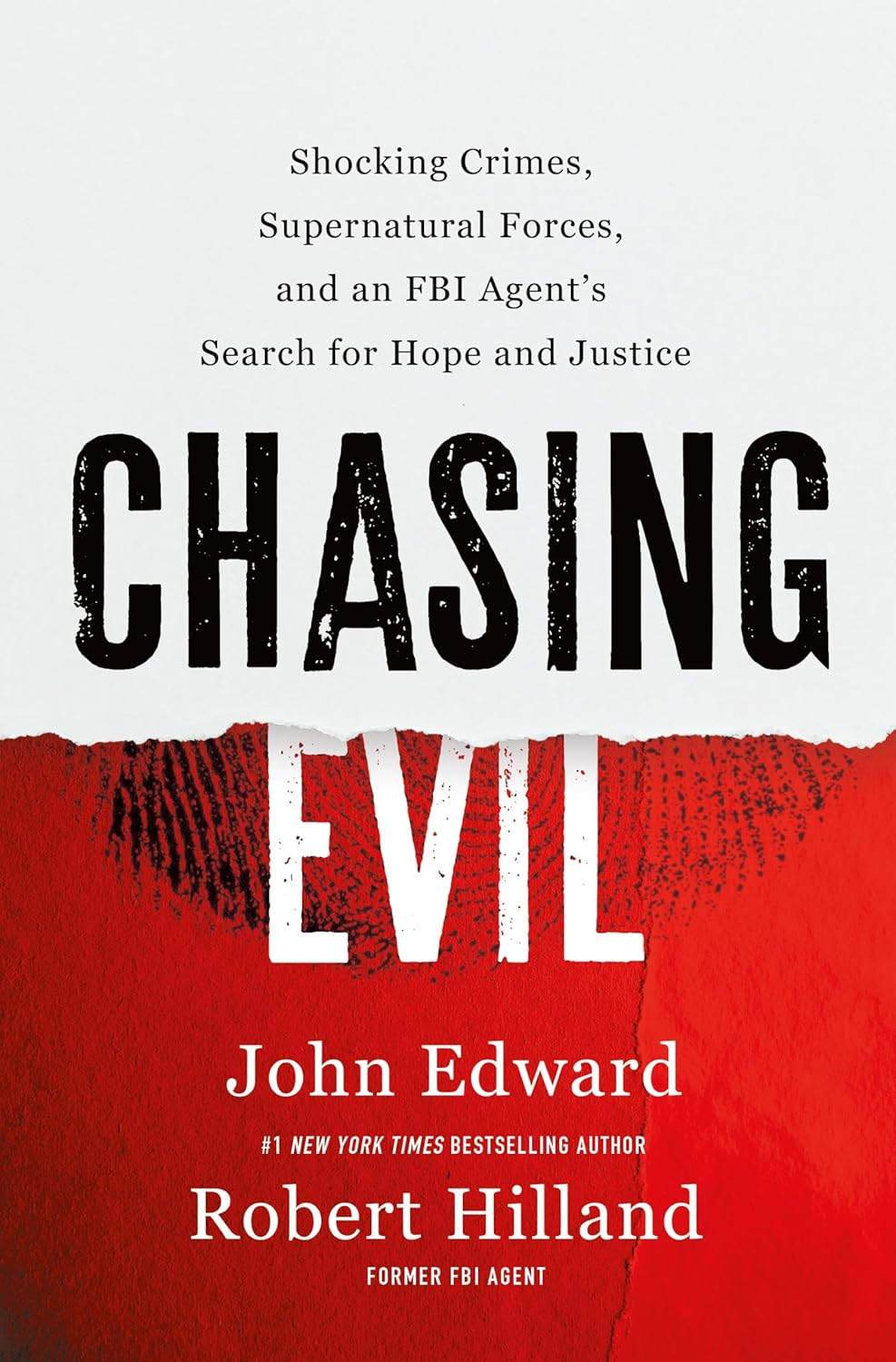
Chasing Evil: Shocking Crimes, Supernatural Forces, and an FBI Agent’s Search for Hope and Justice
- By John Edward and Robert Hilland
- St. Martin’s Essentials
- 368 pp.
- Reviewed by Diane Kiesel
- August 28, 2025
Don’t buy the hocus-pocus? This is still a riveting police procedural.
The early-20th-century’s most famous escape artist, Harry Houdini, spent the last 30 years of his life unmasking charlatan mediums who claimed to carry messages from the departed to the bereaved. Before he died of a ruptured appendix on Halloween 1926, Houdini promised his wife that, if possible, he’d contact her from beyond the grave. But after a decade of waiting in vain, his loving Bess gave up.
Now, former FBI agent Robert Hilland, familiar to insomniac true-crime junkies from late-night reruns of “20/20,” “Cold Case Files,” and “On the Case with Paula Zahn,” reveals having long teamed up with media-star psychic John Edward. Beginning in 1998, Edward and his spectral contacts have (allegedly) helped Hilland solve cold cases and climb the professional ladder.
In their new book, Chasing Evil, Hilland and Edward expect readers to suspend common sense and take at face value that Edward is the real deal (though Houdini never managed to find him) and that Hilland couldn’t have solved the case of serial killer John Smith — and others in his 25 years at the FBI — without assistance from those who have “shuffled off this mortal coil.” The premise is a large pill to swallow.
Hilland says he, too, was skeptical before teaming up with Edward on the Smith case. (Even Hilland’s ex-wife thought Edward was a con artist; perhaps that’s what helped tank their long marriage.) Nonetheless, the cop and the psychic joined forces to outsmart Smith, whose wife Fran disappeared in West Windsor, New Jersey, in 1991. Hilland was a cop in West Windsor back then and caught a glimpse of Smith and his “predatory eyes” when the man came to Hilland’s precinct to report Fran’s disappearance. (The police would discover that Smith also had a first wife, Janice, who’d disappeared from their Ohio home in 1974.)
Six years later, Hilland joined the FBI’s New York City Cold Case Squad, learned the Fran Smith case had never been solved, and convinced a supervisor to let him reinvestigate. After hitting a wall, and with no earthly place left to turn, he threw a Hail Mary pass to Edward, who had a radio call-in show. Visiting Edward at his office with a West Windsor detective, Hilland immediately was impressed that the psychic — without being told — was able to identify him as the fed and his companion as the area cop.
(After a decade as a prosecutor, I can state, with no help from the great beyond, how to spot the FBI guy from a mile away: He’s the one in the well-tailored, Brooks Brothers grey wool suit. The local detective is probably wearing a plaid sportscoat that can be thrown in the dry cycle.)
Knowing nothing about the case, Edward told Hilland the suspect was the victim’s husband or boyfriend, named either John, Jim, or Joe Smith. Edward said the victim’s name was “Fran” and that she was killed, dismembered, and possibly stuck inside a concrete cylinder. Although the police long suspected Smith, there was scant evidence to charge him, and he vanished from their radar by 1995. Edward told Hilland that he was living out West. Recalls Hilland:
“I walked into John Edward’s office that day a cynic and walked out with my belief system rattled, turned upside-down, like one of those snow globes after a vigorous shake.”
Later, Edward revealed that Smith’s brother, Michael, was key to solving the case. Ironically, it would be Janice’s murder rather than Fran’s that the crime-fighting team of Hilland and Edward would solve.
Whether readers buy the idea that Edward possesses clairvoyant powers ends up being irrelevant. Chasing Evil is a good, old-fashioned police procedural and an entertaining page-turner. Pounding the pavement and re-interviewing witnesses eventually led Hilland to Escondido, California, where Smith (as Edward predicted) had moved. He’d taken on a third wife, who investigators feared might also be in danger.
Meanwhile, as also foretold by Edward, Michael Smith revealed that brother John built a plywood box on Thanksgiving Day 1974, which sat in their grandfather’s garage for five years. When it was finally opened, it stank to high heaven and contained some of Janice’s body parts. When confronted, Smith told Michael that Janice had been murdered by drug dealers who thought she was an undercover narcotics agent.
Believing the preposterous story, Michael, a real-estate developer, suggested his brother dump the body under the cement floor of a townhouse he was building. Following the tip, Hilland and his fellow agents spent three days digging there but turned up nothing. Unfortunately, local news stations got wind of it and mistakenly broadcast that the FBI was searching for the body of Jimmy Hoffa. Hilland’s FBI supervisors were furious, yanked him off the Cold Case Squad, and insisted he forget about the Smith homicides.
Edward claims his talents include seeing fragments of names and visions of places that become relevant to investigations. He communicates with dead victims who sometimes hint at where their bodies are stashed. Regardless of whether these assertions are accurate or absurd, it was the miracle of meticulous police work — and not communiques from the departed — that ultimately solved the Smith case.
Early in 2000, investigators methodically sent letters to multiple law-enforcement agencies in the Midwest, asking if a strange box had turned up in their jurisdiction. As it happened, the box containing pieces of Janice had been found along a road outside Hammond, Indiana, back in 1980. At that time, the police didn’t put two and two together. They buried the remains in a pauper’s grave and saved the box’s other contents. After the body was exhumed, John Smith was arrested for Janice’s murder on October 1, 2000. He was convicted and sentenced to 15-years-to-life in prison. To date, neither police work nor hints from the hereafter have led to the location of Fran’s body.
Diane Kiesel is a retired judge. She is currently an adjunct professor of law and an author. Her latest book, When Charlie Met Joan: The Tragedy of the Chaplin Trials and the Failings of American Law, was published this year by University of Michigan Press.