Checkmate: Genius, Lies, Ambition, and the Biggest Scandal in Chess
- By Ben Mezrich
- Grand Central Publishing
- 304 pp.
- Reviewed by Nicole Schrag
- June 29, 2026
The game’s fighters extend far beyond queens and rooks.
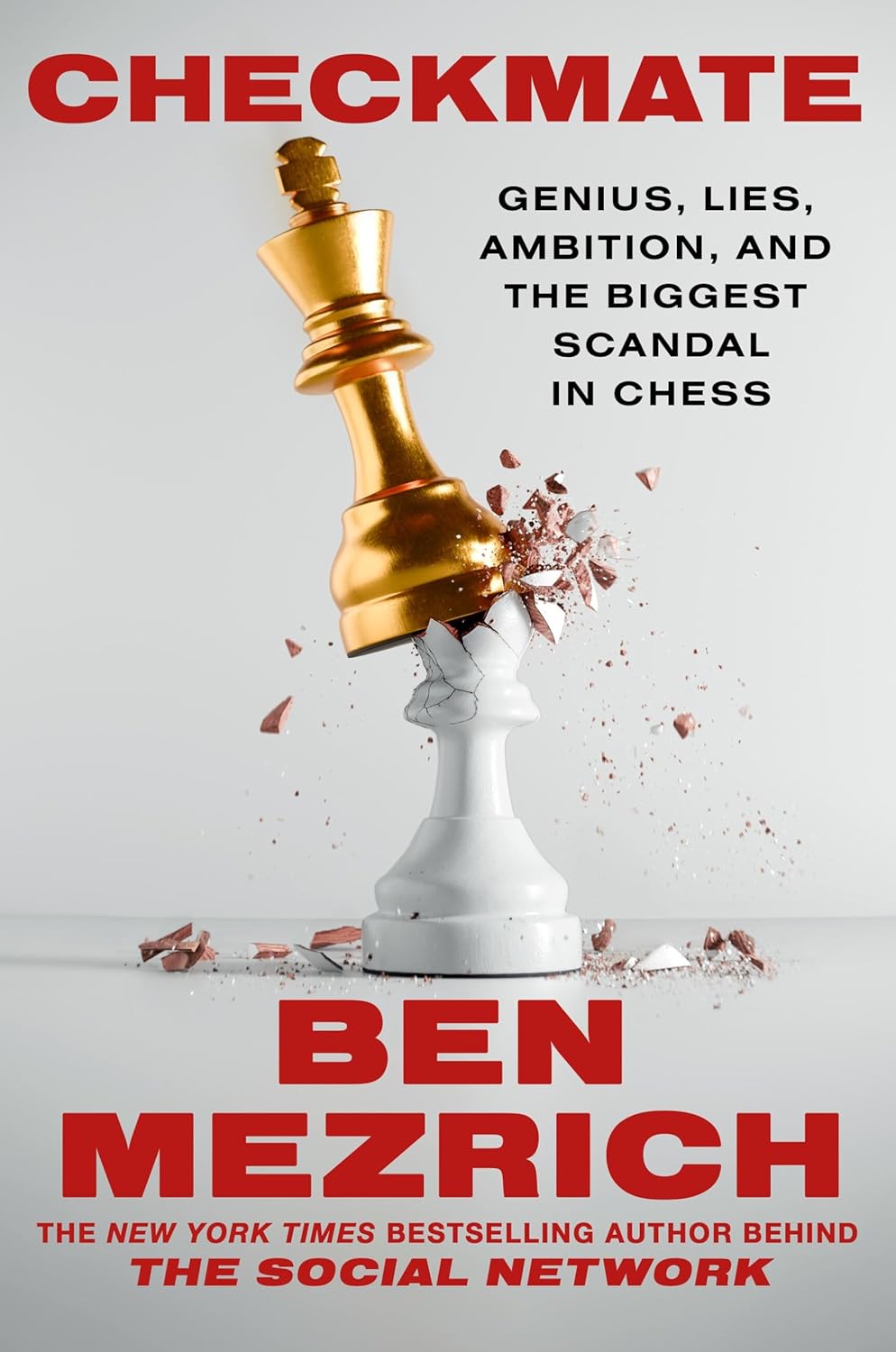
Checkmate begins with what is probably the most famous chess match in recent years: when 19-year-old upstart Hans Niemann beat the reigning world champion, Magnus Carlsen, at the Sinquefield Cup in 2022. The match itself was remarkable, but what came after was even more so: Carlsen was convinced that Niemann cheated and publicly accused him of doing so.
Author Ben Mezrich, best known for The Accidental Billionaires, which was adapted by Aaron Sorkin into the script for the movie “The Social Network,” introduces the idiosyncratic figures who found themselves embroiled in the very online, very messy scandal that followed. In addition to Carlsen and Niemann, we meet Erik Allebest and Danny Rensch, the co-founders of Chess.com, who first discovered Niemann’s cheating in online games and who ultimately took on the investigation into his alleged cheating in “over-the-board” matches.
Magnus’ father, Henrik Carlsen, whom Mezrich repeatedly describes as a man of honor, bears quiet witness to his son’s indignation, making phone calls to lawyers and giving a nod here or there to Magnus’ provocative online statements. And we meet the internet troll responsible for the “anal beads” post retweeted by Elon Musk that catapulted the match into mainstream discourse and humiliated Niemann.
Mezrich’s portraits of Carlsen and Niemann are the stuff of cinema. (And, in fact, an A24 film adaptation of this story is in the works, to be directed by Nathan Fielder and produced by Emma Stone.) Niemann, the “enfant terrible” of chess, lives alone, mostly on the road; wears black on black; and trashes hotel rooms. Carlsen is an impassive Norwegian who, despite being well into his 30s, is accompanied by his dad to most of his major tournaments. But after Carlsen suggests to his massive online following that Niemann cheated at Sinquefield, their conflict quickly escalates to one of Niemann against the world.
This interpersonal drama is one thing, but Mezrich shows how it points to something even larger afoot in the chess universe: the way that online engines are upsetting the status quo. Children training against computers are achieving Grand Master status at younger and younger ages, unquestionably raising the level of the game.
And as Chess.com’s investigation into Niemann’s career demonstrated, cheating online is actually far easier to prove than cheating “over-the-board.” While the viral “anal beads” were a fiction (at least, I’m pretty sure they were), players with a device transmitting information deep in their ear canal could easily infiltrate the old-school, in-person tournaments and receive coaching from someone streaming the match offsite.
Did Niemann cheat? I won’t tell you what Mezrich concludes, though I will say I personally found his deduction a little unsatisfying. Even so, in a stunning late chapter, the author breaks the fourth wall and names his own tendency to sink into the perspectives of the people who populate this story: “As good as he was at endearing himself to his main characters,” he writes of himself in the third person, “Ben was just as easily smitten by them.”
The book comes off like a novel, with Rensch’s tortured past, Allebest’s ex-Mormon guilt, and an internet troll’s repulsive self-satisfaction animating key plot points. While Mezrich may be “motivated to believe everything they told him,” he is in firm narrative control. The structure of the book works to build effective tension, and he paces out revelations at precisely the right moments.
Not being particularly invested in the world of chess or the politics of competitive play, I wasn’t initially inclined to care much about any of these characters. Having finished the book, I can say that nothing has really changed. Still, by Checkmate’s last act, Mezrich had me tearing through the pages. The prose leaves something to be desired — in one instance, a character’s “alarm went off like a fire alarm” — but once I finally bought into the drama, I could forgive the occasional clunky sentence.
References to opening strategies and endgames will enliven the reading experience for those who love chess, but even those who don’t will likely enjoy Checkmate.
Nicole Schrag is a writer and educator based in Tampa, Florida.