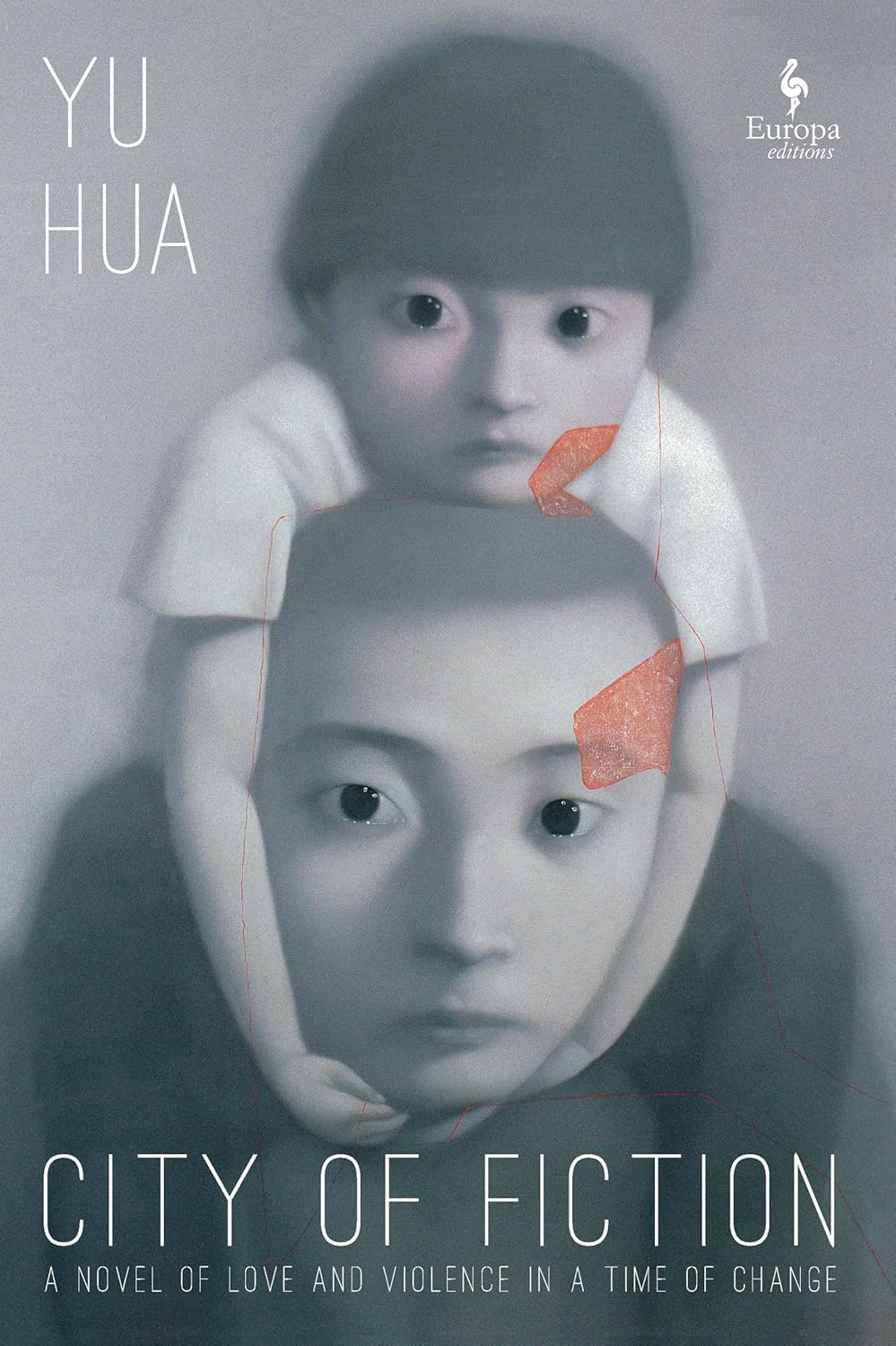
City of Fiction: A Novel of Love and Violence in a Time of Change
- By Yu Hua; translated by Todd Foley
- Europa Editions
- 432 pp.
- Reviewed by Marcie Geffner
- May 9, 2025
Fate looms over all in this dark, ethereal tale from China.
A stranger comes to town. Does his arrival change his fate and everyone else’s? Or does fate itself guide his arrival, setting subsequent events in motion on its own?
The first stranger in Yu Hua’s City of Fiction is Lin Xiangfu, a loving father who carries his newborn, not-yet-named daughter by boat and on foot from their home in northern China to Xizhen. It’s in this far-distant southern city that he’ll become a furniture-maker and landowner while he searches for his child’s mother, who left without an explanation.
Xizhen may also be the hometown of two other strangers, Aqiang, a reckless young man from the south, and Xiaomei, whom Aqiang claims is his sister. They arrived earlier at Lin Xiangfu’s northern home after the wagon transporting them on their journey from “Wencheng” to Beijing broke down, leaving them stranded by the roadside. Given shelter, they play a prank on Lin Xiangfu. Does their deceit change their lives — or his — or were their lies, too, preordained? The novel’s narrator suggests an answer:
“It was all in the hands of fate.”
We’re given this explanation at the pivotal moment when Lin Xiangfu’s wife is deciding whether to remain with him and their daughter or return to another life where a different and ultimately darker fate may await her. Will her choice alter all of their lives, or will everything still happen exactly as fate intended?
Important items made of wood, including the wagon, bridal chairs, and coffins; significant articles of clothing, like headscarves, wedding attire, and children’s wear; and the lucky color red recur in the narrative as couples marry, children grow, elders die, and Lin Xiangfu continues to await his wife’s return.
Few of the deaths are peaceful. More often, severe weather, marauders, war, kidnapping, and torture are involved. The narrator softens the gruesome details with a simplicity and directness that convey plenty of emotional intensity without unnecessary embellishment.
One great battle, in which the brutal gangster One-Ax Zhang and his desperate thugs attack a small village, is described thusly:
“After the ten young women had been gang-raped by all of the bandits, the bandits then chopped off their heads. Flames roared through Qijiacun, crackling and popping as the village burned…The river water, the grass, the leaves on the trees, the dirt on the ground — all of it was stained red with blood…Shrieks and wails pierced the air; after dark, a strong wind carried mournful cries out into the night.”
When it’s over, almost half of the town’s 600 inhabitants are dead. Corpses lay everywhere. Yet the narrator’s telling couldn’t be more matter-of-fact. Outlaws, beheadings, blood that seems to rain from the sky? Such, we are to understand, is the stuff of life. It’s to be expected.
Xizhen’s other residents include Lin Xiangfu’s loyal business partner, Chen Yongliang, and his sympathetic wife, Li Meilian; the town’s respected leader, Gu Yimin; and its patient, aging concubine, Cuiping. They are ordinary people, yet they and many others display extraordinary kindness, generosity, and courage in the face of terrible circumstances. This is a tale of resilience; the people are undaunted. Fate must be faced with fortitude. Again, the narrator emphasizes this point:
“When Gu Yimin learned that Chen Yongliang’s family had moved to Qijiacun, he was shocked. ‘The bandits are all over the Wanmudang,’ he said to Lin Xiangfu…‘Why would Chen Yongliang move out to the Wanmudang?’
“Lin Xiangfu didn’t respond immediately. Then, as if to himself, he said, ‘One can only follow the will of heaven.’”
Though a main character dies at the story’s three-quarter mark, the book’s pace never falters. Reversals and revelations continue to pile up to the devastating ending. Again and again, we’re forced to consider: Can we choose our fate or alter our luck, or are events — and our reaction to them — foreordained?
Born in Zhejiang, the author began writing in the early 1980s. Today, his novels and short stories are beloved and honored in his native China and beyond. Todd Foley’s fine translation of City of Fiction should cause Yu’s work to finally be celebrated by English-language readers, as well.
Marcie Geffner is a journalist, writer, and literary critic in Ventura, California.