Contested Continent: The Struggle for North America, c. 1000-1680
- By Peter C. Mancall
- Oxford University Press
- 752 pp.
- Reviewed by John A. Farrell
- August 21, 2026
No land is ever conquered quietly.
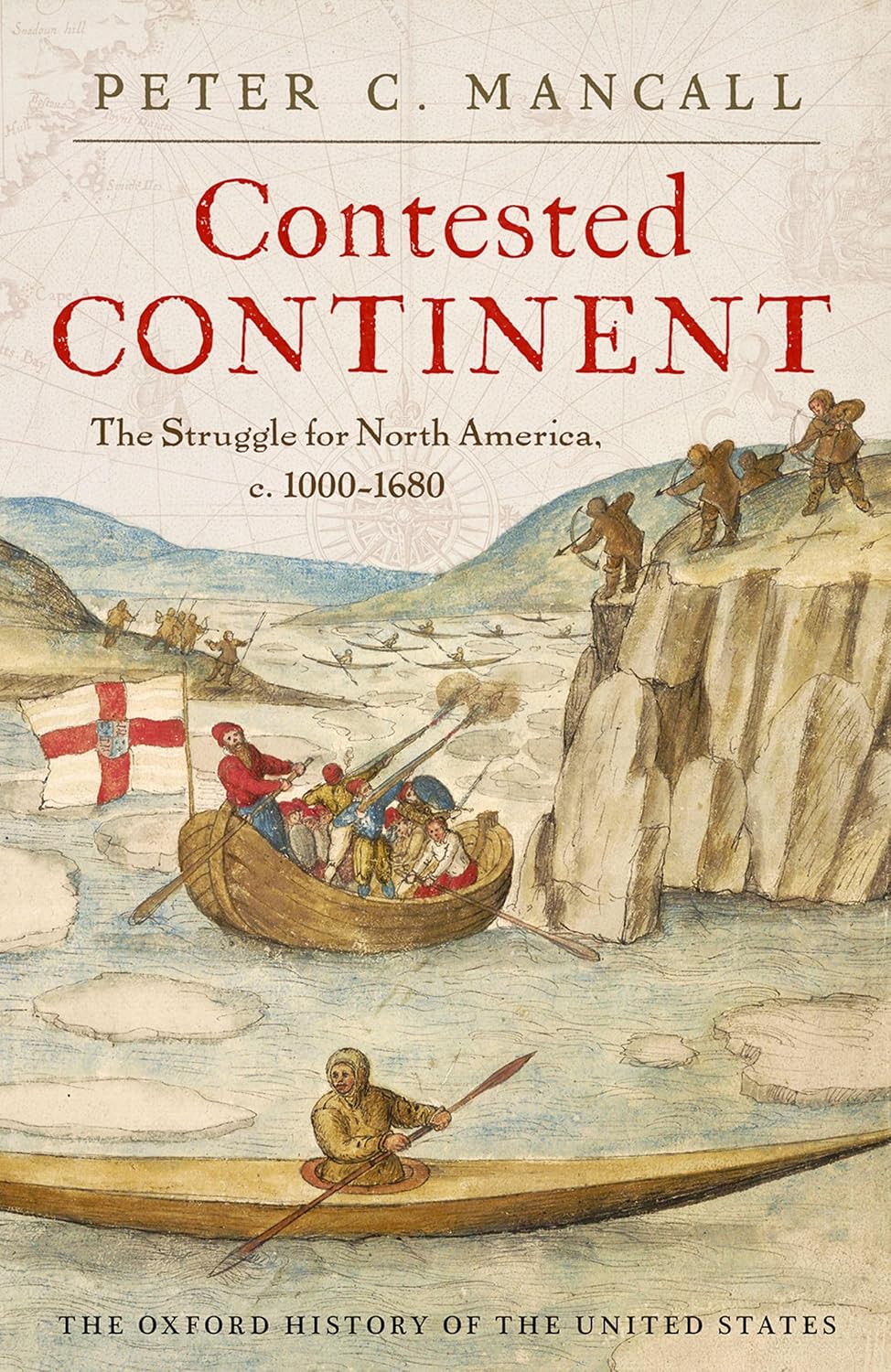
Contested Continent is a book for our amoral era: 700 pages of homicide and thievery, pestilence and greed, starvation, cannibalism, piracy, torture, shipwrecks, rape, and slavery. No one here comes out alive and no one comes out looking good.
Peter C. Mancall’s detailed history of the European exploration and early colonization of North America is the 10th and latest (though chronologically the first) entry in the worthwhile Oxford History of the United States series. From Leif Erikson to William Penn — with featured roles by Christopher Columbus, Hernán Cortés and the conquistadors, an Indian princess named Pocahontas, and others — the book tells an epic story and a grim one.
In the famous concluding paragraphs of The Great Gatsby, F. Scott Fitzgerald wrote about the Dutch explorers who crossed the Atlantic and came upon “the last and greatest” of all human dreams:
“For a transitory enchanted moment man must have held his breath in the presence of this continent, compelled into an aesthetic contemplation he neither understood nor desired, face to face for the last time in history with something commensurate to his capacity for wonder.”
The accounts of the early European adventurers were, indeed, full of wonder. They spoke of a new Eden, of flowers and fruit trees, butterflies and wildlife. Their narratives — reproduced in ink on paper and distributed throughout Europe via the sorcery of the newly invented printing press, Mancall instructs us — made the New World seem a beckoning oasis.
So they came, never short on grit or daring: refugees from Europe’s wars, plagues, and economic dislocation; younger sons with no prospects at home; penal transportees; parvenues and corporate hirelings; enslaved and indentured laborers; religious and political exiles; and all other sorts of desperate human beings.
At one point, Mancall tells the story of “Jane,” an early Jamestown, Virginia, settler “whose remains, scarred by other colonists scraping her flesh for a meal” were uncovered by archeologists in a basement there:
“Something, perhaps dysentery or typhoid fever, had felled her. Maybe she was murdered. Whatever happened, her body ended up underneath a kitchen. Countless thousands of humans, not abstract forces like capitalism or imperialism, struggled to survive in the new world that the era of Columbian voyages had pushed into existence — even if it meant eating their own to avoid starvation.”
From the time that the Norse left their footprints in Newfoundland, it took 600 years before the first European settlements were firmly rooted. One after another, they failed because crops died, the climate changed, pandemics swept through, or the Indigenous tribes concluded that the trading goods of Europe were no longer worth the threat to their lands posed by these inept and avaricious foreigners and their brutal, fanatical priests.
At a moment when the telling of American history is a soccer ball in the culture game, Mancall — an historian from the University of Southern California — gives it to us straight. This is a difficult book to read at times, but it is admirably free of conservative cant and liberal sanctimony. It is a clear-eyed saga about the best and worst in humanity, not a screed on settler colonialism, a preachy treatise on race and gender, or a glowing ode to capitalism.
Dutch. Swedes. Norse. Spaniards. The Oyo and Ashanti. The Portuguese. The French. Indians. The Brits. There is no system, no race, no tribe or nationality to single out for condemnation. The conquering of the New World was a planet-shakingly transformative and inevitable event. All gave as good as they got — though the Indians got it worst. Mancall shows us the fate of two Indigenous warriors taken prisoner in New England for murdering colonial fishermen:
“A crowd of women leaving the Marblehead meeting house seized the prisoners and began to pelt them with stones and wooden planks. The women chased off the colonial soldiers, grabbed the captives by the hair and killed them with their hands. ‘We were kept at such distance that we could not see them till they were dead,’ one of the men informed Boston authorities. ‘We found them with their heads off and gone, and their flesh in manner pulled from their bones.’”
Long before the first enslaved African was landed at Jamestown in 1619, the Spanish conducted a thriving trade in enslaved Indians — until European violence and disease wiped out the native stocks. Bartolomé de Las Casas journeyed with Columbus and, in 1552, published A Short Account of the Destruction of the Indies. The people of Hispaniola (now the island of Haiti and the Dominican Republic) had been reduced in that first half-century, he wrote, from 3 million to 200. When the native Taino people, outraged by the rape of a chieftain’s wife, rebelled, the Spanish invaders marched on the Taino towns, Las Casas writes:
“…slaughtering everyone they found there, including small children, old men, pregnant women and even women who had just given birth. They hacked them to pieces, slicing open their bellies with their swords as though they were so many sheep herded into a pen. They even laid wagers on whether they could manage to slice a man in two at a stroke...or disembowel him with a single blow of their axes. They grabbed suckling infants by the feet and ripping them from their mothers’ breasts, dashed them head on against the rocks...(or) into a river shouting: ‘Wriggle you little perisher.’”
The conquerors of the Americas had become “so anaesthetized to human suffering by their own greed and ambition they had ceased to be men in any meaningful sense of the term,” wrote Las Casas, by then a repentant Dominican priest.
The most that can be said for these pioneers and settlers, concludes Mancall, is that many — perhaps, like us — proceeded in self-delusion, with the best intentions. But by 1682, when he ends his tale, wonderment has turned to horror. “Desecrated churches in the Southwest, decapitated Indigenous in New England, burned bodies in Barbados,” he writes. “No one had fully anticipated a landscape littered with such a legacy of hatred and revenge.”
John A. Farrell, Ph.D., is working on a book about the American Revolution and the frontier. He has written biographies of Richard Nixon, Tip O’Neill, Edward Kennedy, and Clarence Darrow.