Crick: A Mind in Motion
- By Matthew Cobb
- Basic Books
- 608 pp.
- Reviewed by Stephen Case
- January 22, 2026
An outstanding look at the DNA whisperer’s life.
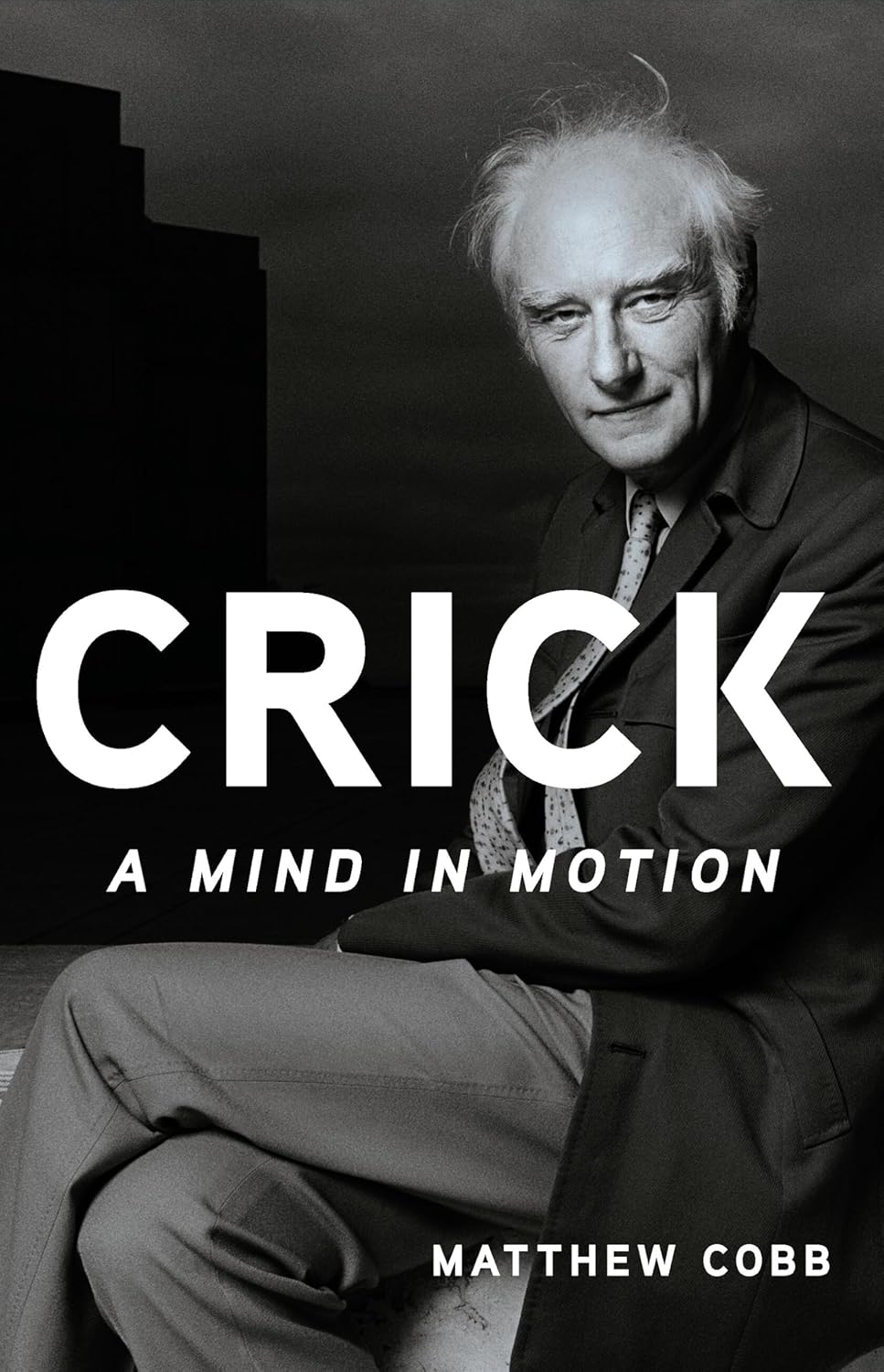
“We found the secret of life!” Francis Crick apocryphally boasted to strangers right after he and colleague James Watson discovered the double-helix structure of DNA in 1953. (Yes, their findings were that monumental, but Watson later confessed the boast was concocted.) The British Crick was, at the time, a 37-year-old doctoral candidate at Cambridge, as well as an impecunious, divorced and remarried, tall, skinny, balding father of two who spoke with a high-pitched voice. For his remarkable discovery, he — along with Watson and another scientist, Maurice Wilkins — won the Nobel Prize.
In the masterful Crick: A Mind in Motion, biographer Matthew Cobb engagingly recounts the man’s life and career. A zoology professor emeritus at the University of Manchester, the author knows his stuff and his subject. (In making their breakthrough, Crick and Watson famously drew on an X-ray image of DNA — “Photograph 51” — taken by a student working under scientist Rosalind Franklin without first requesting consent or later giving credit. The book offers a detailed, well-balanced account of the matter, one that leaves it to readers to judge whether there was any wrongdoing.)
Crick’s work on the double helix — plus much subsequent, tedious research — led him, in 1957, to announce his even-more-momentous “Central Dogma” of molecular biology: Each human cell, its own amazing chemical factory, harbors DNA in its nucleus, and “DNA makes RNA, and RNA makes proteins.” The term “proteins,” however, encompasses much more than the humdrum nutrients we get from eating meat. For example, in molecular biology, fingernail tissue (keratin) and insulin are “proteins.”
The raw materials for protein-making are amino acids, small molecules that link together like chains to become large-molecule proteins. (Think of them as “chapters” in protein “books.”) Obedient to the orders coming from their DNA, the busy little amino acids form countless indispensable-to-life proteins. To assemble them, Crick determined, DNA works through a dizzying array of back-and-forth information transfers — “transcription” and “translation” — involving, among other things, RNA, ribosomes, and methylation. It’s a complex, fascinating process.
(Some readers may find the author’s occasional barrages of jargon to be overwhelming; this reviewer, using dictionaries and the internet, found that drilling down was easy enough and worth the effort.)
Outside his trailblazing research, Crick was an independent, sometimes “bad-boy” free thinker, writes Cobb. While serving at Churchill College, Cambridge, Crick (who abhorred Christianity) resigned when trustees approved the construction of an Anglican chapel on campus. He mailed his resignation letter directly to the college’s 86-year-old chairman of trustees, Winston Churchill, who, puzzled, wrote back, “A chapel, whatever one’s views on religion, is an amenity which many of those who will live in the College may enjoy, and none need enter it unless they wish.”
Cleverly, Crick counter-proposed to Churchill an amenity of his own, the building of a “permanent accommodation within the College, to house a carefully chosen selection of young ladies in the charge of a suitable Madam who…will doubtless be provided, without offence, with dining rights at the High Table.” Churchill returned, uncashed, the check for 10 guineas that Crick had enclosed to kick off the fundraising.
Further cementing his reputation for brashness, Crick went on LSD trips, staged parties at home featuring naked women, and (most disturbingly) flirted with eugenics. He also indulged endlessly in adultery, even though his long-term second wife, the “flirtatious” Odile, didn’t seem to care. She was, Cobb reports, a skilled, sensitive artist and a gracious hostess.
In his career’s final phase, Crick, by then living in California, focused on brain science, specifically vision. “The problem,” writes Cobb, “was that scientists had no idea how sensory stimulation gives rise to conscious perception (we still do not).” Later, he switched his work to human consciousness in general. Despite tireless effort, extensive collaborations, and many publications, by the time of his death in 2004 at age 88, Crick had produced no breakthroughs in the field. “But then again,” the author reminds us, “nobody else did [either] in Crick’s lifetime or since.”
By non-judgmentally recounting both the highs and lows of Crick’s life, Cobb has given readers an affable, informative assessment of a brilliant, imperfect man.
Stephen Case is the co-author of Treacherous Beauty: Peggy Shippen, the Woman Behind Benedict Arnold’s Plot to Betray America and serves as treasurer of the Independent.