Crocodilopolis: A Novel
- By John Manuel Arias
- Bloomsbury Publishing
- 352 pp.
- Reviewed by Mariko Hewer
- August 20, 2026
A searing portrayal of generational strife set against a lush Costa Rican backdrop.
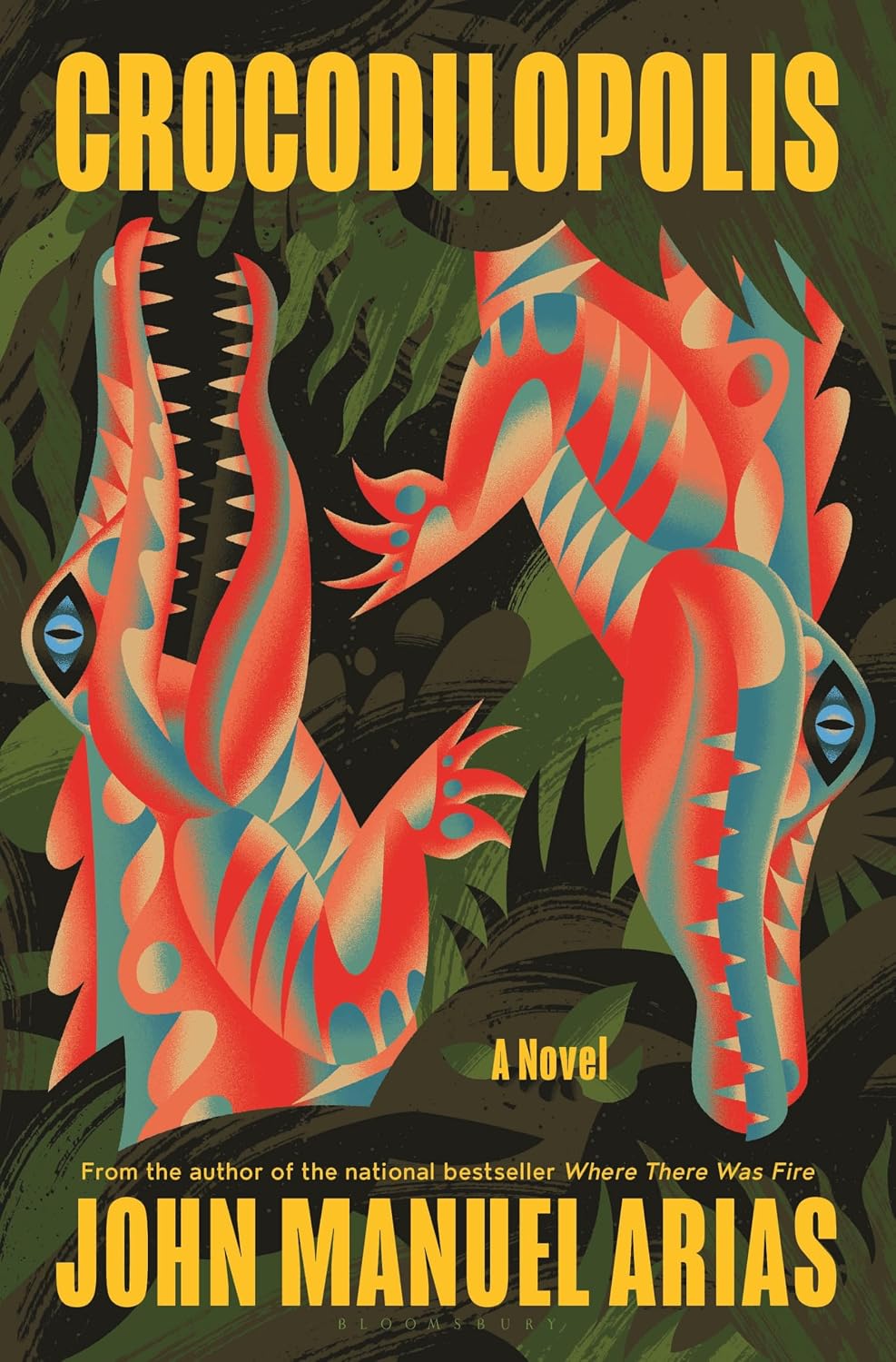
Any writer who attempts to combine sweeping historical fiction with achingly elegant prose is walking a tightrope indeed. In Crocodilopolis, John Manuel Arias pulls it off.
On the day Seth Oreamundo’s younger brother, Osario, is born, their mother strikes Seth across the face after he lashes out at the baby, leaving a scar that will never fully disappear. But the blemish turns out to be the least of their problems, as the dysfunctional Oreamundos — members of a powerful and crooked political dynasty — continue to fracture throughout the brothers’ passage into adulthood.
“If the masculinity they witnessed was violent,” their great-aunt Ola privately observes while watching the boys’ father flounder and excoriate, “they would surely mimic that malice for the rest of their lives.”
The story of the Oreamundo brothers is interspersed with both their family’s history and the broader history and culture of Costa Rica. The boys grow up side by side but live in functionally different households: While Osario is his mother’s little king, Seth lingers on the periphery, raised largely by his great-aunt and grandfather. When Seth is cast out of the family mansion as a teenager after a violent confrontation, Osario experiences profound betrayal at the perceived abandonment, and a rift begins to yawn between them.
The fissure only expands in adulthood, when Seth becomes head of Costa Rica’s national oil refinery, while Osario is appointed Minister of the Environment. The position is a mixed blessing for the younger brother:
“He could no longer visit the forests he swore to protect, and was instead strangled by a three-piece suit like a straitjacket in air-conditioned rooms. He grumbled at Styrofoam cups that he’d tried to ban in his first month as minister, yet his secretaries served tar in them every day…‘I’m the Minister of the Environment,’ Osario would whisper to the city outside his office window. ‘And I can’t even get these idiots to recycle.’”
Somehow, the brothers manage to coexist for several years, eventually marrying their childhood friends, the sisters Nieves and Isa. But the détente is shattered when Osario (propelled by figures with ulterior motives) accuses Seth’s company — and Seth specifically — of corruption and negligence resulting in lasting environmental damage. Amidst the fallout, Seth, Nieves, and their son, Andrés, flee Costa Rica for the United States, even though the pull of their homeland is never far:
“The longer Seth and his family spent in D.C., the deeper Seth receded into the nostalgia his [Costa Rican] flora exuded like nectar. If he closed his eyes tight and inhaled the perfume from the potted hibiscus, purple-yellow orchids, and crowned birds of paradise, he would be home again. If only he could go back.”
Eventually, he does — when he decides to exact revenge on Osario, “hatching the plot to kill his brother like an egg.” Obtaining a visa, Seth travels home in secret on a plane that “is akin to a time machine. Within the hurtling, metal bird, one’s reality is encapsulated, independent. Intense turmoil or joy might transpire tens of thousands of miles below, but within a plane, time is suspended.”
Seth’s meeting with Osario does not go as planned, and both brothers emerge transformed beyond recognition. With Seth hovering in the shadows of his former life, and Osario disappearing completely, the lives of Nieves, Andrés, Isa, and Isa’s son, Horacio, unexpectedly intersect once again when Isa moves to Washington to be close to her sister and nephew.
When Horacio returns to Costa Rica to visit a paramour named Carlos — “They kissed with their eyes open, to observe the beauty of the other and to keep their peripheral vision alert” — and to participate in a celebratory Pride parade, he comes face to face with the uncle everyone thought dead. Seth is seeking something much darker at the event, and his clash with Horacio sets off another round of family turmoil and recriminations.
Will the next generation of Oreamundo children be doomed to repeat the mistakes of their parents, or do Andrés and Horacio have a chance to break the curse? In bejeweled language, Arias asks these and other incisive questions in this gem of a story.
Mariko Hewer is a freelance editor and writer as well as a nursery-school teacher. She is passionate about good books, good food, and good company.