Cromwell’s Spy: From the American Colonies to the English Civil War: The Life of George Downing
- By Dennis Sewell
- Pegasus Books
- 384 pp.
- Reviewed by Stuart Kay
- January 27, 2026
The famous London street was named for a rather infamous character.
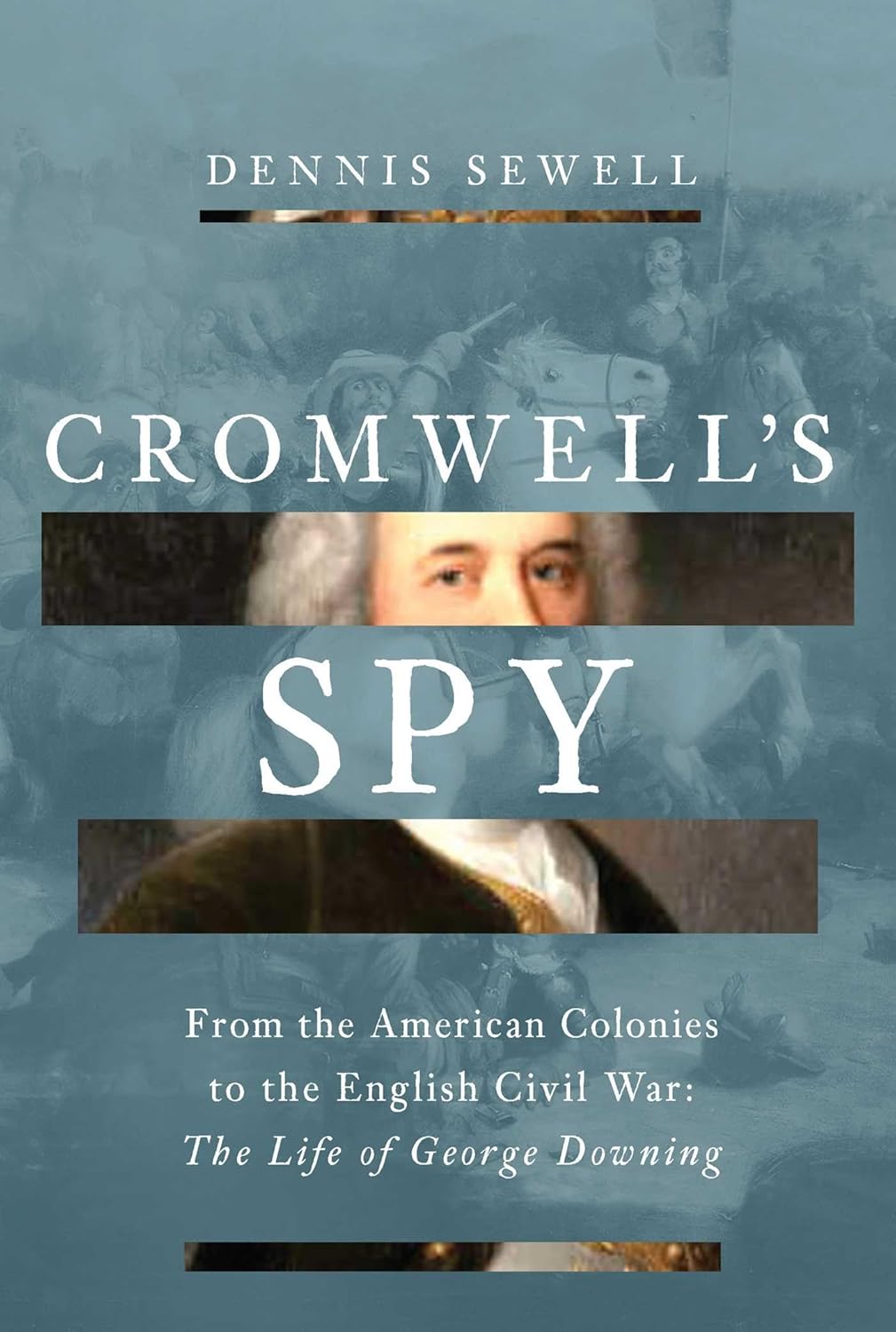
George Downing (1623-84) is chiefly remembered nowadays, as Dennis Sewell notes in his absorbing new biography, Cromwell’s Spy, as the man who built and gave his name to the street in central London that has housed generations of British prime ministers. His colorful and scandal-ridden career as a soldier, diplomat, member of Parliament, envoy extraordinaire, and spy has been largely forgotten.
Contemporaries who observed that career were savage in their criticisms of Downing. The diarist Samuel Pepys considered him to be “a perfidious rogue.” The Earl of Shaftesbury described him as “real vile.” In New England, committing an act of gross treachery came to be known as “doing a George Downing.” He was, as Sewell says, “a shameless turncoat” who, after the English civil war, shifted his allegiance from the Republicans, schemed in support of a Stuart restoration to the throne, and helped to hunt down and send to their death friends, patrons, and colleagues who had signed Charles I’s death warrant.
Downing was born in Dublin and spent his early years in London. His father was a barrister and a Puritan; his mother was a sister of the governor of the Massachusetts Bay Colony. The family arrived in New England in 1638 as part of the migration of 20,000 Puritans to America. George, who was an able scholar, attended Harvard College and was in its first graduating class. He would go on to become its first tutor before moving on, as a preacher, to the Caribbean, where, Sewell observes, he was “much struck by the importance of owning African slaves in making a fortune.” Downing would, Sewell says, cheer on the wider adoption of slavery “with unselfconscious glee.”
Downing’s decision to return to England in the mid-1640s was apparently spontaneous. There, he quickly rose to eminence on the Republican side in the convulsions of the civil war. Oliver Cromwell, impressed by his abilities, appointed Downing head of military intelligence and sent him on missions around Europe as a diplomat and spy. Cromwell remained his patron during the Commonwealth and the Protectorate.
With the restoration of the monarchy in 1660, however, it seemed that Downing simply swapped one patron for another. He had contrived to keep his old posts and add some new ones. Blaming his previous views on principles “sucked in” in New England, he would, under Charles II, retain his lucrative position as a Teller of the Exchequer, pioneer state-sponsored kidnappings, play a part in starting two major wars, and have an important role in extracting Manhattan and Long Island from the Dutch, thus helping to found New York.
His bribing and blackmailing in the Low Countries to send to the gallows erstwhile comrades on the Republican side cemented his infamous reputation among contemporaries. He would become one of the richest men in the kingdom. Sewell’s focus in Cromwell’s Spy is, as he explains, primarily on Downing’s spying and scheming as opposed to his public-finance reforms and involvement in great-power diplomacy.
The portrait of Downing that emerges is a bleak one. He was, Sewell asserts, a “strange and darkly knotted character” who spent much of his life in the shadows. In a self-serving career, his two signature traits were “resourceful competence and ruthlessness.” His proposal that a hole be bored with a red-hot poker through the tongue of the Quaker leader James Naylor as a punishment for riding into Bristol on a horse in a re-enactment of Christ’s Palm Sunday entry into Jerusalem was entirely characteristic. He was a Puritan preacher turned affluent voluptuary and an opportunist who traded in betrayal.
Despite his enormous wealth, Downing was notably stingy. He refused to provide his elderly mother with an adequate allowance in her old age and, in a year in which he had earned over £20,000, responded to a fundraising appeal to Harvard alumni with a donation of just £5. There appeared to be less stinginess, however, when it came to his own physical pleasure: A fellow MP claimed that he kept in business no fewer than six prostitutes.
There is, of course, a danger that we hold Downing to our own standards. The brutal and bizarre world that he found himself in (and helped to shape) was manifestly very different from our own, and Sewell is especially good at evoking that world. It was one in which the commander of the Royalist troops in Drogheda in Ireland was beaten to death with his own wooden leg and the splendidly named Abiezer Coppe would stand naked to draw a crowd and insist that swear words were the language of angels.
Downing had many grievous faults, Sewell concludes; he was, however, “a turncoat when turncoats were ten a penny.” Only a few months after he switched his allegiance from the Republic to the Crown, the country did likewise.
Nonetheless, Downing’s tangible legacy seems fitting. The clever mortar lines painted on the buildings on his eponymous street — to make the brickwork seem more even and of higher quality — indicate deceit and parsimony. Downing never lived on Downing Street; its construction was simply a quick business venture to make money. As Winston Churchill observed, the buildings were “shaky and lightly built by the profiteering contractor whose name they bear.” Sewell’s biography of this “profiteering contractor” is an engaging, albeit ineluctably grim, read.
Stuart Kay is a freelance writer based in Edinburgh, Scotland. He is a former reporter and sub-editor for the Scottish Parliament’s Official Report.