Cross
- By Austin Duffy
- Melville House
- 304 pp.
- Reviewed by Anne Eliot Feldman
- December 17, 2024
A Northern Irish border town struggles to survive after 30 violent years of the Troubles.
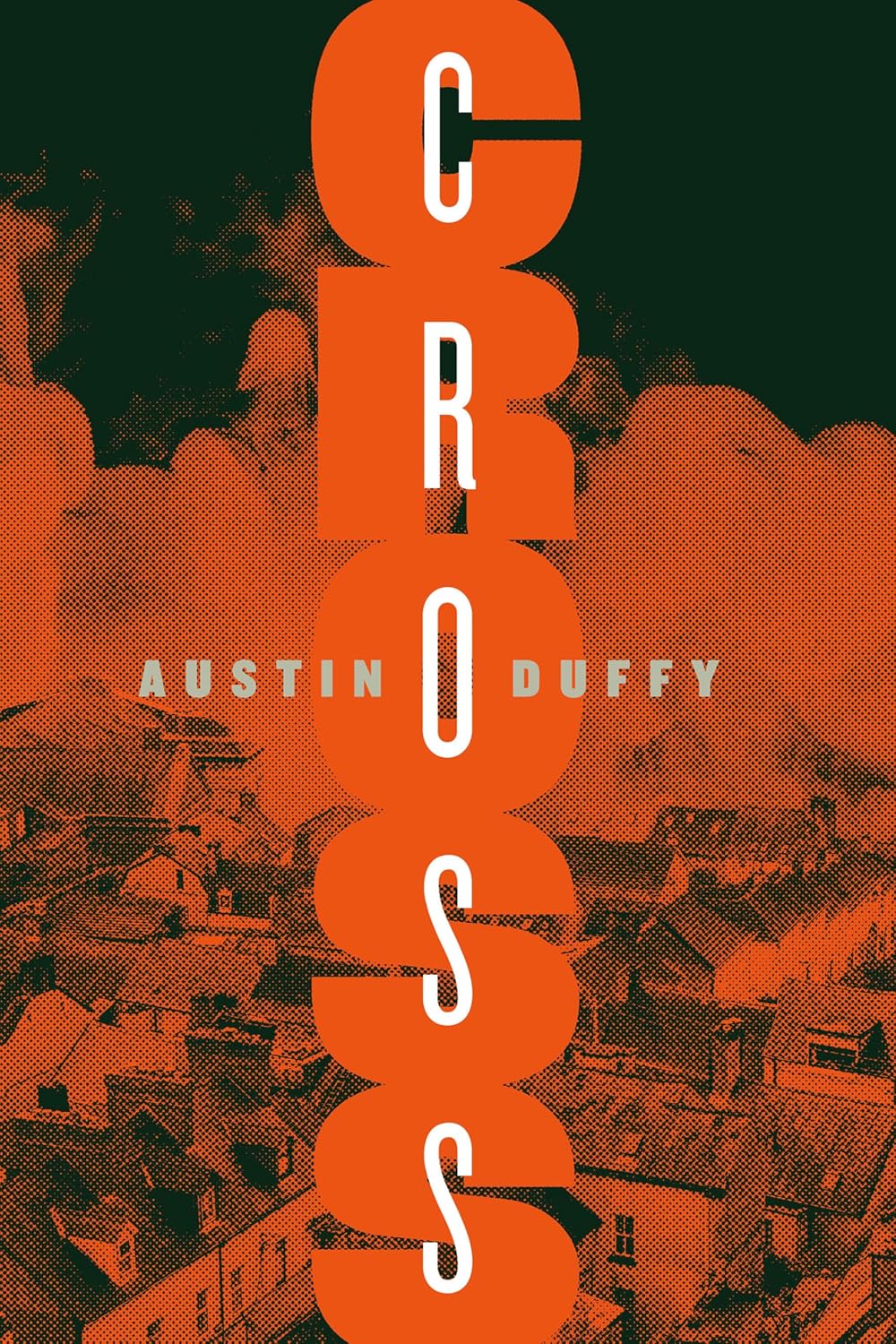
Dublin-based author Austin Duffy makes an auspicious U.S. debut with his fourth novel, Cross, a riveting story focused on tensions in the fictional Northern Ireland border town of Cross during the summer of 1994, just as the Troubles seem poised to end.
A violent conflict lasting from the late 1960s to 1998, the Troubles pitted the mostly Catholic Republicans, who wanted a unified, independent Ireland, against the mostly Protestant Loyalists, who wished for Northern Ireland to remain its own entity and part of the United Kingdom. With well-drawn characters, Duffy elucidates the goals and motivations of provisional Irish Republican Army (IRA) soldiers, families, and local politicians, reflecting a complex community riven with the fissures and mistrust that constant violence engenders.
As the story opens, “Our Francie” Begley, the coldblooded IRA elder who directs operations, sends two young men to kill a police officer. He’s hypervigilant since, after decades of successful terrorist acts, operations by “the boys of Cross” now appear to be going wrong, and it’s got everyone on edge. There must be a tout — aka a snitch — among them, but longtime loyalties muddy the evidence and make it tough to figure out who it might be.
Besides his day job as a “diligent and conscientious — almost to a fault — officer in Her Majesty’s Customs and Excise service,” Francie is the town’s eyes and ears. “Francie knows, we’d say. Francie knows. Sure he’d practically know your business before you knew it yourself.” Still, dreams of his victims, “their gaze as haunting as birdsong over Flanders,” torture him.
Nailer is Francie’s boss, “practically a one-man Cause and Struggle all by himself,” who earned his nickname after once nailing a victim to the floor. A taciturn man who considers the Encyclopedia Britannica “the one unadulterated bit of goodness The Brits did for the world,” Nailer manages Francie’s operations.
Black humor is sprinkled throughout the novel — such as when, on a morning visit from Francie, Nailer must move the “weapons” sitting in his sink so he can boil water for tea — whereas quotation marks in dialogue are not:
Nailer moved over to the sink. There were engine parts in it and he lifted one of them, a heavy metal pipe that would do some shape of damage to the side of a man’s skull. He placed it to one side on the draining board.
- Cup of tea Francie?
- That would hit the spot nicely thanks.
On the political front, Councilman Mairtin O’Cuilleanáin, who represents Cross, is pushing for peace. He frets to Francie that Nailer is losing it. “That makes us nervous,” O’Cuilleanáin admits. “Because you know that one notch below Nailer and you’re into pure headbanger territory.”
Noteworthy among the headbangers is Handy Byrne, an IRA psychopath whose crack-shot marksmanship makes him indispensable to the fight and quashes persistent whispers of him being a tout. Having lost a father and two brothers — and two fingers from his brother Gerry’s hand — to the cause, Handy is untouchable. As Gerry explains, “Youse all know the price my family has paid…There’s a debt there.”
The women of Cross seem invisible, but to their immense credit, a few speak out. The Widow Donnelly, for one, stages daily hunger strikes in the town square to protest her boy’s disappearance after being accused of being a tout. And 14-year-old Cathy Murphy, whose Protestant father was killed as a suspected tout, advertises the horrific abuse she endures and spills secrets about Handy Byrne. This “odd couple…the rape victim and the grief-demented mother” give the town pause:
“As a silently sobbing mother is finding out about her dead son…there would admittedly have been among some but certainly not all of those who bore witness to it a small, unwilling though not insignificant hint of admiration for the majesty of this woman’s pure maternal fury.”
Here and elsewhere, Duffy lets the characters tell their story. The point of view alternates between third person — sometimes close, giving an intimate sense of one character, and sometimes omniscient — and first-person plural, wherein a chorus of townsfolk narrates the proceedings. The result is a nuanced and powerful tale. And Duffy’s rich depictions of the setting dazzle amid the otherwise graphic portrayals of gruesome acts:
“Down the docks it was a blue night still, not yet a black one, the sky limpid, weightless, every shape blocked dense and exact right up against it, the dusk at least covering some of the desolation.”
Will justice prevail in the end? Maybe. Maybe not. But what will persist regardless is the exhaustion, the sense of needless loss, and the despair felt by those on both sides of the Troubles, all of whom are convinced that theirs is the noble one. Ultimately, Cross seems to suggest, bearing witness to the tragedy around us may be the best anyone can do, and flawed heroes may be the only kind we have.
With a B.A. from Colgate University, an M.A. from Georgetown University, both in Russian area studies, and a UCLA certificate in fiction writing, Anne Eliot Feldman has worked in the Library of Congress and the defense industry. She’s currently at work on a writing project of her own.