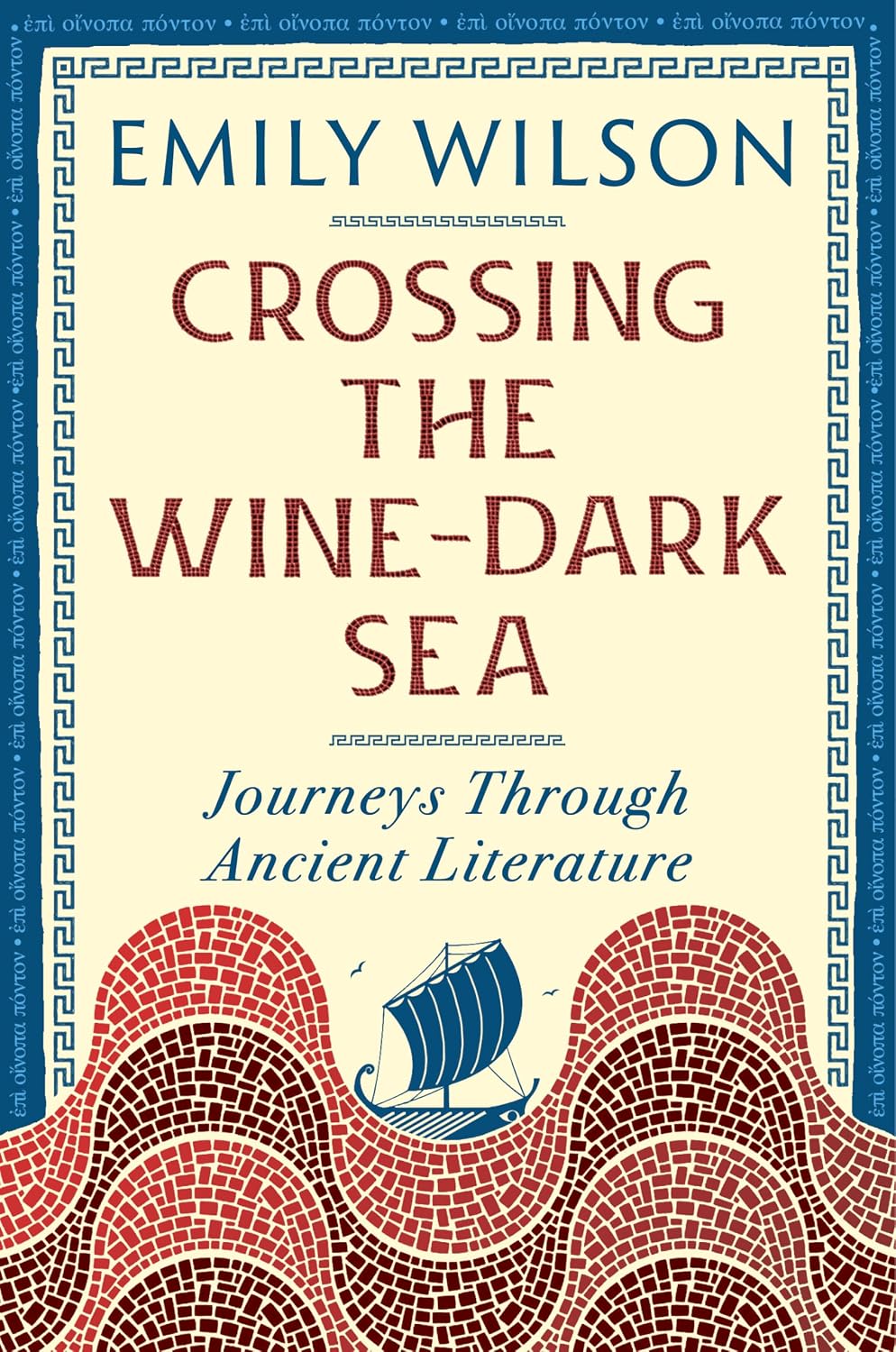
Crossing the Wine-Dark Sea: Journeys Through Ancient Literature
- By Emily Wilson
- Liveright
- 280 pp.
- Reviewed by Arthur Ivan Bravo
- October 21, 2026
A renowned translator questions the foundations of her discipline.
Translation is like the many different depictions we could produce of a single person (or that a single person could issue forth), according to the Polish British literary scholar and writer Adam Czerniawski. Whether those depictions are via photography, painting, or other media, they both remain distinct and, when done truthfully, leave the person depicted still recognizable.
Renowned classicist and translator Emily Wilson echoes this sentiment in her new collection of essays, Crossing the Wine-Dark Sea: Journeys through Ancient Literature. But as her title indicates, her translations focus not on people of our time but the ancients. That distance both enriches and complicates the endeavor.
Wilson suggests that translating the ancient involves not only an interpretation of the linguistically and culturally foreign, as it would with contemporary translation, but also of the unbridgeable distance of time and history. In this case, the ancient sources just happen to be part of what people often consider the foundations of Western civilization. Therefore, any attempt at interpreting such material wades into the history of that history and the discussions around its meaning.
Wilson herself notes the challenge of understanding lives and writings through the hazy lens of time’s passage. She observes that “even…the past of ten years ago — before Covid, before Brexit, before Trump, before the advent of ChatGPT…can feel ‘unimaginably different’ from the present moment.”
Wilson is no stranger to such an exercise, of course. She is a professor of classical studies at the University of Pennsylvania, and her own translation of Homer’s Odyssey, mostly praised but also panned by some for its accessibility and divergence from prior iterations, has become, according to many, a standard. She recently earned internet fame by criticizing Christopher Nolan’s film “The Odyssey” for misinterpreting (or failing to interpret at all) the original source material.
It’s possible that the critical reactions to her Odyssey translation inspired many of these essays. In them, Wilson seems to be arguing that even the ancient literature that underpins the Western canon remains quite open to interpretation; it’s not set in the same stone as ancient buildings.
Crossing the Wine-Dark Sea consists of roughly a dozen pieces dating from 2010 to the present, some previously published. Wilson ably demonstrates her mastery of the essay form throughout, combining nitty-gritty literary scholarship with generous shares of personal reflection.
She offers doses of humor, references pop culture, wades into the culture war (though with nuance), and declares her likes and dislikes in the translations others have done. This gives the book a notably contemporary, conversational flavor. She also delivers on her promise in the volume’s first essay of providing an “engaging and accessible introduction to some central themes within the interpretation and translation of ancient literature and its relationship to modernity.”
Wilson interprets the ancient’s relationship to the contemporary when she traces modern, feminist, and queer claims about the Greek poet Sappho based on the scarce few surviving fragments of the woman’s writing. She then ties that lesbian claim to the poet’s themes of alienation found in those fragments.
Translations reflect the historical moment in which they are made, as Wilson shows by discussing the various representations of Helen of Troy in literature, ranging from a shamed to an empowered figure. The claiming of stoicism by “tech bros” and their ilk is revealed by Wilson as nothing more than a convenient corruption of the ancient philosophy by a privileged few to make peace with their self-interestedness. She also introduces readers to the unconventional life and career of 20th-century English poet Christopher Logue and what she decides to interpret as his “translation” of Homer’s Iliad, though others might argue it is instead a wholesale rewriting of the poem, complete with modern vocabulary and references.
In some ways, Wilson saves the best for last. For the penultimate piece, “Translating the Odyssey,” she treats the reader to a fascinating, almost exhaustive comparison of some of the most notable translations of the first few lines of Book 5 in Homer’s epic, from that of Alexander Pope to present-day writers. The sheer range on display is, well, staggering but also inspiring, and it only drives home Wilson’s point that “there is never a single ‘correct’ translation of a specific word, phrase, sentence or passage.”
So, naturally, she is working on a new translation of The Odyssey, from scratch.
Arthur Ivan Bravo is a writer, teacher, and Ph.D. student in anthropology at SUNY Albany. He lives in New York City.

