Crucible: A Novel
- By John Sayles
- Melville House
- 496 pp.
- Reviewed by Jennifer Bort Yacovissi
- May 22, 2026
This curiously inert story might’ve worked better as nonfiction.
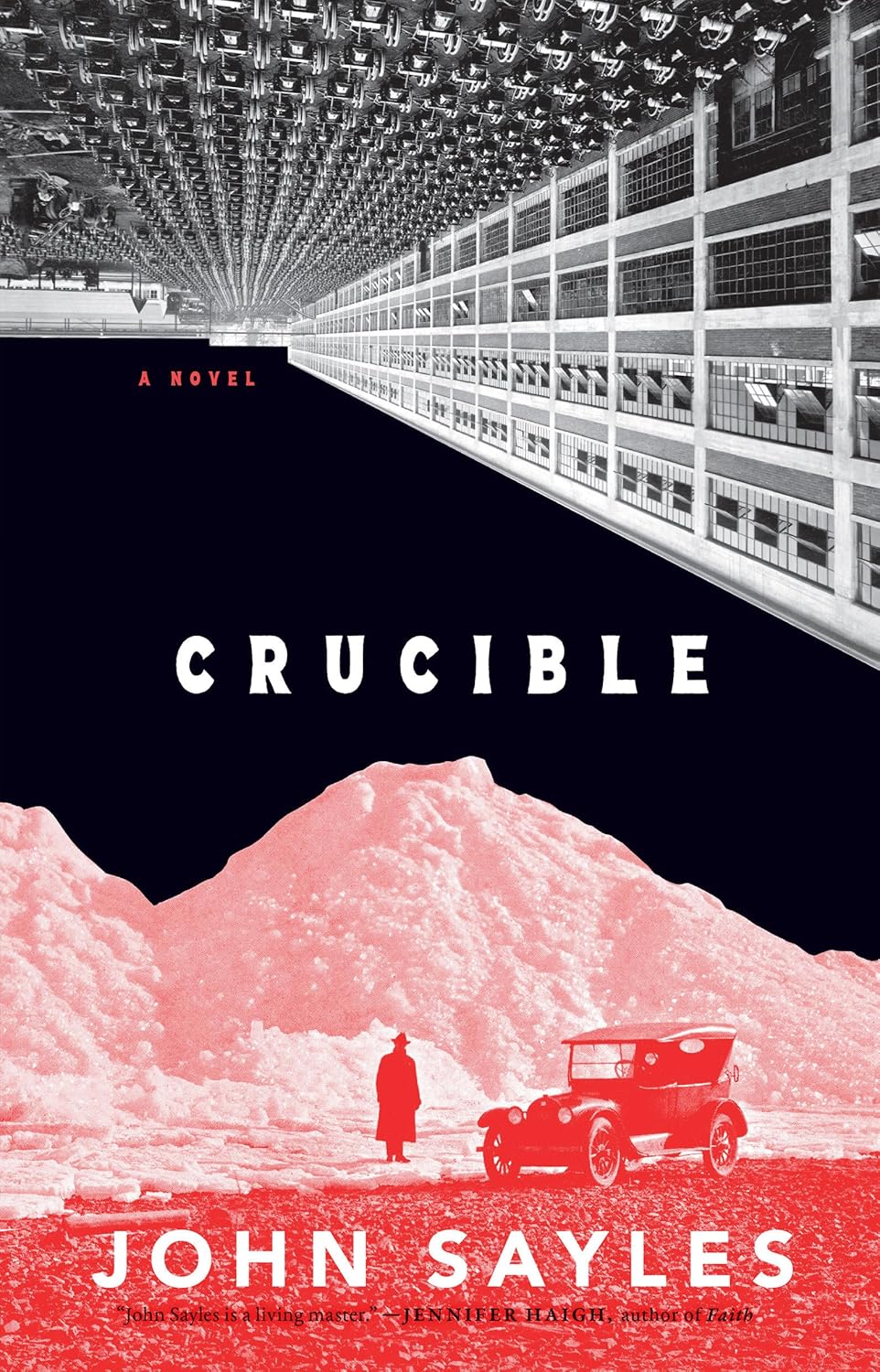
The jacket of Crucible, John Sayles’ latest novel, notes that Henry Ford was “the Elon Musk of his day, in more ways than one.” As I read the book, I had a hard time shaking the feeling that Sayles’ project might have been more successful if he’d taken that as his thesis statement and built a solid work of nonfiction from there.
The novel covers about 15 years in the heyday of the burgeoning U.S. auto industry post-WWI, when Ford — “King Henry” — was America’s acknowledged captain of industry, controlling the levers of capital almost single-handedly. Sayles is obviously drawing parallels between those times and the present, not just with Ford’s many similarities to Musk and to our own metaphorical king, but even with RFK Jr., given Ford’s insistence on the health benefits of unpasteurized milk.
There’s a wide-ranging cast to keep track of, though (eventually) we’re able to remember who it is we’re checking in with when a particular set of characters comes around. All the archetypes are here: Rosa, the Jewish Communist; Kaz, the Polish organizer; Zeke, the Black foundry worker; Smitty, the ready-for-anything journalist; and Harry Bennett, the (real-life) head-cracking enforcer. Each of them comes with a universe of family, friends, or associates, some of whom get their own little arc. There’s also a substantial thread — entirely separate from the main narrative — about Ford’s foray into the Brazilian rainforest to ensure his company’s private supply of rubber.
Except for sprinkling ad copy for various Ford models throughout, Sayles doesn’t tell us where we are in time. But no worries: It’s a simple matter to google names and events, such as when Edsel Ford, the Old Man’s son, introduced the Tudor — so named because it was a two-door — (late 1927), or the one-two-punch timing of Joe Louis knocking out the German Max Schmeling to prove America’s might over the Nazis (June 1938), followed hard upon by Ford’s accepting of a medal on his 75th birthday from the Führer himself (July 1938).
Indeed, I took to keeping my phone nearby to check the backstory on many people and events in Crucible, which may not be the response the author hoped for. All the elements of a good tale are here: the mendacity of the corporate machine as it pretends to care about its workforce; the technological leaps forward as companies compete for market superiority; the cultural color of the times, exemplified by the huge working-man’s mural executed for Ford by Diego Rivera; the long struggle of workers to unionize; and the intentional stoking of animosity between Blacks and white immigrants in order to sow division. It’s all undeniably interesting, especially given the parallels to today, but as a novel, it’s not very compelling.
Certainly, countless works of historical fiction feature large casts of characters and long slices of time yet still succeed as coherent wholes. So, what’s missing here? Drama. Endless plot points aside, the endeavor feels strangely inert.
Sayles is an accomplished writer, but he’s allowed himself to fall prey to the historical novelist’s trap of shoehorning it all in — fascinating little details his research unearthed that he can’t resist including. I’m still scratching my head over his insistence on describing two different cartoons in almost frame-by-frame depth.
The author’s acknowledgements say that the element of the story that first captured his imagination was the idea of the Fordlandia settlement in the jungle of Brazil, but that component is so completely disconnected from the rest of the story that it should’ve stood alone.
More damning, he gives us no place to hang our hearts. We don’t spend enough quality time with any of the characters to be able to invest in them one way or the other. We see that Bennett (the enforcer) is execrable, even if he does appreciate art, but Ford himself is presented as little more than a collection of well-known brilliance, pig-headedness, and ugly prejudice. So, who is our hero? Who is the central figure, the focal point, who serves to gather all the threads and weave them into a story? Journalist Smitty, with his many connections and position as ubiquitous observer, comes closest, but Sayles doesn’t carry through. Even his threads are left to dangle.
Which brings me back to my initial thought: Sayles notes the number of books written about Ford — both the man and the company — over the years, but none have been written recently enough to analyze the similarities to our present situation. Maybe it’s not as much fun as writing fiction, but such an analysis could be insightful. Plus, it would give an author license to include every eye-catching fact he uncovered.
Jennifer Bort Yacovissi’s novel, Up the Hill to Home, tells the story of four generations of a family in Washington, DC, from the Civil War to the Great Depression. She reviews regularly for the Independent and serves on its board of directors as president. Follow Jenny on Bluesky at @jbywrites.bsky.social.