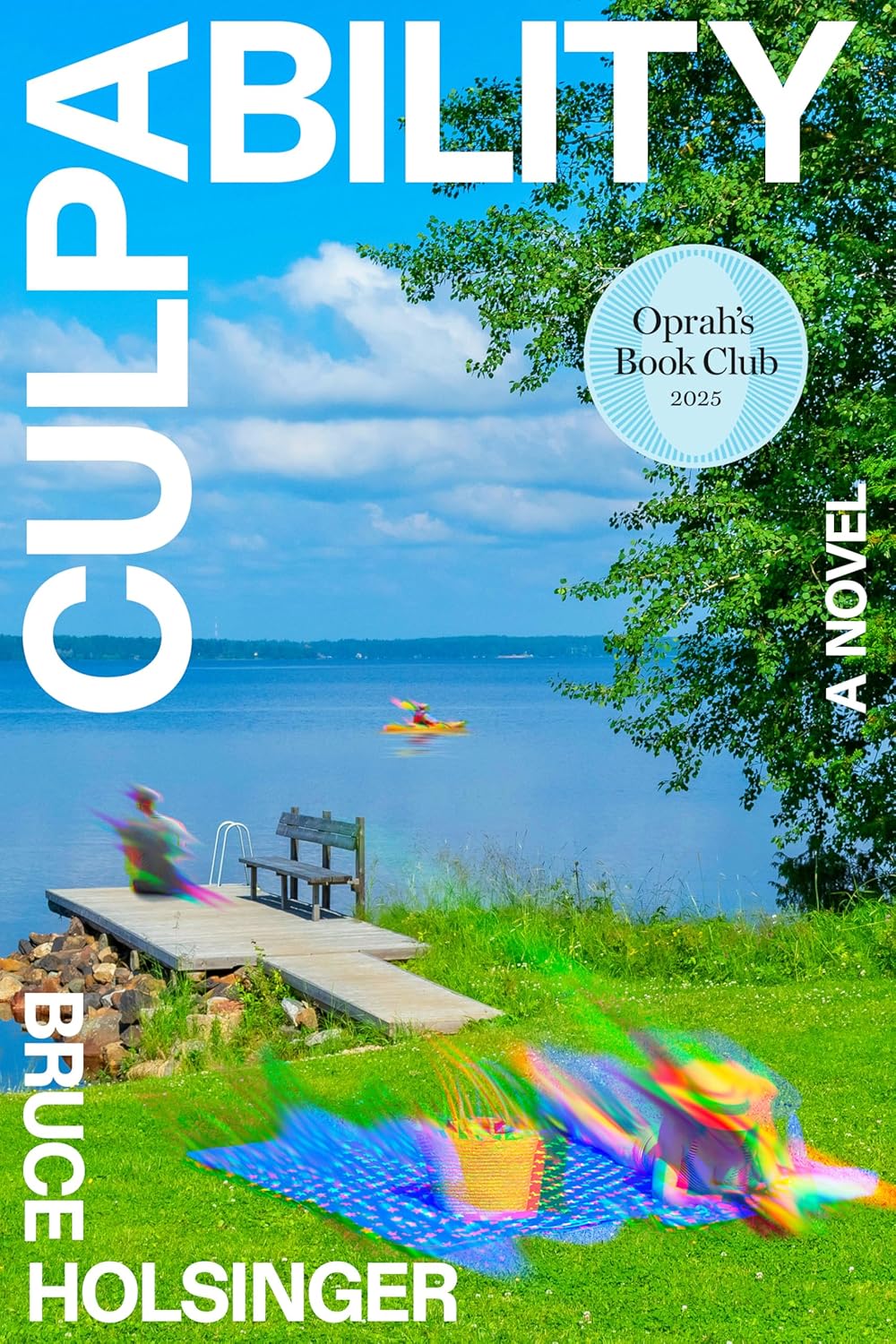
Culpability: A Novel
- By Bruce Holsinger
- Spiegel & Grau
- 380 pp.
- Reviewed by Tara Campbell
- August 7, 2025
Unnervingly relevant moral dilemmas ignite this AI-propelled family drama.
A family trip turns into a nightmare in an instant on a Delaware Highway: Noah Cassidy is sitting in the front passenger seat of the self-driving minivan, working at his laptop, while his 17-year-old son, Charlie, sits in the driver’s seat. In a flash of screaming and screeching, the minivan strikes a vehicle coming in the opposite direction. Noah and his son climb out of the wreckage, but his wife, Lorelei Shaw, and two daughters, Alice, 13, and Izzy, 10, sustain various levels of injury, from broken legs to concussions. The elderly couple in the other car is killed.
And the investigation begins.
While the outlines of the incident seem relatively clear, the issue of responsibility is anything but: An autonomous AI system was driving the minivan. Charlie was supposed to be monitoring from behind the wheel, but he was texting until just before impact, when Alice’s screams caused him to jerk the wheel, which wrenched the minivan out of autonomous mode. So, who — or what — is at fault? Did the AI malfunction? Did the other car swerve into their lane? Should the AI have recovered, or was Charlie’s sudden jerking on the wheel the fatal factor? And, as the parent of the minor child driving, is Noah actually to blame?
As the investigation continues, the family retreats to a vacation rental on the Chesapeake Bay to recover. Noah is disgusted to find that a once-picturesque section of the coastline has been resculpted into a monstrous, showy estate with a helipad and an aggressive security detail, courtesy of tech mogul Daniel Monet.
While Noah objects to Monet’s encroachment onto public areas of the bay, Charlie and Monet’s daughter, Eurydice, spot one another and instantly become infatuated. Lorelei, a renowned scholar and sought-after AI expert, knows Monet through their mutual profession, but as Charlie and Eurydice spend more time together and the two families interact, Noah begins to suspect that Lorelei and Daniel, too, are closer than she’s been letting on.
As interpersonal family dynamics come to a head amidst the crisis in Culpability, author Bruce Holsinger explores the role of privilege in the utilization of technology and the administration of justice. Noah has risen to the upper-middle class from a blue-collar family who toiled and died in grinding, low-paid work, were killed in the military, or took their lives in prison. He’s keenly aware of socioeconomic precarity, how one misfortune can plunge a family into a sinkhole of poverty and powerlessness. Lorelei, in stark relief, comes from a wealthy, powerhouse clan and, therefore, as Noah reflects:
“doesn’t see all the ways her life has been insulated against calamities...For the Shaw siblings and people like them, the advantages of money and prestigious schools and attentive parents and accessible healthcare have always functioned automatically, a bit like the algorithms she adores. In this she resembles Charlie, blithely confident that the foundation will never crack.”
Privilege clearly smooths the Cassidy-Shaw family’s road: Vacationing on the Chesapeake during a traffic-fatality investigation seems like something only the wealthy would think to do, and Noah is able to put down a $10,000 retainer for Charlie’s attorney without breaking a sweat. No price is too high to protect his golden boy, the very definition of confidence and virility in Noah’s eyes:
“The mid-afternoon sun plays on his glistening skin, his ripped abs, his powerful arms. My son looks like an ad for a luxe beach resort, with the well-wrought torso of a Michelangelo.”
Charlie, however, doesn’t seem to grasp the gravity of the situation, spending all his time with Eurydice, ignoring calls from the investigator, and slacking off on his training regimen, potentially putting his lacrosse scholarship at risk. Increasingly anxious about the sparkling life of opportunity Charlie stands to lose, Noah makes moves to preserve his son’s future, keeping secrets from his wife and children in order to do so. But he’s not the only one in the family withholding information.
The story takes readers step by step through a minefield of secrets and blame as the investigation unfolds, coming back to the incident through rounds of questioning by investigators and attorneys as each character alternately conceals and reveals what they know.
Of the various genres under which this novel could be classified, “Family Life Fiction” is the best fit. It doesn’t have the fast pacing or multiple threads of head-spinning intrigue I associate with thrillers. I didn’t find myself making as many notes about the prose as I usually do when reviewing a book, but even if I wasn’t swept away by striking language or imagery, I was still curious to find out what would happen next. Noah’s propensity for mulling things over in detail ensures that readers remain clear on what’s happening, even while secrets are being withheld from him.
Culpability is an Oprah Book Club selection, and I agree that it provides excellent fodder for discussion. As easily digestible as it is, it still offers readers relevant, thorny issues to debate. It’s also very much a book of its time, unspooling the effects of artificial intelligence on our lives. Yet it retains a certain timelessness by keeping the focus on human relationships, remaining at its root a family drama. The particulars of technology have changed over the epochs, and will continue to change, but families will stay messy, juggling competing demands and calls on their loyalty, forever balancing truth and culpability.
Tara Campbell is a writer, teacher, Kimbilio Fellow, and fiction co-editor at Barrelhouse Magazine. She teaches flash fiction and speculative fiction and is the author of two novels — including, most recently, City of Dancing Gargoyles — two hybrid collections of poetry and prose, and two short-story collections.