Cursed Daughters: A Novel
- By Oyinkan Braithwaite
- Doubleday
- 384 pp.
- Reviewed by Marcie Geffner
- December 18, 2025
A generational hex destroys the love lives of Nigerian women.
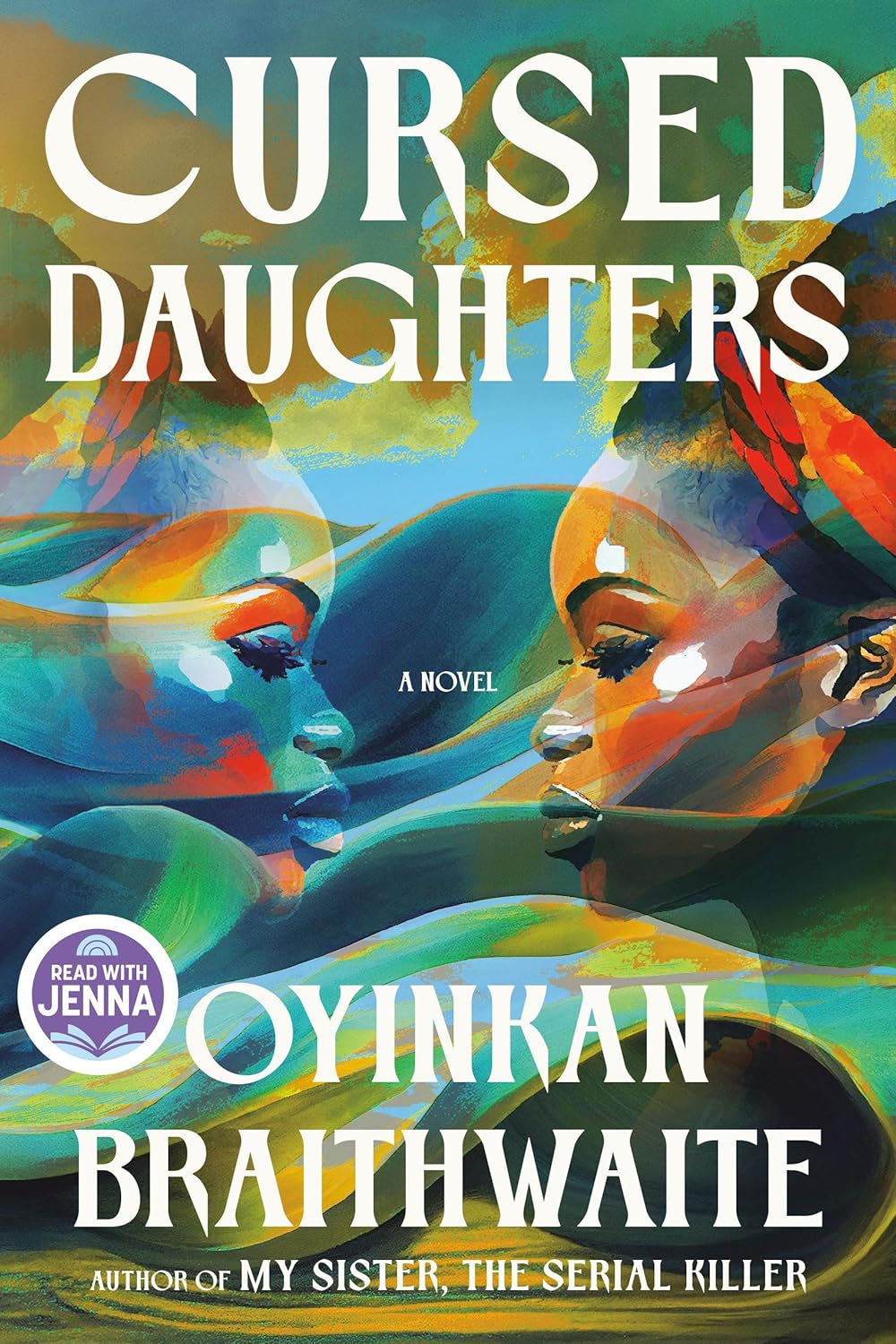
Oyinkan Braithwaite’s audacious 2019 debut novel, My Sister, the Serial Killer, wowed readers with its originality, sly humor, and short, punchy chapters. Her second novel, Cursed Daughters, takes a sharp turn in a new direction with a mature voice, a dark, serious tone, traditional themes, and a complex structure.
The novel begins with a distressing and hard-to-follow prologue in which a lovesick young woman, Monife, dies by suicidal drowning in 2000. The story then moves backward and forward in time with Monife from 1994 to 2000; with Monife’s younger cousin, Ebun, a practical single mother, from 2000 to 2012; and with Ebun’s daughter, Eniiyi, a recent college graduate, from 2023 to 2025.
Monife and Ebun live in a large, dilapidated house in Lagos, Nigeria, with Monife’s mother, Bunmi, and Ebun’s mother, Kemi, as fellow full-time residents, and with Eniiyi as a welcome visitor. All of them are in different ways the “cursed daughters” of the book’s title.
The curse comes from their fifth great-grandmother Feranmi Falodun, remembered as “the one who was cursed.” In the story Monife tells Ebun, Feranmi seduces and marries a stranger who comes to town to bury his father. When the wife he already has later discovers Feranmi’s marriage and daughter, a catfight ensues, after which the aggrieved original wife delivers the hex and seals it with her own blood spilled on the ground.
“It will not be well with you,” she declares. “No man will call your house, home. And if they try, they will not have peace. Your daughters are cursed — they will pursue men, but the men will be like water in their palms…Your daughters, your daughters’ daughters and all the women to come will suffer for man’s sake. Ko ni da fun e.”
The final words (translated from Yoruba) mean “It won’t be enough for you.” The implication is clear: All the ruined love lives of all the Falodun daughters until the end of time won’t be enough to offset the harm of Feranmi’s offenses against her husband’s wife.
The nature of the curse is open to interpretation. It might be a watery monster, a family pattern, a self-fulfilling prophecy, or simply bad luck. Regardless, it’s a heavy burden for the daughters whether they believe in its power literally, figuratively, or not at all.
Exactly how it operates is also left unexplained. That’s for the best because Cursed Daughters isn’t about fantastical magical systems. It’s about the trauma that results from the retellings of the family’s history. As each generation adds new romantic failures, the curse’s strength is renewed, and the women’s fears are compounded.
In the circa-2000 timeframe, Bunmi’s husband abandons her and their two children. Kemi dates men for money. Monife becomes obsessed with a young man she calls “Golden Boy,” though he’s clearly not worthy of the name. And Ebun excludes Eniiyi’s father from her and Eniiyi’s lives because she’s convinced he’ll abandon them. That is, after all, the way men have typically treated the women in her family.
The person who benefits from all the strife is Mama G, a wolfish practitioner of a traditional West African belief system that involves everyday objects and potions she claims possess magical powers. Again and again, she promises the desperate women that, for a price, her smoky herbs, misshapen stones, bags of dirt, and other charms will bring the men they desire back to them. Their misplaced faith in these “cures” depletes their finances and deprives them of their personal agency.
And there’s another problem: Eniiyi’s physical resemblance to Monife and her birth on the day Monife dies lead Bunmi to an unshakable belief that Eniiyi is possessed by Monife’s ghost, controlled, puppet-like, by Monife from beyond the grave or is a reincarnation of Monife.
Ebun is the most rational of the women, yet even she is troubled by certain peculiar goings-on at the time of Eniiyi’s birth and the fact that Eniiyi does look like Monife. Still, Ebun refuses to accept her aunt Bunmi’s conclusion that the girl and the dead woman are one and the same.
“She is not Monife,” Ebun tells herself. “Monife is gone…She still couldn’t believe she would have to go on through life without her. But, her child would not be the vessel her cousin could use to come back into this life. You were given one life and Mo had decided what to do with hers.”
Though Ebun scoffs at Mama G’s offers to intercede with the gods to free Eniiyi from Monife’s supposed interference in her life, Mama G is very determined, and she’s a hell of a good saleswoman. As the uncanny events multiply, even the confident, no-nonsense Ebun is left unsettled and uncertain:
“She looked at [Bunmi, Kemi, and Mama G] in the dim light…She would be foolish to let them lead her down this path of fear and superstition. Yet, as she walked away…she couldn’t shake the feeling that perhaps something sinister was at play.”
The novel’s narrow focus on romance, marriage, and motherhood may leave readers with a niggling desire for something more than generations of women with man troubles. Three of the women have careers, but their professional pursuits aren’t explored, as if fulfillment in that aspect of their lives is simply not of much importance to them.
It’s not easy to say whether Cursed Daughters is or isn’t a better novel than My Sister, the Serial Killer. Though very different, both are good.
Marcie Geffner is a journalist, essayist, and book critic in Ventura, California.