Darkness Becomes Bright: On the Brief Life and Immortal Art of Edgar Allan Poe
- By Emily Ogden
- Viking
- 240 pp.
- Reviewed by Marcie Geffner
- October 29, 2026
A clever exploration of the macabre master.
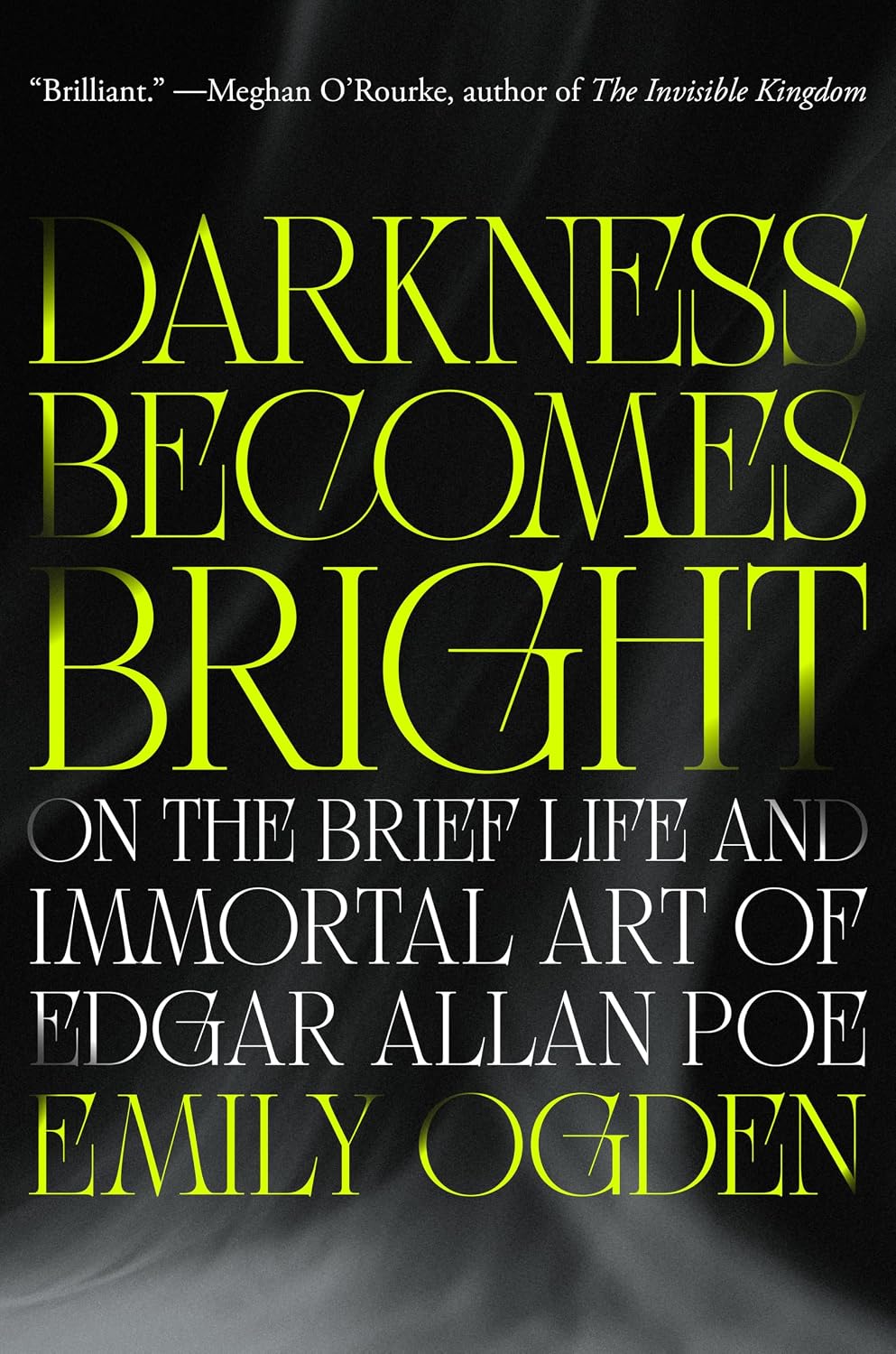
In Darkness Becomes Bright, literature professor Emily Ogden explores readers’ enduring fascination with Edgar Allan Poe and his intimate explorations of humanity’s dark side. Perversity, nightmare, death, cruelty, horror — these are the elements with which Poe conjured “The Raven,” “The Tell-Tale Heart,” and other frightening poems and stories and with which Ogden infuses the essays in her book.
“Poe speaks directly to us, as if we will surely understand — as if we, too, could have been, or are, among the worst,” she writes. “To join his crew of castaways, you need to be ready to go to the edges of human experience: to madness, to loneliness, to pain and the causing of pain. You need to follow him.”
The bare facts of Poe’s life, as Ogden relates them, are grim. Born in 1809 and orphaned at age 2, he grew up as a charity case on a plantation in Virginia. A short time at a university where enslaved people attended to his and other students’ everyday needs left him not only able to pass examinations in Latin and French, but also burdened with gambling debts he had no ability to repay.
After a series of arguments with his foster father, Poe fled the plantation, only to fall into poverty and struggle with depression, alcoholism, paranoia, and suicidal thoughts. His stories were popular, in demand, and often published and reprinted in magazines, but he typically earned little or no money for his work. At the time, Ogden explains, “The idea that writing was a profession from which one could make a living was still new.”
At 26, Poe married his 13-year-old cousin, Virginia, who later contracted consumption (tuberculosis). While his young wife wasted away, coughing up blood for years, Poe faced the endless specter of her death and “wrote constantly” to try to earn enough money to keep her warm and fed. Says Ogden:
“The force of death and the force of life pressed constantly on him...Death demanded that he sit down on the floor and weep; life demanded that he get a job.”
In Poe’s correspondence, Ogden finds a passionate, willful, and self-destructive man who possessed a canny ability to maneuver others into giving him what he wanted. His actions could be so inexplicable that Ogden likens him to “a penguin with a faulty compass [that] will set out toward the fatal Antarctic interior if no one flicks him back into the seabound flock.”
It is Poe’s darkness that makes his writing irresistible to readers, she argues. As examples of these most avid readers, she cites the poet Charles Baudelaire, who translated Poe’s work into French in the 1840s; the Argentinian writer Julio Cortázar, who translated his work into Spanish in the 1950s; and Marie Bonaparte, a great-grandniece of Napoleon, who used Poe’s stories to trigger nightmarish fears she would later discuss during psychoanalysis sessions with Sigmund Freud in the 1920s.
Ogden adds herself to the list of the Poe-obsessed. In the book, she explores her own dark experiences, including, as a child, “episodes of sharpened perception” and dreams in which she mentally designed houses with multiple basements and curving staircases, and, as an adult, the violent deaths of her backyard chickens and the loss of a beloved dog.
Essays in which she relates the mysterious circumstances of Poe’s untimely death in 1849 and expresses her fervent wish for him to have lived forever are especially powerful:
“I knew that unless books kept being written, renewing Poe’s life and art — unless epiphanies continued to visit his readers — he would be gone. I would help keep him alive a little longer, and I wouldn’t mind if the effort was absurd, like ferrying [my] dying dog back and forth between his daytime and nighttime hospitals.”
The book has some less-than-wonderful elements, too. The introduction is confusing, and the chronology is difficult to follow at times. The Freudian dream analysis is heavy-handed and problematic. And Ogden’s fictional imaginings of incidents in Poe’s life can seem presumptuous or disrespectful of historical facts.
These flaws aside, her creative mashup of biography, history, literary criticism, and memoir ultimately resolves into a thoughtful and engaging narrative about why Edgar Allan Poe’s darkest stories still attract and fascinate us today.
Marcie Geffner is a journalist, writer, and literary critic in Ventura, California.