Deadwood: Gold, Guns, and Greed in the American West
- By Peter Cozzens
- Knopf
- 432 pp.
- Reviewed by Peggy Kurkowski
- October 8, 2025
A rip-roaring read about that most iconic frontier town.
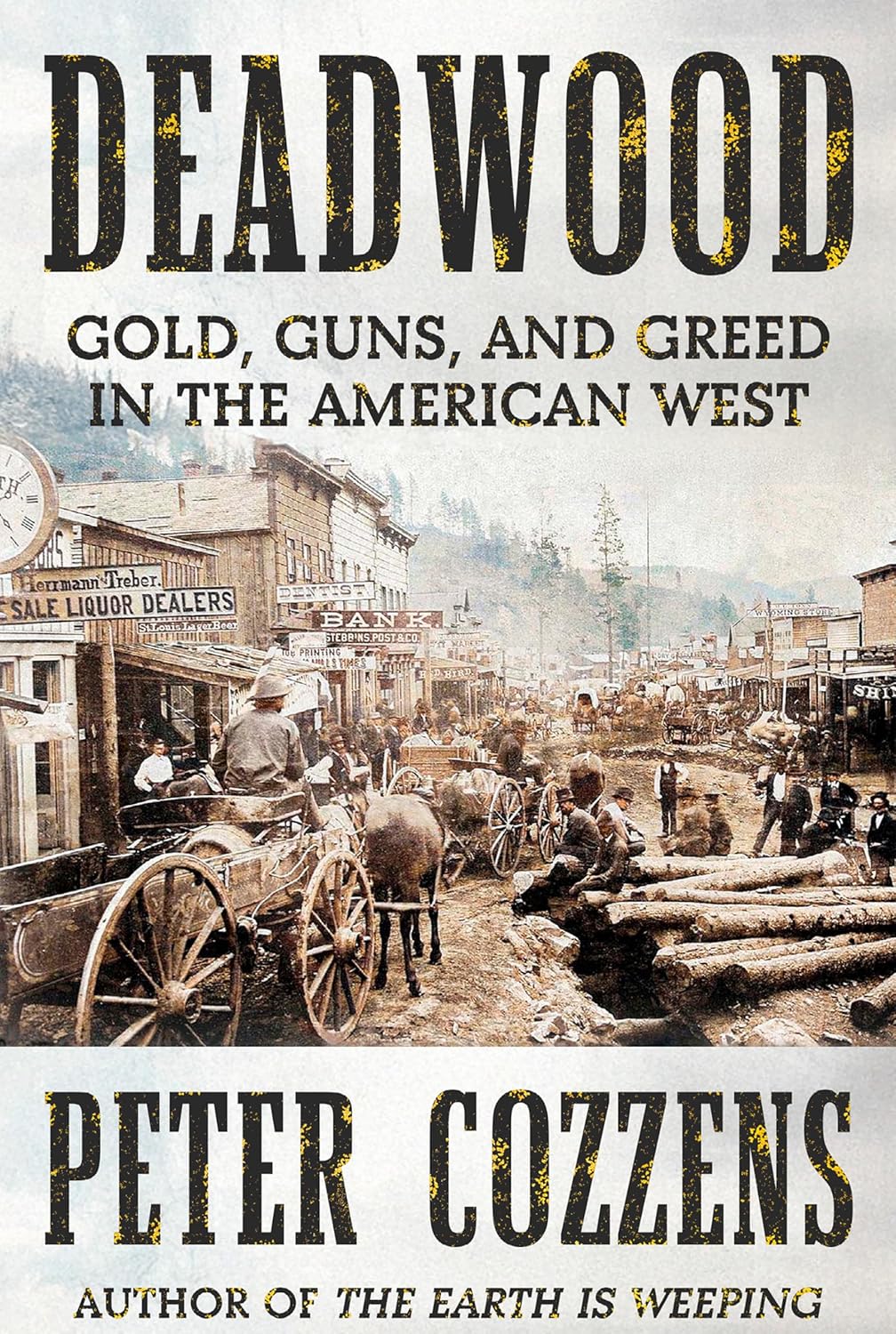
The outlaw beginnings and colorful life of one of America’s most dangerous frontier towns is the main attraction of eminent historian Peter Cozzens’ Deadwood. Anyone familiar with the HBO series of the same name already knows a bit about the mining-camp-turned-boomtown and the thrilling menagerie of bawdy, brazen, and bellicose characters who raised hell there. But the truth of Deadwood is more beguiling than the legends, as Cozzens’ immersive and sensory-rich narrative reveals.
His is the first book to document Deadwood’s early life, providing the tragic background of its “foundational sins.” Located in the Black Hills of South Dakota, Deadwood began as a coarse mining camp where hordes of fortune-hunting white men converged amid whispers of gold (despite the fact that the territory, as codified in the 1868 Fort Laramie Treaty, belonged solely to Lakota Indians). By April 1876, the nascent town’s population had soared from 200 to 4,000 in just 30 days’ time. The twin propellants of gold and greed fueled the incandescent heat of the city’s creation; ironically, a different type of incandescence would later bring its heyday to an end.
In four parts that chronicle Deadwood’s conception, birth, “volatile adolescence,” and fiery demise, Cozzens crafts an enchanting cradle-to-grave biography of his “city-protagonist” that offers fresh interpretations of its celebrities — Wild Bill Hickok, Calamity Jane, and saloon/brothel owner Al Swearingen — as well as introduces a slew of lesser-known but just as splashy denizens. Swearingen “represented all that was vile, salacious, and base in the pioneer town,” writes Cozzens. Deadwood’s first sheriff, Seth Bullock, on the other hand, helped bring stability to the rough-and-tumble outpost with his “bold, decisive, and evenhanded enforcement” of the law.
Along with the gamblers, gunmen, and whiskey guzzlers, Cozzens provides a poignant and heartbreaking portrait of the “soiled doves” of Deadwood. The rampant prostitution and treatment of these unfortunate women makes for hard reading:
“…deaths from frontier diseases, narcotics, unsterile abortions, venereal disease, and dangerous quack remedies…also ravaged the ranks of women already weakened by constant copulation with filthy, lice-ridden men.”
For all its depravity and violence, Deadwood stood out in one positive way: for its “well deserved reputation for racial tolerance — within the context of the times — and ethnic diversity.” Chinese workers came to Deadwood, a few to mine for gold, but many more as laborers, servants, cooks, and launderers. Blacks “enjoyed a climate of tolerance” that was mostly contingent on the political affiliations of whites (Republicans were more welcoming than Democrats). Cozzens peppers these observations with the personal stories of several prominent residents of color, including Wong Fee Lee, who bought property and opened a shop specializing in imported Asian goods. Lee counted as his friends Sheriff Bullock and Sol Star, Bullock’s hardware-store partner.
By 1879, Deadwood had achieved a level of stability and respect. But the “blind, entrepreneurial spirit and desperation” that drove people there inadvertently sowed the seeds of its destruction, too. The town, up until then, had escaped the dreaded “fire fiend” despite a few close calls. But because Deadwood had yet to incorporate, it was up to citizens to fund firefighting equipment and cooperate with each other to ensure the place’s safety. That did not happen.
On September 26, 1879, “Black Friday,” a blaze swept through a bakery built from dried pine and soon engulfed the town; no lives were lost, but more than 300 buildings were destroyed. Cozzens contends that the disaster revealed “the perils of unbridled individualism…the accumulation of wealth took precedence over communal welfare.” While Deadwood was eventually rebuilt, the fire signified the end of its three-year reign of wild wooliness.
Peggy Kurkowski is a professional copywriter for a higher-education IT nonprofit association by day and major history nerd at night. She writes for multiple book-review publications, including Publishers Weekly, Library Journal, BookBrowse Review, Historical Novels Review, Independent Book Review, Shelf Awareness, and the Independent. She hosts her own YouTube channel, “The History Shelf,” where she features and reviews history books (new and old), as well as a variety of fiction. She lives in Colorado with her partner (quite possibly the funniest Irish woman alive) and four adorable, ridiculous dogs.