Death of a Racehorse: An American Story
- By Katie Bo Lillis
- Simon & Schuster
- 384 pp.
- Reviewed by Charles Caramello
- July 16, 2025
Did we really think a for-profit industry would benefit the animals it uses up?
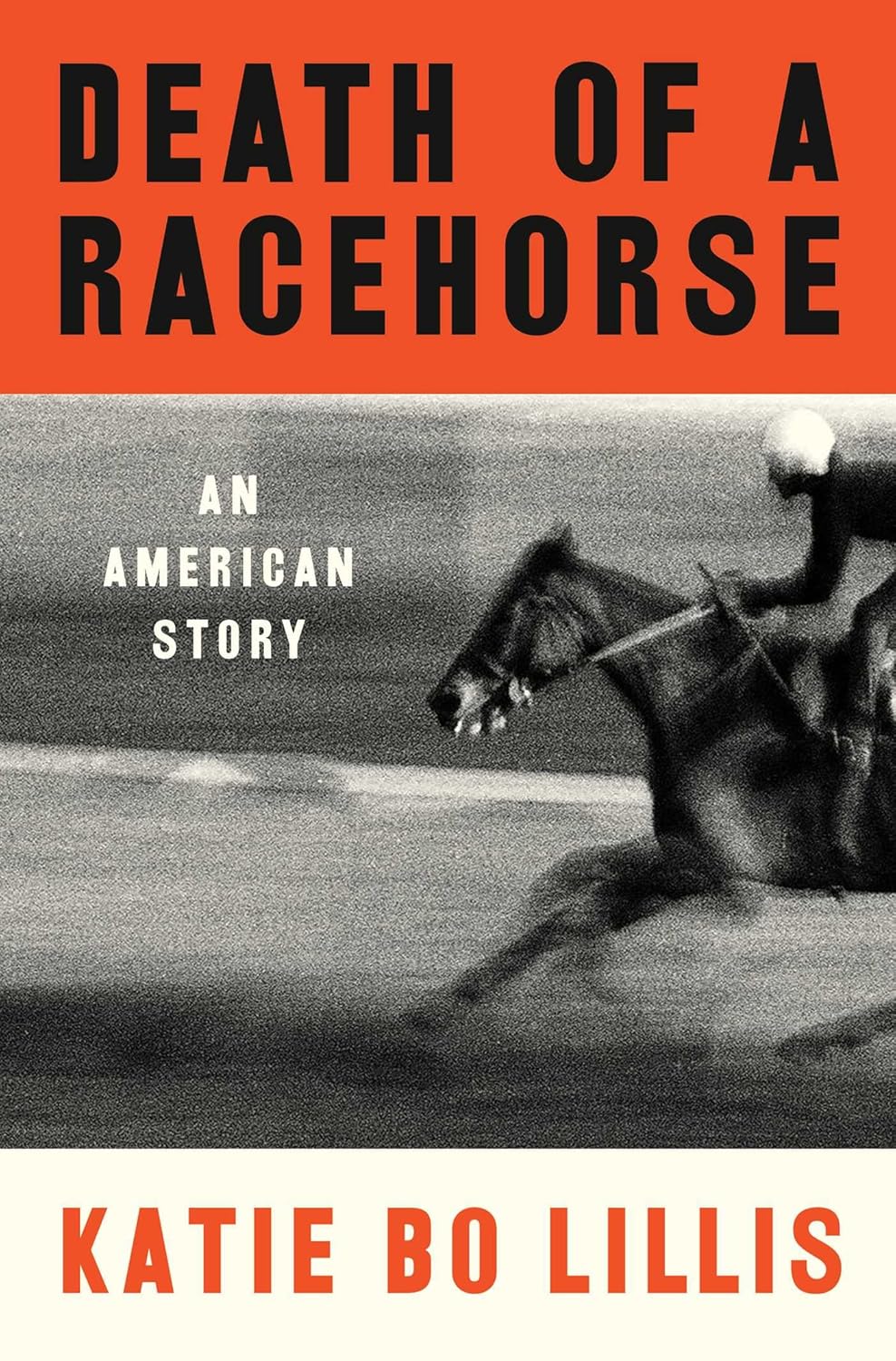
Horseracing dates to antiquity, but Thoroughbred racing only to the 18th century, when England established the breed that quickly dominated the sport. Since then, racing has been both glorified as “the Sport of Kings,” nobles, gentry, and oil-rich sheiks and vilified as the milieu of criminals, fraudsters, shady characters, and demimondaines. Racing has done cultural work as a sport, business, political lightning rod, and moral metaphor, and it has generated a vast body of coverage.
Newsreels and the sporting press in the United States reported on horseracing, once a hugely popular spectator sport, throughout the 20th century. Countless pulp novels and noir films mined racing, together with the equally ambiguous sport of boxing, for atmospheric settings and juicy plots and characters. And more highbrow fiction and journalism have given the sport literary cachet, Laura Hillenbrand’s Seabiscuit (1999) setting the standard for nonfictional group portraits of famous racehorses and the humans in their orbit.
Katie Bo Lillis’ Death of a Racehorse is a thorough and thoughtful work by an author with ideal credentials. An experienced reporter at CNN, Lillis amply demonstrates here that she has the skill to find and to persuade credible and reliable sources to talk about an industry where, she notes, many observe “the code of omertà.” Also a lifelong Virginia horsewoman, Lillis knows and admires Thoroughbreds and, more to the point, offers in Death of a Racehorse an insider’s perspective on the horse world.
Her title may lack the poetry and precision of Rod Serling’s Requiem for a Heavyweight, but once parsed, it makes its point. Lillis’ book is not about a dead racehorse but rather about untold racehorses literally exploited to death, represented here in statistics and in stories of select individual animals whose controversial demises may lead, sooner or later, to the death of the Thoroughbred as a breed of racehorse. Her subtitle applies to both the industry and her main character, Bob Baffert, an upstart Westerner who goes East and learns the high price of fame and fortune — an archetypal “American story” that he shares with Jay Gatsby, Charles Foster Kane, and Fast Eddie Felson.
A complex work, Death of a Racehorse advances multiple narratives and themes in three registers: investigative reporting, cultural critique, and moral allegory. Many readers will deem the book an organic and seamless unity of clearly weighted parts — an ambitious success. Others will judge it a mechanical and unevenly joined assemblage of unweighted parts — an ambitious overreach. The jury, in my view, is still out. Lillis, in any case, calls her book “my love song to horse racing.” Though it seems an odd metaphor for an ambivalent work, the sentiment nicely captures Lillis’ love for the sport despite her despair over the industry it has become.
As investigative reporting, the work offers an objective and insightful account of that industry’s economics and politics, its principles and protocols. As Lillis succinctly puts it, “racetracks are in the gambling business, not the horse business.” Their “basic imperative…is that horses run. If horses don’t run in [competitive] races, gamblers don’t have anything to bet on and the track loses.” The “real money” may lie in breeding and selling horses, but betting “is the engine that powers the entire industry” and virtually invites iniquity. Equine bodies in the starting gate fuel that engine, whatever it takes to get them there.
Death of a Racehorse, given that imperative, also unfolds a lurid exposé of criminality and corruption, cheating and fraud, and, above all, ubiquitous “doping,” the manufacturing, distributing, and dispensing of both therapeutic and performance-enhancing drugs. Despite the best efforts of federal, state, and industry regulators to quash the “drugmakers and users,” too many horses still die from doping. “And it is racing’s tolerance of drugs, legal and illegal,” Lillis contends, “that has become the focal point of the debate over whether the sport has outlived its time.”
The racing industry, in Lillis’ social commentary, also replicates American class stratification. Ensconced in central Kentucky, its upper crust comprises prestigious racetracks like Churchill Downs and blue-blooded associations like the Jockey Club, which is personified by board members like Stuart Janney III, “the scion of a racing dynasty that spanned generations.” This Ancien régime oversees the ownership class that makes the “real money” and employs and manages, below it, a professional caste of trainers and veterinarians that, in turn, depends on racing’s proletariat — the hotwalkers, stall-muckers, and other exploited track laborers, mainly immigrants, who live onsite in “run-down dormitories.”
The whole system, of course, is “built on the backs of individual, living animals,” the Thoroughbreds who are “beloved” but are also “financial assets,” whose “care is centered not on the horse’s well-being for its own sake but on enabling the animal to run and breed.” They die in chilling numbers — 21, for example, in “three and a half months” at Aqueduct alone — their deaths attributed to causes explainable, downright baffling, or darkly suspicious. The celebrated are not spared: Barbaro and Princess Lili B, for example, euthanized following injuries, or Eight Belles, her death on the track “horrific, gruesome, and glaringly public,” and Medina Spirit, “gone down” during a routine exercise session less public but no less tragic.
This explains, in part, why Lillis also presents their story as an allegory of rampant amorality out to trample a still vestigial morality. The book’s long part II narrates the FBI’s investigation and the subsequent indictment of genuinely bad actors — mainly veterinarian Seth Fishman, purveyor of “designer drugs” intentionally difficult to detect, and his client, the trainer Jorge Navarro, aka “the Juice Man.” By way of contrast, it also introduces dupes like Jason Servis, a “blue-collar trainer [of] blue-collar horseflesh,” whose combination of “innocence” and “mendacity” provides a cautionary tale of how racing “could lead even those who believed themselves to be on the straight and narrow to lose their way.”
Fishman and Navarro serve Lillis as both counterparts and counterpoints to Bob Baffert, the acclaimed trainer whose horses win big races but also die in numbers, eliciting in either case rumors of doping. The controversy peaked in 2021, when Baffert won his record seventh Kentucky Derby; the victory was followed by investigations, accusations, and the suspension of Baffert for alleged misuse of medication and to the disqualification of his winning horse, Medina Spirit. As always, Baffert “believed that he was being singled out,” but a “cardinal rule” of racing, Lillis reminds us, holds that “the trainer is the absolute insurer of the animal’s care and welfare.”
Lillis’ story has no heroes, but it finds its antihero in Baffert. In her estimation, “Baffert wasn’t being punished because of a medication violation [but] because…he was a risk to the bottom line.” As an image of horseracing, he “posed a danger to the customer base,” mainly because he insisted “on drawing attention to racing’s biggest vulnerability, medication.” For Lillis, Baffert is not a villain but “a symbol of racing’s failure to reckon with the foundational business model it has built around the horse, a model that may have finally outlived its time.” As she puts it, “Baffert’s story is the story of Thoroughbred horse racing,” a perhaps fitting aperçu but also a massive weight to load onto one symbolic set of shoulders.
Transitioning in Death of a Racehorse from reporter to reformer, Lillis, finally, leaves herself with the innate question: What to do? She is correct in observing that “racehorses capture the imagination of humans in a way few other animals do” and in admonishing “the industry [to] address the cultural failing that is racing’s original sin: its view of the horse,” but those are bromides. And her “basic prescription…to raise and race these beautiful animals, without attention to return on investment” makes perfect sense, but how to do it remains the challenge.
Charles Caramello is a professor emeritus of English at the University of Maryland and John H. Daniels Fellow at the National Sporting Library and Museum in Middleburg, VA.