Degas at the Gas Station: Essays
- By Thomas Beller
- Duke University Press
- 280 pp.
- Reviewed by Yelizaveta P. Renfro
- December 10, 2025
Wit and insight illuminate this wise collection.
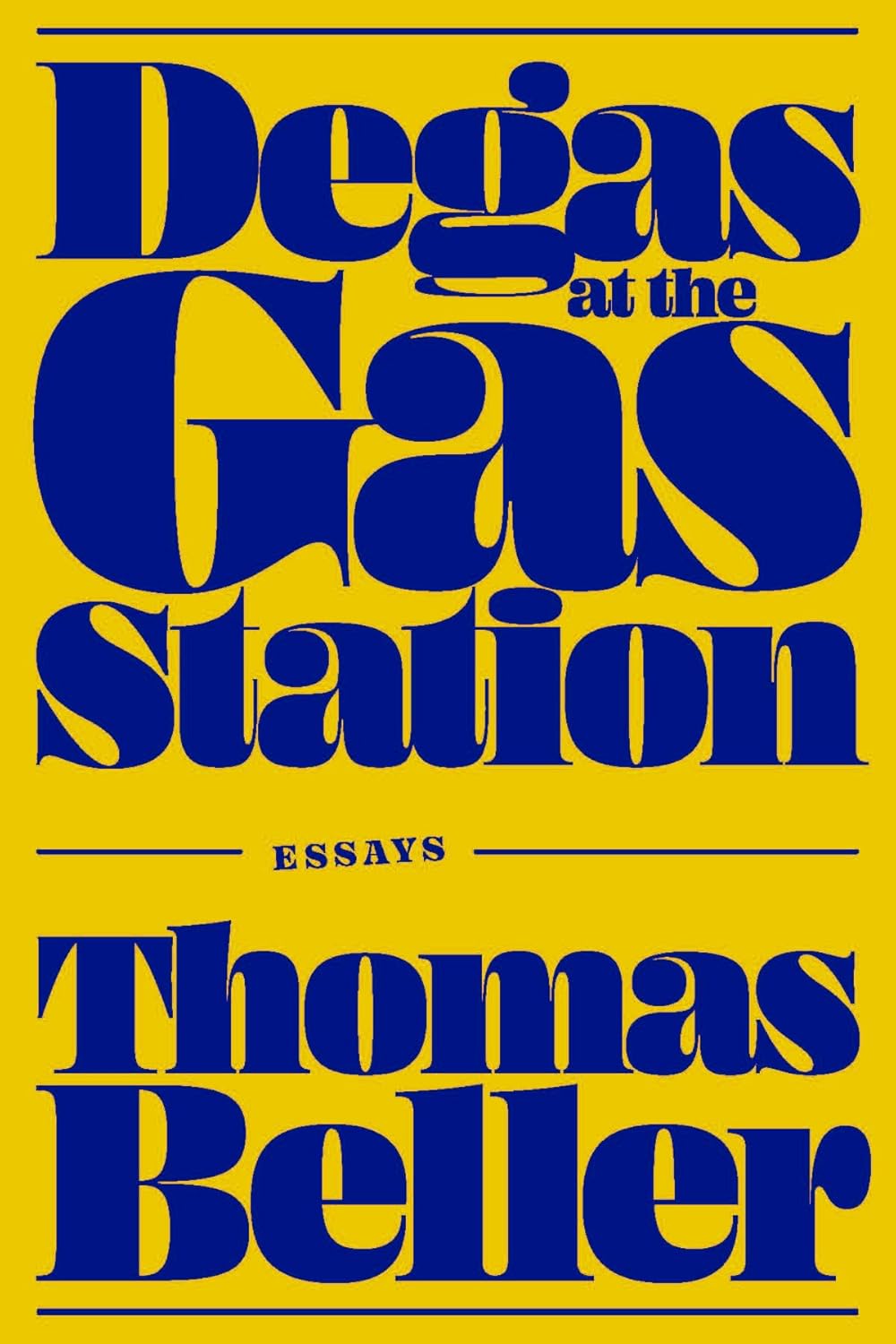
Thomas Beller’s wry and insightful collection of essays, Degas at the Gas Station, revolves around two central themes in his life — losing his father to cancer when he was 9 years old and his own experiences as a father of two young children. While his exploration of parenthood forms the core of the book, Beller also delves into other topics, such as growing up in the New York City of the 1970s and 1980s and his identity as a secular Jew.
The author is at his best when he places the loss of his father side by side with his young children, as he does in “The Rights.” This essay features scenes with his kids, particularly his daughter, Evangeline, who was then 2, as well as scenes of Beller and his mother’s annual visits to his father’s grave over the years. “Why, having started thinking about my daughter, am I going on about my father’s grave?” he asks, then proceeds to examine the associative, meandering way his mind works:
“In becoming parents, I suppose, we meet our own parents again, in a way for the first time. And if you didn’t really know one of your parents that well, then the dialogue that now springs up — what you were like when I was a kid, what it was like to stand in the place you now find yourself standing — becomes not so much a reunion on different terms, but an entirely new acquaintance.”
Beller draws a number of parallels between his father’s life and his own — for example, Beller married at 40, a year older than his father was when he married, and they both became fathers at 42 — and he makes it poignantly clear that his absent father is with him always as he parents his own children. In one scene, as he is roughhousing with Evangeline, he describes what her giggling does to him: “There is something about a child’s laughter that opens you up to the universe in its totality, shooting you into its mysterious depths.” But even in moments of joy, he continues, the specter of loss haunts him:
“A spear of pain moved through me, which was also kind of delicious, delivering a blunt truth — this person needs me. Pretty obvious, I know, simple, goes without saying — but this was an understanding that bypassed the intellectual, even the emotional, to plant something very heavy in my chest; it encompassed a fantasy of my absence, and what that would do to her, how it would hurt her, how the ongoing absence could hurt even more than the departure itself, as my father’s absence, an absence that could not be challenged, only endured, had hurt me.”
Evangeline features at the center of many of the collection’s most moving offerings. In the title essay, Beller describes picking up his tutu-clad daughter from dance class on an ordinary day. “You are never entirely past a potential freeze when talking to a pretty girl, even if that girl is your six-year-old daughter,” he writes. To satisfy her demand for a drink, they stop at a gas station, where Evangeline takes a seat on a stack of soda boxes:
“Sitting there on those cartons of Diet Coke and Coke Zero, sipping from her bottle of water in a manner both poised and carelessly slouched, she looks like something Degas might paint if he went on a field trip to the Stop & Shop.”
Beller is a master of this type of slice-of-life vignette in which the action is limited but that leaves a lasting impression. In another brief essay, “iPod on the Tracks,” he describes dropping his iPod on the subway tracks. “The iPod had fallen through a hole in my coat pocket and, hitting the concrete at a reckless angle, skidded across the platform like a bright white puck,” he writes. “There was a sharp thwack as it slammed into the side of the subway car and then fell into the crack between platform and subway, all the way down to the tracks. The whole moment had the brisk finality of a goal in air hockey.”
In the following scene, Beller eventually retrieves his device, but the real payoff comes in the last line of the essay. After telling his fiancée, Elizabeth, about his escapade, she becomes upset, and he promises not to jump onto any train tracks in the future. The essay ends with Elizabeth’s one-line rejoinder: “I ought to put some of your sperm in the freezer.”
In the more meditative “Saying Goodbye to Now,” Beller contemplates his penchant for taking photos “when something notable or beautiful or just atmospheric unfolds in my family.” To mitigate the effect of seeing important moments in the lives of his children happen onscreen, he employs a strategy: “I often shoot blind, looking past the phone, or just quickly, like a glance.” Still, he concedes that photography may in fact have a deleterious effect on his ability to be present in the moment:
“Am I deceiving myself? Because if you are taking a picture of your children, which is to say if you are holding a camera (in the form of a phone) and snapping a picture, then are you, in that moment, looking at them? Or are you simply anticipating a moment in the future — ten seconds or ten years — when you will be looking at this very moment?”
He goes on to describe in detail a day he spent at the beach with his kids when he did not take any photos, reflecting:
“All of this exists in my memory and nowhere else. The clarity of each silvery minnow in the ocean, or the boy’s head outlined against the bright blue sky as he brings a chip to his mouth beneath the umbrella. About them all I must ask: Are they any more vivid to me because there are no photographs? Conversely, would photographing them have taken me away and made it all less sharp in my mind?”
He concludes the essay with the suggestion of “a weekly ritual of twenty-four hours of undocumented life,” during which “memory must do all the heavy lifting — or none of it, as it chooses, the consequences being what they may be.” Without phones or other mediating technology, “the only options are appetite, experience, memory, and later, should one be so inclined, writing it down.”
As Beller shows throughout, writing it down is a powerful vehicle for both preserving memories and extracting meaning from them. Indeed, much of the territory that he covers from his early years was not meticulously recorded or documented, yet he brings it to life through careful recall and research. Besides his essays on fatherhood, Beller offers readers a number of pieces on his urban childhood — including, among others, a vivid portrayal of the colorful characters who lived in his apartment building in “The Laundry Room,” a meditation on Central Park in “Negative Space,” and an engaging depiction of the summer he spent as a street vendor in “The Egg Cream in Mid-Manhattan, 1982.”
Overall, Beller’s writing is smart, witty, and contemplative, offering observations that will resonate far beyond his particular experiences to give readers a fresh perspective on their own lives. At the end of “That Time My Band Opened for Blur,” he writes, “You open a drawer to the past for the purpose of moving some old relics around as though curating an exhibit, and then something with life still in it jumps up and bites you.” This is an apt description of his collection as a whole: full of life and bite.
Yelizaveta P. Renfro is the author of a book of nonfiction, Xylotheque: Essays, and a collection of short stories, A Catalogue of Everything in the World. Her fiction and nonfiction have appeared in Glimmer Train Stories, Creative Nonfiction, North American Review, Colorado Review, Alaska Quarterly Review, South Dakota Review, Witness, Reader’s Digest, and elsewhere. She holds an MFA from George Mason University and a Ph.D. from the University of Nebraska.