The lauded author grows reflective in this autofictional swansong.
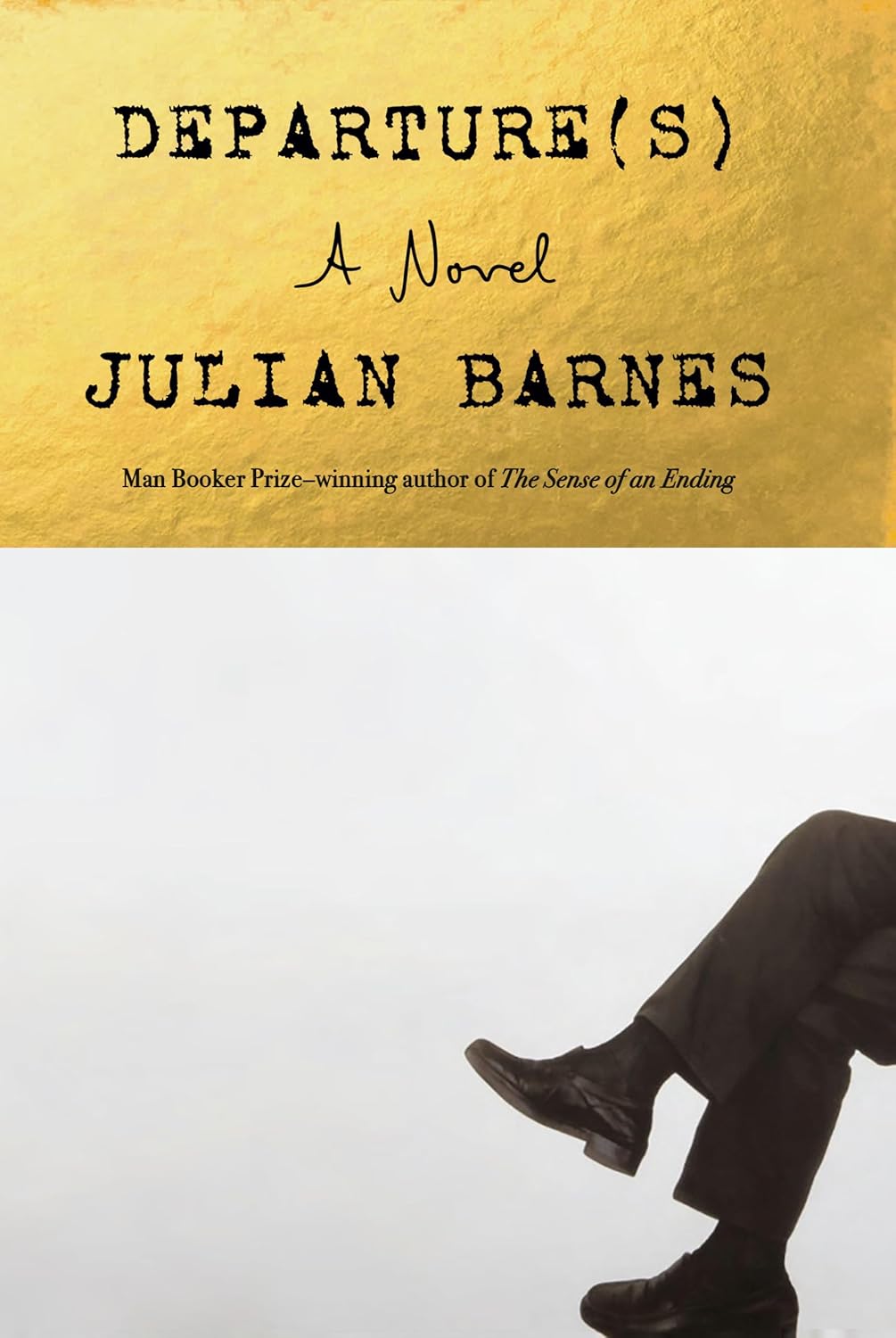
It is not uncommon for bookish publications (like this one) to ask readers to imagine dinner-party conversations with famous authors. After reading Julian Barnes’ latest novel, Departure(s), I feel I know what a conversation with the author would be like: witty, literary, deeply intelligent, and wildly rambling.
Yet it would also be capable of getting right to the point. Barnes (whose narrator is also a writer named Julian) begins here with a description of the medical phenomenon known as Involuntary Autobiographical Memory (IAM) — in which some catalyst causes an avalanche of related memories — offering the extreme example of a man who, every time he tastes pie, must relive every slice of pie he’s ever eaten.
Naturally, this leads the author to thoughts of Marcel Proust and the famous petite madeleine that inspired In Search of Lost Time. Barnes then digresses to subjects as diverse as travel literature, French poetry, aging, the language around death, and Jimmy (a Jack Russell terrier that belongs to more than one character). He also promises us a story, but all this rambling seems always to return to memory itself.
The narrative involves Jean and Stephen, two friends Julian met at Oxford whose brief, intense affair became a source of pride for the young narrator. He introduced them, after all, and gained satisfaction and validation from being their third wheel. But Barnes is short on details. All we really hear of Jean and Stephen’s romance is that they dressed more like adults when they were together and that each used Julian as a sounding board to discuss the relationship.
This is how he comes to know that, despite his urging, they won’t marry. After about 18 months, they break up, Julian feels betrayed and, no longer central to their love, loses (for a moment) his sense of purpose. Then he loses touch with them, and so do we.
Forty years later, Julian, now a famous author, is adjusting to old age. His wife has died, and he has received a cancer diagnosis. He will undergo chemotherapy to manage his disease. He has a witty response to this sign of “the universe’s utter indifference,” at one point challenging the temerity of cancer for harassing a winner of the Booker Prize.
But even as he goes into the minutiae of his diagnosis and treatment, there’s something shaky about this autofictional work. Barnes refuses to bolster our confidence in its veracity, slipping in qualifiers like, “This, at least, is as I recall it” or “Also, I may well be wrong.”
Around this same time, he receives a letter from Stephen, who’s been reading Julian’s books. Motivated by ego and nostalgia, the two agree to meet. Over drinks, they quickly decide that Julian will help Stephen get back in touch with Jean.
Soon, the now-elderly pair again becomes a couple, with the aged Julian once more serving as their go-between. This second incarnation of the relationship gets a more detailed portrayal than the first, driven largely by Jean’s more provocative and cynical character, and by the absorbing presence of that terrier, Jimmy.
However, even here, this seemingly significant thread only occasionally takes center stage. Instead, Barnes writes about his own health, the passing of old friends Martin Amis and Christopher Hitchens, the fact that Jimmy doesn’t know he’s a dog, and memory’s relationship to experience, its unreliability, and its importance to narrative and to identity itself.
This connection between identity and memory — and Barnes’ sense of how tenuous it is — is the real subject of Departure(s). He describes memory as “spotty, unreliable and even mischievous,” and while he claims his story about Jean and Stephen is true, we never quite believe him, not least because of his notion that memory’s weakness is what makes it valuable. “Without memory we are just a nothingness adrift,” he tells us, before admitting that he’s gently directed the tale of Jean and Stephen “towards the ends which I desired.”
His assertion that he’s writing nonfiction — in a book with the word “novel” literally on its cover — is further undermined by his repeated return to that exemplar of memory, Proust. He points out that the Frenchman worked through multiple drafts and that the famed petite madeleine wasn’t his first choice of catalytic cookie, having initially tried stale bread as the refresher of life’s memories, and later toying with plain toast. Perhaps all our memories are inevitably reworked toward the end we desire.
Barnes interrupts himself occasionally to address the reader directly (“I’ll tell you the rest another time”) and writes more than once that this will be his last book, worrying that he’s begun to repeat himself. Of course, this concern, too, is related to memory, and he admits to having checked with some of his more fervent readers to make sure he hadn’t used any of the material in Departure(s) in previous works.
And so we begin to realize that Julian the narrator’s story of Jean and Stephen may be an excuse for Barnes the author to say goodbye to us, his readers. The book’s closing is both moving and provocative, as he (Barnes, Julian, both) pictures us with him not in some contrived conversation but at a sidewalk café, looking together at “the many varied expressions of life.” He may not be there next time and has doubts about what we’ll remember, but he insists we keep looking.
John P. Loonam has a Ph.D. in American literature from the City University of New York and taught English in New York City public schools for over 35 years. He has published fiction in various journals and anthologies, and his short plays have been featured by the Mottola Theater Project several times. He is married and the father of two sons; the four have lived in Brooklyn since before it was cool. His first novel, Music the World Makes, will be published by Frayed Edge Press in 2026, while a collection of his short stories, The Price of Their Toys, is forthcoming from Cornerstone Press this February.