Devouring Time: Jim Harrison, a Writer’s Life
- By Todd Goddard
- Blackstone Publishing
- 558 pp.
- Reviewed by Ellen F. Brown
- November 21, 2025
The late author embraced machismo but revered poetry.
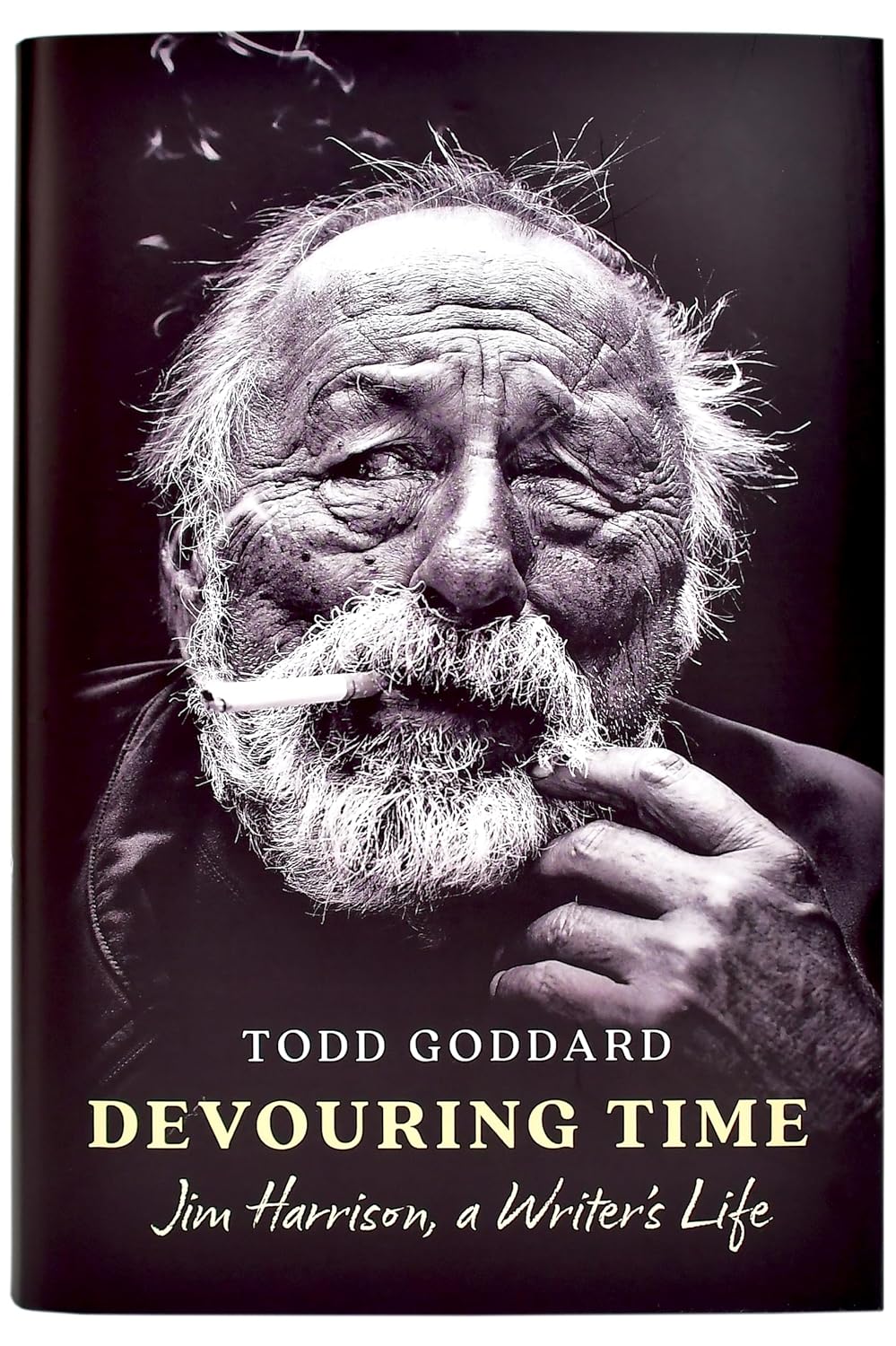
If the name Jim Harrison rings a bell but you can’t quite place him, you’ve probably heard of his novella Legends of the Fall, which was made into a movie starring Brad Pitt. Or maybe you heard Anthony Bourdain sing Harrison’s praises as a writer and a gourmand. “There aren’t that many people I really look up to in this world,” Bourdain once said. “But Jim Harrison — I want to be him when I grow up.”
Still drawing a blank? You’re not alone. Although Harrison has a cult-like following among his most avid readers, he never quite became a household name. But, almost a decade after his death, he might now finally reach that status thanks to the efforts of literary-studies scholar Todd Goddard, whose Devouring Time: Jim Harrison, a Writer’s Life is a cradle-to-grave biography that offers fascinating insights into an author as colorful as the characters he created. It surely will spark conversation and serve as a launching point for further study of this distinct American talent.
Born in 1937, Harrison was a middle-class Midwestern kid who bristled at midcentury mores. Inspired by the barbaric yawps of Walt Whitman, he envisioned for himself a nomadic life immersed in — and writing about — the great outdoors. He was just establishing himself as a poet of substantial promise when he was faced with the challenge of keeping food on the table for his wife and children. A practical sort, Harrison took his literary skill and off-the-grid lifestyle on a detour into fiction writing, screenwriting, and contributing to men’s magazines. The enterprise delivered spectacular results: Harrison ended up a bestselling author wealthy beyond his wildest dreams.
In many ways, explains Goddard, Harrison’s commercial success was in service of poetry, which remained his first priority. With money in the bank, Harrison had the freedom to work on his craft while knowing his family was well provided for. Having a bankable name afforded him the luxury of publishers being eager to acquire his poetry.
Harrison’s fame and fortune also brought distractions. Already a drinker and a smoker, he developed a voracious appetite for cocaine. And while he clung to the notion of himself as an everyman outsider, he expanded his social circle to include Hollywood types, palling around with Jack Nicholson and having a fling with Jessica Lange. He also had a grand time burning through a significant proportion of his riches on gourmet meals, first-class flights, luxury hotels, and, in his own words, “two hundred dollar whores.”
In any good rags-to-riches story like this one, there’s always a reckoning. For Harrison, it was failing to gain the recognition he thought he deserved as a poet. While he published an enormous quantity of verse over his lifetime, and some of it sold quite well, he was generally overlooked by what Goddard refers to as “the New York literary establishment.” Not that Harrison ever gave up trying. In the last years of his life, riddled with physical ailments and depression, he continued writing poetry. He died at his desk in 2016, a pen in his hand.
A driving question of Devouring Time is whether Harrison was underestimated as a poet. Goddard makes a convincing case that his fame and commercial success probably got in the way of him winning major awards or being included in important anthologies. At the same time, the author doesn’t shy away from the other factors that may have limited Harrison’s ascent to the Pantheon.
For one, Harrison would’ve had to have been superhuman for his talent to emerge unscathed from all the alcohol and drugs. There was also his macho problem. Because so much of his writing was autobiographically inspired, the results sometimes veered into low-brow territory, such as in essays titled “A Man’s Guide to Drinking” and “Naked Women Dancing.” When critics took note, Harrison insisted he wasn’t a “tough guy” and endeavored to write more sensitively about women. But there was no getting around the fact that his life and work were balls-forward. This limited his appeal while he was living and may continue to do so today.
Regardless, Devouring Time establishes Harrison as a versatile wordsmith of considerable intellect and good humor. “I find myself quite confused about death,” he once wrote to a friend. “I assume it will be a no-smoking situation?” The book also offers a candid look at what it means to be a writer. Although the publishing landscape has changed significantly since Harrison’s day, evergreen insights abound about the hard work, tough choices, and economics involved in pursuing a literary life.
Ellen F. Brown is a nonfiction writer whose work specializes in literary and theater history. She is currently writing a biography of playwright Tennessee Williams with a particular focus on the last 20 years of his life.