Diamond and Juba: The Raucous World of 19th-Century Challenge Dancing
- By April F. Masten
- University of Illinois Press
- 360 pp.
- Reviewed by Eliza McGraw
- January 14, 2026
A pre-Civil War sporting event comes vividly to life.
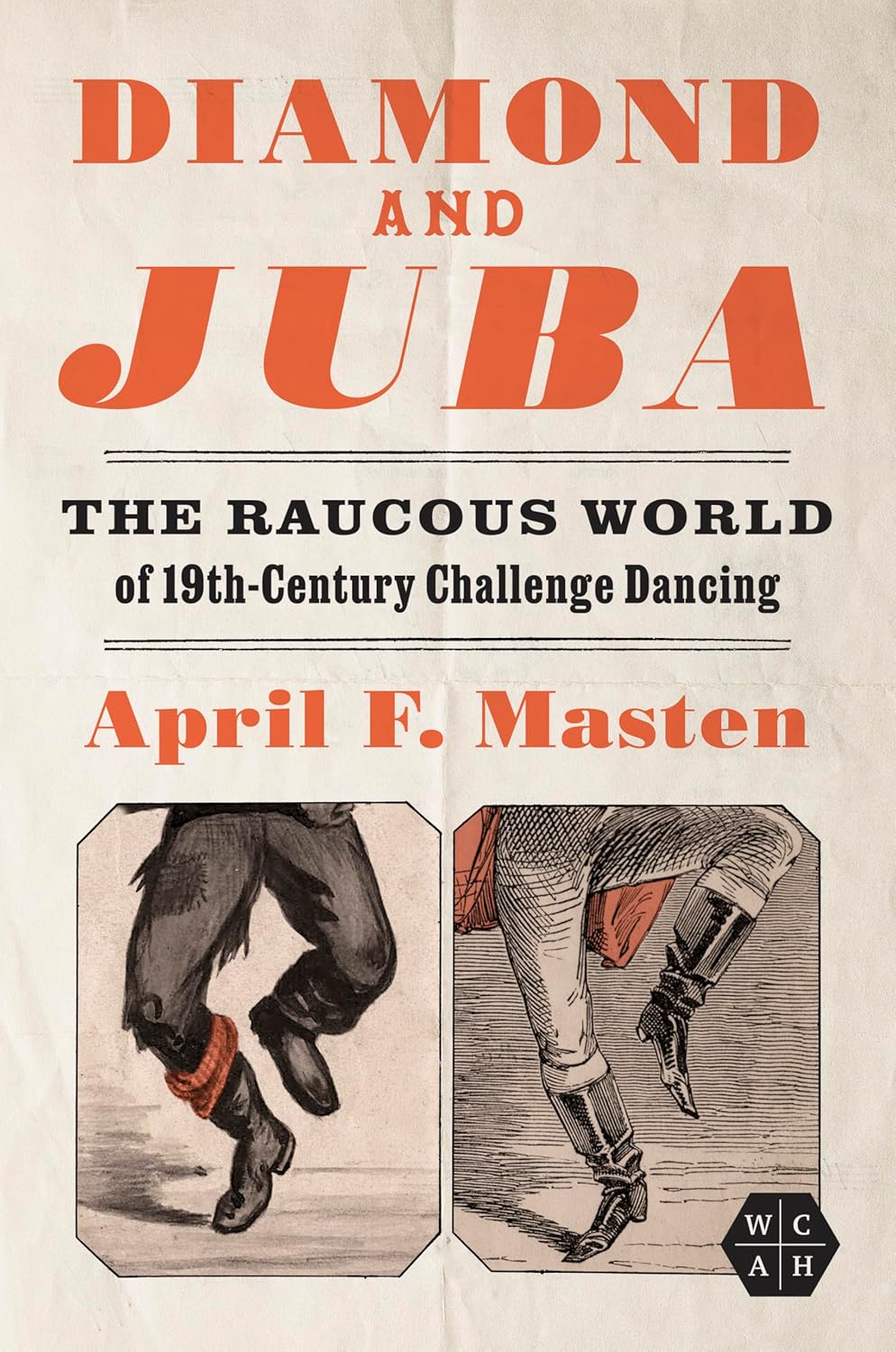
In Diamond and Juba, author April F. Masten writes an in-depth story of performance in the 19th century. Like the deep dive of a feature article you can’t put down — did you know there are people who collect fountain pens? did you know there are magazines about convenience stores? — this comprehensive book takes readers into the far reaches of the world of challenge dancing through two of its primary figures, William Henry Lane (aka Juba), who was Black, and the Irish American John Diamond, who was white. Both became so famous that they had to deal with imposters.
Challenge dancing, as Masten defines it, crisscrossed boundaries. It was a “creolized form of jig dancing,” a style that came from Irish reels and hornpipes combined with the “hip play and upper body movements of African dance practices.” Steps had names like the Camp Town Hornpipe and the Grape Vine Twist. The early dance halls where Diamond and Lane performed were dark enough — and equally dim between stage and audience — that even the border between performer and spectator blurred at times.
As Masten writes, challenge dancing was exciting to watch and meaningful beyond its nature as an athletic or artistic performance. “Jig dancers shared a boisterous pride in physicality with artisans and journeymen,” she explains, “who were suffering from financial degradation and social disrespect in an industrializing society.” This sentence, like many others, brings the two main figures into sharp focus against the incendiary background of the pre-Civil War era, a time when almost 3 million Black people were enslaved.
With its deceptively narrow topic, Masten’s book covers moments as wide-ranging as xenophobic mob violence, minstrel shows, child performers, and a time in New York when “the color line dividing the races was faintest in the lowlier wards, saloons, and theaters of the city.”
The book’s title comes from the poster for one particular challenge dance held in 1843 between Diamond and Lane. It took place in a tavern before a rowdy crowd, more akin to a boxing match than a dance recital. People placed bets. There was no judge, so it was the audience’s job to choose the winner. The stakes of that event convey through the rest of this dual biography, which captures an age when the New York Sporting Whip ran dancing-match results. A devolution of the interracial sport would come later.
Some big names appear on the scene — Charles Dickens and P.T. Barnum both enter the dancers’ stories in important ways. Benjamin Rush also makes an appearance. Because Masten uses such concrete detail, the settings and practicalities of daily life also act as characters. For example, she describes how, in 1840, Diamond danced in 12 cities from Boston to Washington, DC, traveling alternately via ferries, stagecoaches, trains, and steamboats.
Masten, a dancer herself, is an American-history professor at SUNY-Stony Brook, and her straightforward, expressive writing makes you think her classes must be terrific. (When I looked up her profile page, I was gratified to see she teaches a seminar in which students ring shout, jig, and salsa.) Within the text, well-titled subsections help keep the dance scenes and their sprawling historic context manageable.
The book also features plenty of art, including playbills, portraits, and a poster from Royal Vauxhall Gardens advertising a performance by Lane (along with fireworks at 11 o’clock). Throughout, Masten manages to take a seemingly niche series of episodes and demonstrate why they matter. Challenge dancing told a story not only of a moment in time, but of its impact now, as Americans continue navigating questions of masculinity, class hierarchies, athleticism, and art.
Both dancers were dead by 1857. In the years following, Masten writes, fewer spaces existed where Black and white dancers could perform together. But in vaudeville, Lindy Hop contests, breakdance battles, and elsewhere, the echoes of their footsteps can still be heard.
Eliza McGraw is the author of Here Comes Exterminator!: The Longshot Horse, the Great War, and the Making of an American Hero and Astride: Women, Horses, and a Partnership that Shaped America. She lives in Washington, DC.
_1.png)