Dinner with King Tut: How Rogue Archaeologists Are Re-Creating the Sights, Sounds, Smells, and Tastes of Lost Civilizations
- By Sam Kean
- Little, Brown and Company
- 464 pp.
- Reviewed by Peggy Kurkowski
- July 30, 2025
This lively gambol is way more fun than Archaeology 101.
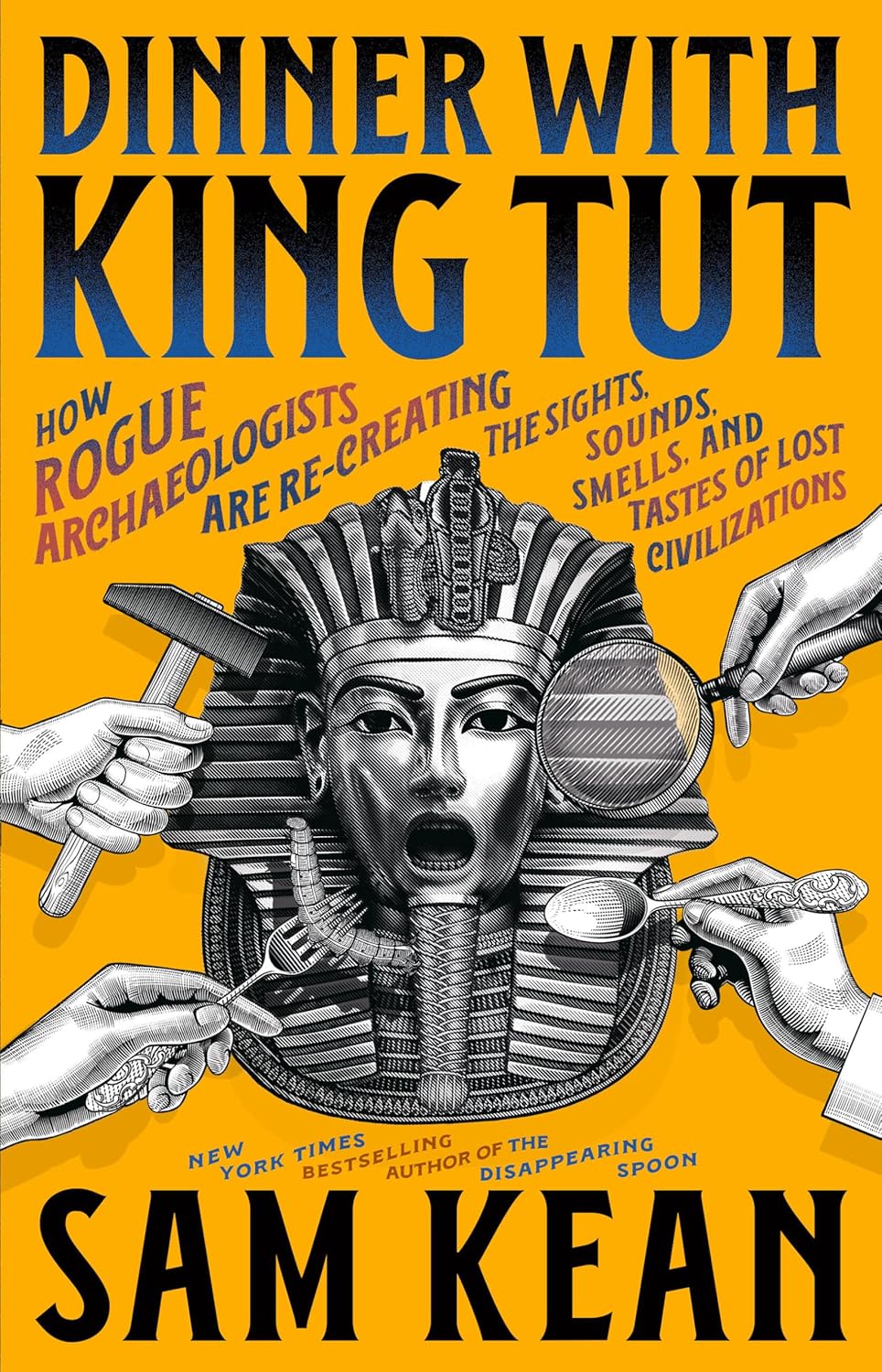
Popular-science writer Sam Kean trades in dull archaeological excavation for a sensory-rich, first-person experience of the distant past in the delightful Dinner with King Tut. Describing the work of traditional archaeology as “the most godawful tedium I could imagine,” Kean finds his tribe among experimental archaeologists who put ideas about the past to the test. Literally.
To recreate elements of ancient peoples’ lives across cultures and time, experimental archaeologists eschew digging in favor of doing — either in the lab or out in the wild — to resurrect bygone eras. From baking ancient Egyptian bread and brewing Viking beer to building replicas of ancient Polynesian sea-faring canoes and undertaking a host of other ridiculously fun trials, Kean and company leave no stone unknapped (“knapping” being the shaping of stones into tools).
Though experimental archaeology remains controversial in the academic community — and is often considered a “rogue upstart” — Kean emphasizes the benefits of a firsthand approach to learning about extinct cultures. In 11 absorbing chapters that range from Africa of 75,000 years ago to Mexico in the 16th century, he teams up with experts to walk in the footsteps of prehistoric hunters, sailors, pyramid builders (and looters), and others.
Along the way, Kean shares his own do-it-yourself experiments and their enlightening (and sometimes hilarious) outcomes. When baking his version of the Egyptian bread that once fed hundreds of thousands of pyramid laborers, for instance, he becomes more Indiana Scones than Jones and declares a delicious victory (apparently, the long-ago bread was spongy, with a sourdough tang).
What makes Dinner with King Tut unique (as if DIYing a mummy isn’t enough) are the stories in each chapter that illustrate a typical (or not-so-typical) “day in the life” of various imaginary protagonists. One might be wary of mixing nonfiction with fiction, but in this context, it is both effective and affecting. Through witty prose, colorful characters, and a narrative that links to each chapter’s theme, Kean adds depth and human dimension to the book. (But beware: Just like in real life, not every interlude ends happily.)
In bringing to life South America circa 7500 BC, he tells the story of Asana, a fictive Peruvian hunter who uses a throwing stick called an atlatl to bring down her prey. “Atlatls were probably the most widely used hunting weapon in prehistory, in climates from the tropics to the poles,” Kean writes. “As a result, there’s a serious contingent of atlatl enthusiasts within experimental archaeology.” He takes a turn with the prehistoric weapon, gleefully chronicling the whoosh of darts flying in his class of amateur atlatl flingers:
“Unfortunately, hits are few and far between. However easy to fling, the darts are nearly impossible for beginners like us to aim.”
Within each chapter and era, Kean discusses more than one facet of a people and culture. In conjuring 13th-century China, for example, he studies arcane and obsolete practices such as foot-binding and the castration of young boys as a path to a promising future (no DIY here!) before moving on to the invention of the trebuchet — or catapult — which he gushes over after launching for the first time:
“The firing pin holds thousands of pounds of tension in place, and it takes a hard, full-body tug to release it. But when it goes, my God. It’s like snapping your fingers and watching a dragon spring to life — hulking and graceful all at once.”
It’s clear from traipsing with Kean across the millennia that experimental archaeology should be seen as an important adjunct to more traditional, artifact-focused study. As he rightly concludes, “artifacts sitting on a shelf, behind glass, can take us only so far into the minds of other people. To reach them on that deeper level, we need to inhabit their world…we need to feel the fabric of their lives.”
Peggy Kurkowski is a professional copywriter for a higher-education IT nonprofit association by day and major history nerd at night. She writes for multiple book-review publications, including Publishers Weekly, Library Journal, BookBrowse Review, Historical Novels Review, Independent Book Review, Shelf Awareness, and the Independent. She hosts her own YouTube channel, “The History Shelf,” where she features and reviews history books (new and old), as well as a variety of fiction. She lives in Colorado with her partner (quite possibly the funniest Irish woman alive) and four adorable, ridiculous dogs.