Dodge City: A Novel
- By Patrick deWitt
- Ecco
- 256 pp.
- Reviewed by Ryan Davison
- October 28, 2026
A draft-skirting young man treks from California to Canada.
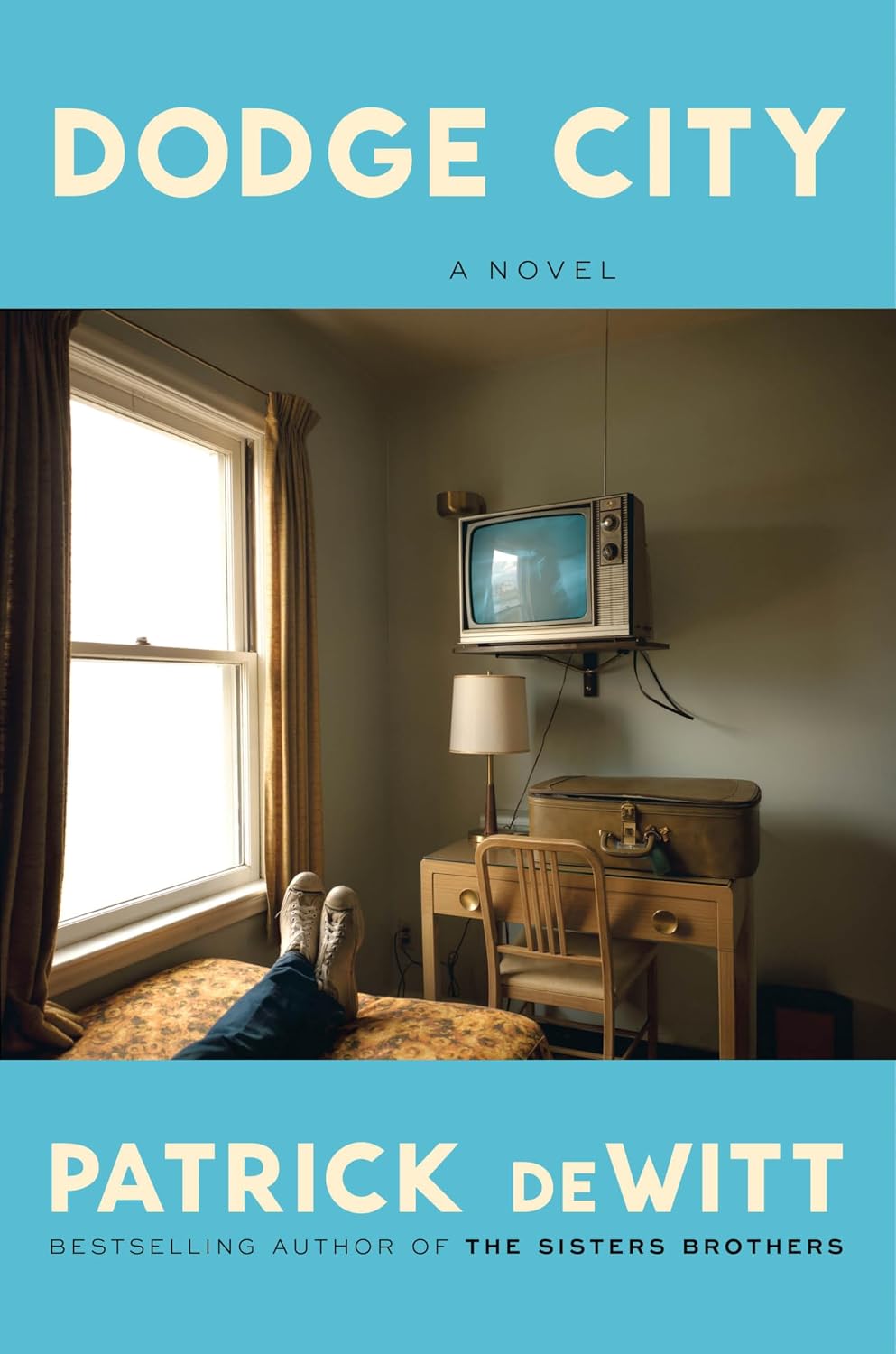
Leland Clarke’s 1967 expulsion from college comes at the worst time — smack in the middle of the Vietnam War. University enrollment had kept him safely tethered to a deferment, and without that buffer, he is quickly drafted. But Lee has no intention of complying and employs a sell-all-my-stuff-and-flee-to-Canada approach to being called up.
For a set of wheels, he registers with a car-delivery service, masterfully fakes his way through the interview, and is soon handed a brand-new Jaguar that “looked just to have been minted, the paint a rich British racing green, the nubs still on the tires.” Lee agrees to carefully transport the gorgeous automobile to a buyer in New Jersey; in truth, he intends to drive it to the Canadian border.
The one sticking point in his departure plan is a matter of the heart. He is unsure what to do about his girlfriend, Calliope, but finds a note bubble-gummed to his front door that wonderfully displays author Patrick deWitt’s talent for adopting the voice of Cal and his other characters:
“I can’t do the big goodbye scene, Lee. I love you basically but I can’t do it and I’m sorry, seriously. I’m my mother’s daughter, and she taught me that all emotion must be ground to a powder and tossed down the well, so that’s my method for dealing with your leaving. Will you call me from the road? You can yell at me, then forgive me? Or not yell at all, and the forgiveness will just come naturally, the way it does sometimes.”
Lee heads east with a significant supply of uppers given by a generous friend to help him stay awake on the drive. As he visits relatives along the way, Dodge City becomes the thoughtful “amphetamine-fueled cross-country road trip” promised in the publisher’s blurb. The reader is drawn in with every mile traveled, and we grow to respect this contemplative young man trying to understand his place in the world and gain clarity about the present by revisiting the past.
He encounters his father, a WWII veteran, asleep behind the wheel of a white van. It sits in the dirt driveway of Lee’s childhood home. Dad is now a dog-catcher, and the house shelters dozens of feral canines; Lee’s dad intermittently lets a couple of them loose to keep his retrieval business thriving. The father-and-son interactions, though soaked in gloom, are hilarious.
Lee’s mother is deeply manic, and he hasn’t spoken to his brother, Harry, in years. Only Lee’s twin sister, Grace, a nurse at a Manhattan psychiatric hospital, does he find truly relatable.
Varying from eccentric to psychotic, tender to drunk, each Clarke provides interactions that are uniquely authentic. Taken together, they add important insights to Lee’s journey and offer readers a genuine taste of 1960s America. The novel perfectly captures the absurdity of family dynamics and blends it with just the right amount of dry humor.
DeWitt’s smooth prose fuses into an intelligent, streamlined narrative that’s a pleasure to follow. The dialogue — as in his darkly comic The Sisters Brothers, shortlisted for the 2011 Booker Prize — is punchy and realistic, but even during emotional exchanges, the author never fails to entertain. Dodge City forces us to confront the moral dilemmas brought on by the draft, but it does so in a sneakily poignant, sympathetic way. It’s a remarkably readable story, and one that’s relevant in our current moment, when endless wars again demand an endless supply of ambivalent young people to fight them.
Ryan Davison, Ph.D. is a regular contributor to the Independent, Open Letters Review, Edelweiss+, and NetGalley. His work has also recently appeared in the Chicago Reader and the Malahat Review, and his blurbs are often cited by LitHub’s Book Marks, the popular book-review aggregator.

