Dream Count: A Novel
- By Chimamanda Ngozi Adichie
- Knopf
- 416 pp.
- Reviewed by Jennifer Bort Yacovissi
- March 17, 2025
After a 12-year fiction drought, the author makes it rain.
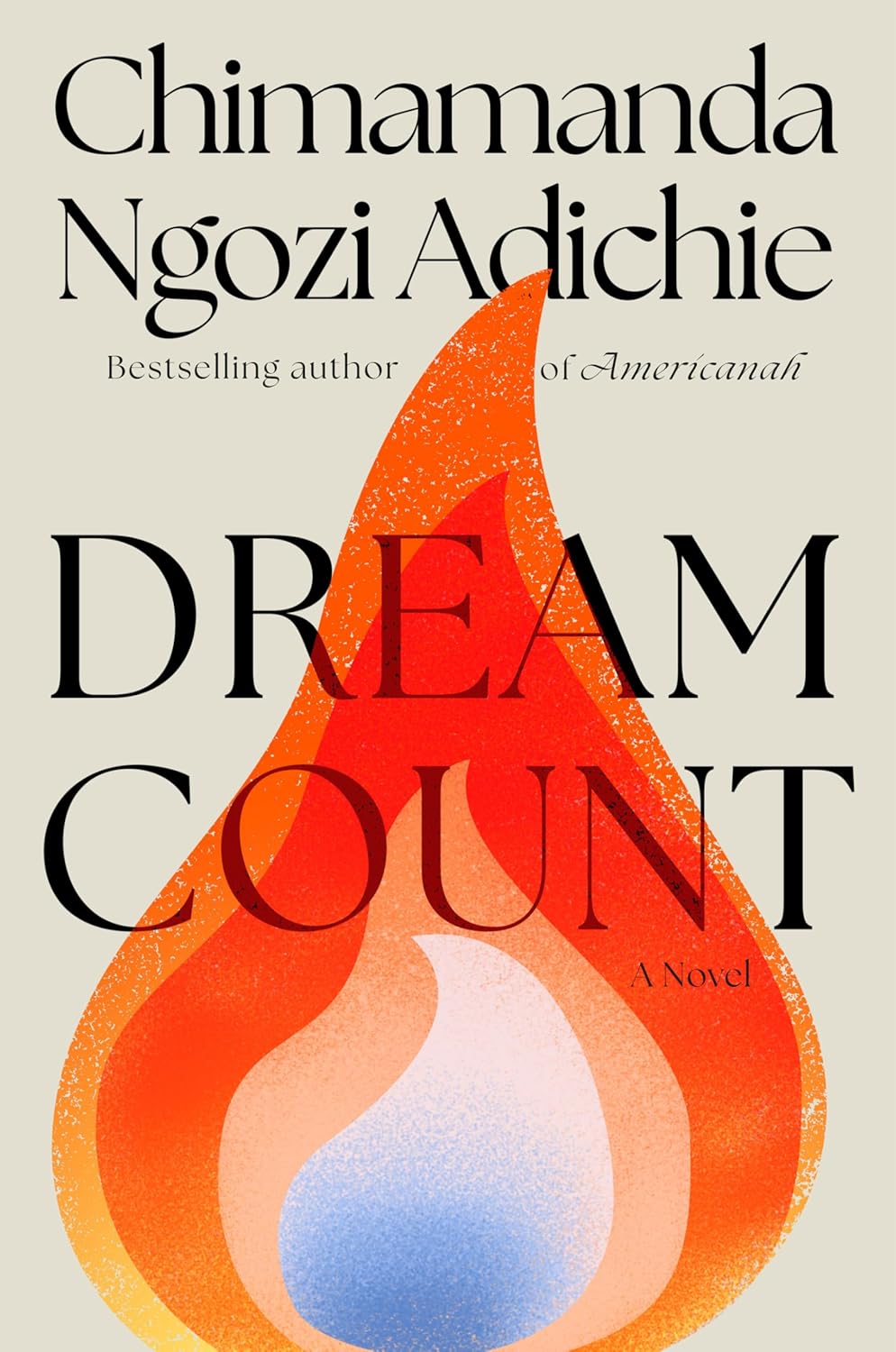
Though 2013’s Americanah was author Chimamanda Ngozi Adichie’s fourth book, it was the one that sizzled across the literary landscape and made her a widely known name. It was also her last novel for 12 years. In the time since, she’s published numerous nonfiction projects (including Notes on Grief, which I had the pleasure of reviewing) and a children’s book. If you’ve been waiting anxiously for your next fix of her lovely voice in fiction, your patience is now rewarded. Welcome, Dream Count.
The novel, which opens in the early days of the pandemic, is narrated by Chiamaka, a travel writer from Nigeria living in the U.S. She captures the pervasive sense of dread and dislocation of that time, with its Zoom calls, scavenger hunts for toilet paper, and absence of touch. Her isolation leads her on a long review of her past romantic relationships:
“I thought: I’m growing old. I’m growing old and the world has changed and I have never been truly known…This is all there is, this fragile breathing in and out.”
The three other main characters are all defined by their relationship to Chiamaka: Zikora is Chia’s best friend, Omelogor is her cousin, and Kadiatou is her housekeeper. All signs point to this being primarily Chia’s story. And yet the emotional center lies elsewhere.
After Chia’s recounting of her search for a man to truly know her — from losing herself to the insufferable Darnell to being unable to love the thoroughly decent Chuka — we hear successful, U.S.-based lawyer Zikora’s odyssey toward her dream of a husband, children, and a home as time ticks inexorably away and she is waylaid by its thieves:
“She knew in that moment that he was never going to propose…he didn’t have to be ready, he wasn’t agonizing about the age of his eggs…Zikora almost envied him this, the luxury of walking at his own pace, free of biology’s hysterical constraints.”
Given the rhythm built to this point, Kadiatou’s story throws an elbow and upends our expectations. While both Chia and Zikora come from affluent Nigerian Igbo Catholic families — indeed, Chia can only afford her life as a travel writer because her father pays her living expenses — Kadi is the daughter of a Guinean Fula Muslim miner from a small village. Her father is killed in the mine, and her beloved sister, Binta, later dies, too.
It is here, in Kadiatou, that we find the heart of things. Like Job, she is pummeled with loss and violence but continues quietly on — primarily for the sake of the dreams she has for her own daughter, whom she names Binta. Those dreams bring them both to America.
One of Adichie’s most resonant recurring themes is that of cultural disconnect — less a divide than an unbridgeable chasm that swallows nuance, understanding, and empathy. In Kadi, she has imagined the most exquisitely relatable character, in whose life the reader is fully immersed by walking miles and miles in her shoes.
In her author’s note, Adichie confirms what many will have suspected: Kadi’s story was inspired by the widely followed 2011 legal case of Nafissatou Diallo, a housekeeper at a luxury hotel. The head of the International Monetary Fund, Dominique Strauss-Kahn, was credibly accused of raping her.
It is Adichie’s gift of empathy that she makes us grasp — against every impulse — that, for Kadi, the worst thing that happens to her, even beyond the assault, is that it is reported.
I confess that I felt a reprieve from the tension when the story shifted from Kadi to Omelogor. With a background much like Chia’s and Zikora’s, Omelogor is a tough, seemingly fearless woman who’s had a successful career in Nigerian banking; presented with a corrupt scheme, she explains how to hide the transactions more effectively. Still, she leaves that behind to pursue a liberal-arts degree in America but returns home feeling defeated by her experience. Belying her somewhat cynical outer layer, Omelogor begins to give money to women to invest in their own businesses, with instructions to pay it forward.
During lockdown, the three women confer over Zoom about Kadi’s case, which only underscores the stark difference in their circumstances — from economics and education to culture and language. The power differential is palpable, the least of it being that Kadi is one of the help. The others care about her, but they have the luxury of living in luxury, of having this be something that happened to someone else.
With her sharp eye, it is Omelogor who shows the greatest understanding of what Kadi is enduring:
“When they ask, ‘Anything you need?’ they mean water, ibuprofen, the bathroom. What she needs is a Pular interpreter and an interviewer who understands that immigrants are desperate to raise children who think they have a right to dream, and what she needs is an America that understands this.”
Dream Count weaves easily in and out through geography and culture, spending as much time in Nigeria and Guinea as in the U.S., confident that readers are fully engaged in the journey. Given the hints sprinkled throughout her body of work, it seems clear (and predictable) that, when Adichie started out, the experts in the publishing world wanted her to write stories more “relatable” to the — presumably white, American — book-buying audience. Lucky for all of us, she didn’t listen.
Jennifer Bort Yacovissi’s debut novel, Up the Hill to Home, tells the story of four generations of a family in Washington, DC, from the Civil War to the Great Depression. Her short fiction has appeared in Gargoyle and Pen-in-Hand. Jenny reviews regularly for the Independent and serves on its board of directors as president. She has served as chair or program director of the Washington Writers Conference since 2017, and for several years was president of the Annapolis chapter of the Maryland Writers’ Association. Stop by Jenny’s website for a collection of her reviews and columns, and follow her on Bluesky at @jbywrites.bsky.social.